
AI is accelerating the telecommunications industry’s transformation, becoming the backbone of autonomous networks and AI-native wireless infrastructure. At the same time, the technology is unlocking new business and revenue opportunities, as telecom operators accelerate AI adoption across consumers, enterprises and nations.
NVIDIA’s fourth annual “State of AI in Telecommunications” survey report unpacks these trends, underscoring strong AI adoption, impact and investment in the industry.
Highlights from the report include:
- 90% said AI is helping increase annual revenue and drive down costs.
- 77% said they expect to see AI-native networks launch before the deployment of 6G.
- 65% of telecom operators said network automation is being driven by AI.
- 60% said their organization is using or assessing generative AI, up from 49% in 2024.
- 89% said open source models and software are important to their AI strategy.
- 89% of telcos plan to boost AI spending in 2026, up from 65% a year ago.
“There is a seismic shift underway in the telecom industry driven by AI,” said Sebastian Barros, managing director of Circles, a Singapore-based telecommunications provider. “Communication service providers are converging on a new realization. Their role in society extends beyond moving bits across networks toward moving intelligence across local and regulated infrastructure. That transition defines the move from telco to ‘AICO’ — AI infrastructure companies operating at network proximity, not application vendors riding on top.”
Here are some more key findings from the report.
Tangible Revenue Impact and Return on Investment
The telecommunications industry is seeing a definitive revenue impact from the use of AI. Overall, about nine out of 10 respondents said AI is helping to increase revenue and reduce costs. Telecommunications operators, which represent about a quarter of the 1,000 responses in the survey, are also seeing the benefit, with 90% saying AI has had a positive impact on revenue and costs.
The top AI use cases cited for return on investment (ROI) were AI for autonomous networks (50%), followed by improved customer service (41%) and internal process optimization (33%).
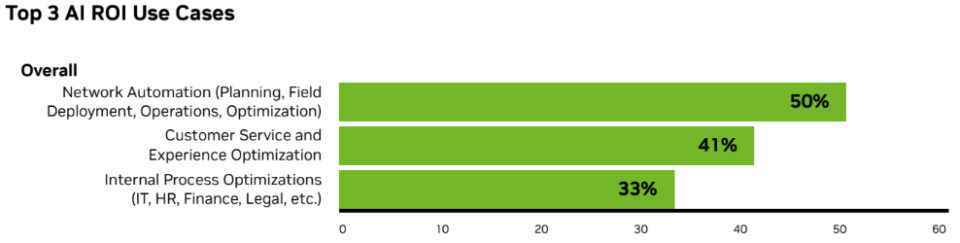
“Autonomous networks deliver immediate ROI by eliminating human effort from repetitive, reactive workflows,” said Barros. “The fastest impact areas are energy management, fault prediction, configuration drift correction and capacity planning.”
This strong impact on revenue and ROI is leading telecommunications companies to increase their AI budgets in 2026. Overall, 89% of respondents said their AI budget will increase in the next 12 months, up from 65% in last year’s survey, with 35% saying their budgets would increase more than 10% from this year.
Focus on AI-Native Networks and Autonomous Operations
Network automation has overtaken customer experience as the leading use case for investment, deployment and ROI impact. This signals a bold step toward autonomous networks — AI-driven, self-managing systems that can self-configure, self-heal and self-optimize with minimal human intervention. Eighty-eight percent of organizations report being between levels 1-3 of autonomy, as defined by the TM Forum, and the use of generative AI and agentic AI is expected to accelerate the shift to level 5 autonomous networks.
“Autonomous networks are delivering return on investment faster than any other AI use case because they directly reduce outages, energy consumption and manual intervention,” said Chetan Sharma, CEO of Chetan Sharma Consulting. “Agentic AI accelerates this by coordinating decisions across domains in real time.”
A surge in edge computing investment is reshaping telecom network architectures, bringing AI inferencing closer to users through a distributed computing infrastructure. Telcos are stepping up investments in AI-native RAN and 6G — signaling a major industry intercept ahead of the traditional 6G deployment cycle, with 77% of respondents anticipating a much faster time to deployment of this new AI-native wireless network architecture.
The top drivers of investment are using AI to enhance spectral efficiency, improving the performance of the radio access network supporting edge AI applications and accelerating the research and development of 6G.
A Universal Boost in Productivity
AI in telecommunications is advancing autonomous networks and business opportunities as well as improving internal operations. Nearly every respondent in the survey said AI is boosting employee productivity, with 26% citing major to significant improvements to their ability to complete more tasks with higher quality in less time.
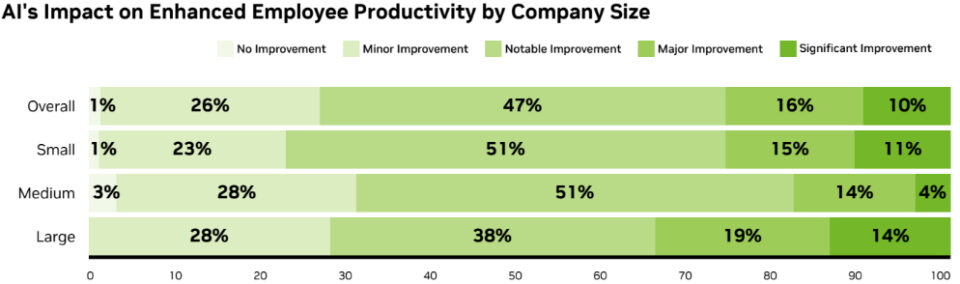
The productivity gains are coming from generative and agentic AI solutions deployed across operations, from the back office to networks.
“Generative AI delivered fast productivity gains, but agentic AI is where telecoms begin to see structural ROI,” Sharma said. “Autonomous agents can act across networks, IT and customer journeys, turning insights into decisions without human delay.”
Download the “State of AI in Telecommunications 2026 Trends” report for in-depth results and insights.