
March 10, 2026 by Jensen Huang
AI is one of the most powerful forces shaping the world today. It is not a clever app or a single model; it is essential infrastructure, like electricity and the internet.
AI runs on real hardware, real energy and real economics. It takes raw materials and converts them into intelligence at scale. Every company will use it. Every country will build it.
To understand why AI is unfolding this way, it helps to reason from first principles and look at what has fundamentally changed in computing.
From Prerecorded Software to Real‑Time Intelligence
For most of computing history, software was prerecorded. Humans described an algorithm. Computers executed it. Data had to be carefully structured, stored into tables and retrieved through precise queries. SQL became indispensable because it made that world workable.
AI breaks that model.
For the first time, we have a computer that can understand unstructured information. It can see images, read text, hear sound and understand meaning. It can reason about context and intent. Most importantly, it generates intelligence in real time.
Every response is newly created. Every answer depends on the context you provide. This is not software retrieving stored instructions. This is software reasoning and generating intelligence on demand.
Because intelligence is produced in real time, the entire computing stack beneath it had to be reinvented.
AI as Infrastructure
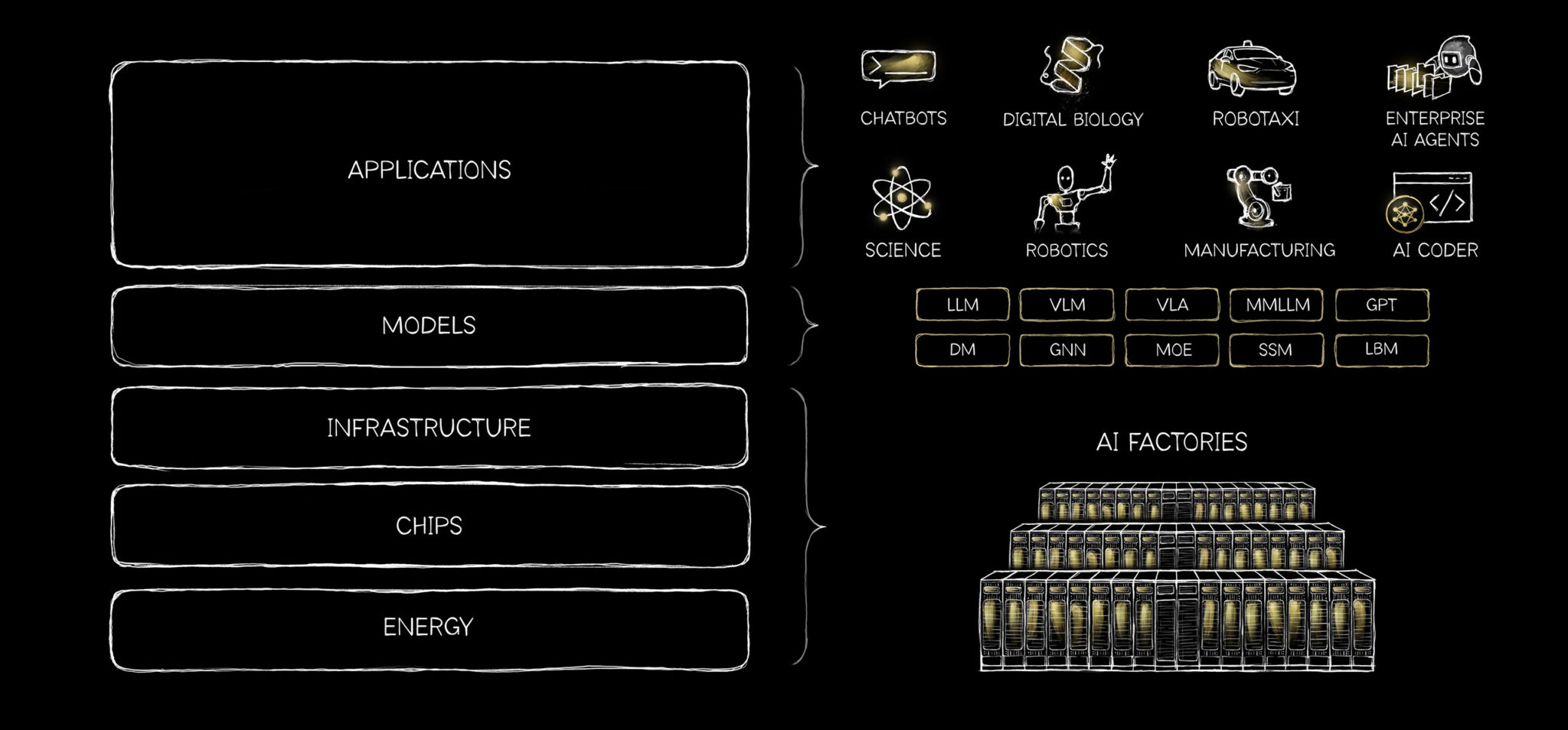
When you look at AI industrially, it resolves into a five-layer stack.

Energy
At the foundation is energy. Intelligence generated in real time requires power generated in real time. Every token produced is the result of electrons moving, heat being managed and energy being converted into computation. There is no abstraction layer beneath this. Energy is the first principle of AI infrastructure and the binding constraint on how much intelligence the system can produce.

Chips
Above energy are the chips. These are processors designed to transform energy into computation efficiently at massive scale. AI workloads require enormous parallelism, high-bandwidth memory and fast interconnects. Progress at the chip layer determines how fast AI can scale and how affordable intelligence becomes.

Infrastructure
Above chips is infrastructure. This includes land, power delivery, cooling, construction, networking and the systems that orchestrate tens of thousands of processors into one machine. These systems are AI factories. They are not designed to store information. They are designed to manufacture intelligence.

Models
Above infrastructure are the models. AI models understand many kinds of information: language, biology, chemistry, physics, finance, medicine and the physical world itself. Language models are only one category. Some of the most transformative work is happening in protein AI, chemical AI, physical simulation, robotics and autonomous systems.

Applications
At the top are applications, where economic value is created. Drug discovery platforms. Industrial robotics. Legal copilots. Self-driving cars. A self-driving car is an AI application embodied in a machine. A humanoid robot is an AI application embodied in a body. Same stack. Different outcomes.
That is the five-layer cake:
Energy → chips → infrastructure → models → applications.
Every successful application pulls on every layer beneath it, all the way down to the power plant that keeps it alive.
We have only just begun this buildout. We are a few hundred billion dollars into it. Trillions of dollars of infrastructure still need to be built.
Around the world, we are seeing chip factories, computer assembly plants and AI factories being constructed at unprecedented scale. This is becoming the largest infrastructure buildout in human history.
The labor required to support this buildout is enormous. AI factories need electricians, plumbers, pipefitters, steelworkers, network technicians, installers and operators.
These are skilled, well-paid jobs, and they are in short supply. You do not need a PhD in computer science to participate in this transformation.
At the same time, AI is driving productivity across the knowledge economy. Consider radiology. AI now assists with reading scans, but demand for radiologists continues to grow. That is not a paradox.
A radiologist’s purpose is to care for patients. Reading scans is one task along the way. When AI takes on more of the routine work, radiologists can focus on judgment, communication and care. Hospitals become more productive. They serve more patients. They hire more people.
Productivity creates capacity. Capacity creates growth.
What Changed in the Last Year?
In the past year, AI crossed an important threshold. Models became good enough to be useful at scale. Reasoning improved. Hallucinations dropped. Grounding improved dramatically. For the first time, applications built on AI began generating real economic value.
Applications in drug discovery, logistics, customer service, software development and manufacturing are already showing strong product-market fit. These applications pull hard on every layer beneath them.
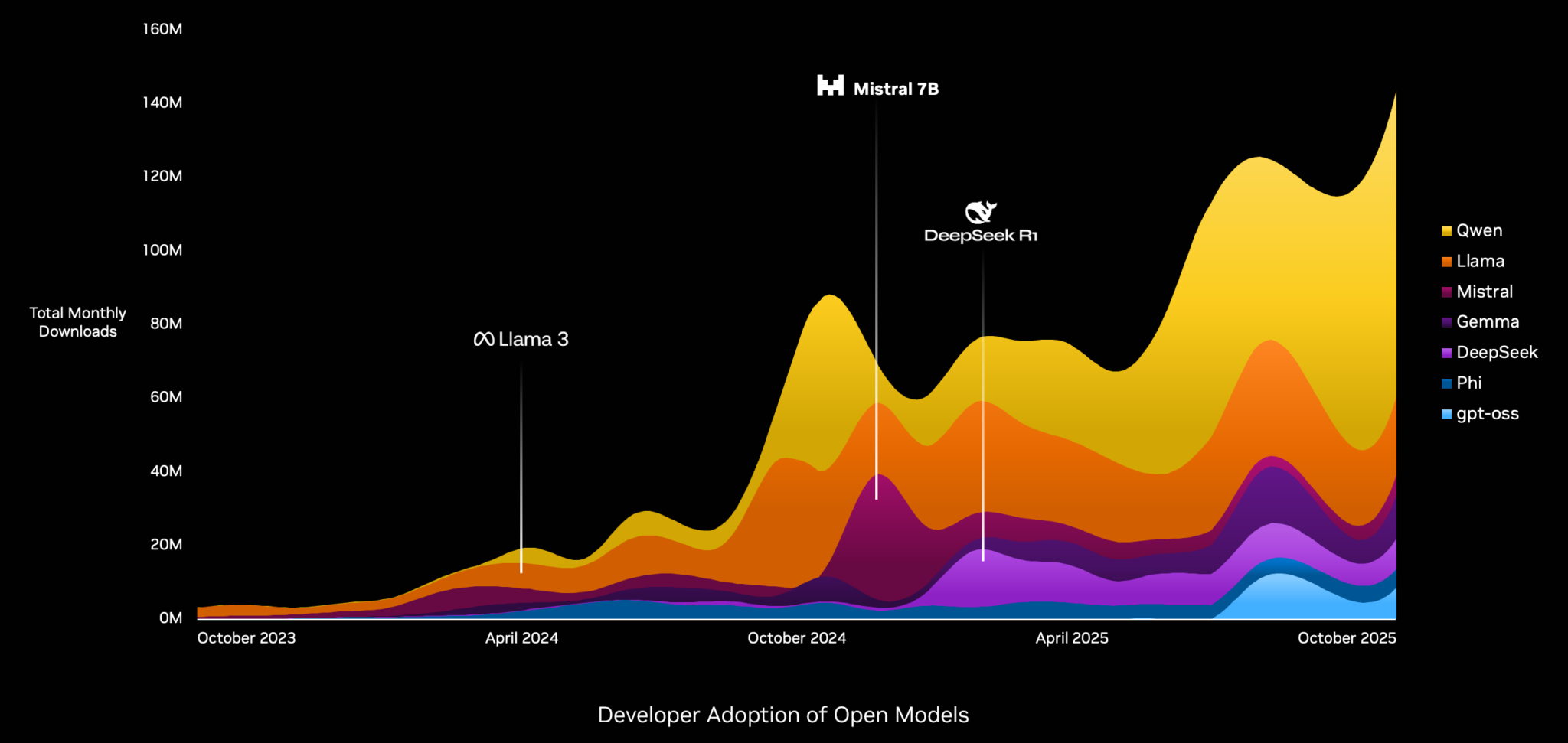
Open source models play a critical role here. Most of the world’s models are free. Researchers, startups, enterprises and entire nations rely on open models to participate in advanced AI. When open models reach the frontier, they do not just change software. They activate demand across the entire stack.
DeepSeek-R1 was a powerful example of this. By making a strong reasoning model widely available, it accelerated adoption at the application layer and increased demand for training, infrastructure, chips and energy beneath it.
What This Means
When you see AI as essential infrastructure, the implications become clear.
AI starts with a transformer LLM. But it’s much more. It is an industrial transformation that reshapes how energy is produced and consumed, how factories are built, how work is organized and how economies grow.
AI factories are being built because intelligence is now generated in real time. Chips are being redesigned because efficiency determines how fast intelligence can scale. Energy becomes central because it sets the ceiling on how much intelligence can be produced at all. Applications accelerate because the models beneath them have crossed a threshold where they are finally useful at scale.
Every layer reinforces the others.


This is why the buildout is so large. This is why it touches so many industries at once. And this is why it will not be confined to a single country or a single sector. Every company will use AI. Every nation will build it.
We are still early. Much of the infrastructure does not yet exist. Much of the workforce has not yet been trained. Much of the opportunity has not yet been realized.
But the direction is clear.
AI is becoming the foundational infrastructure of the modern world. And the choices we make now, how fast we build, how broadly we participate and how responsibly we deploy it, will shape what this era becomes.
Related News