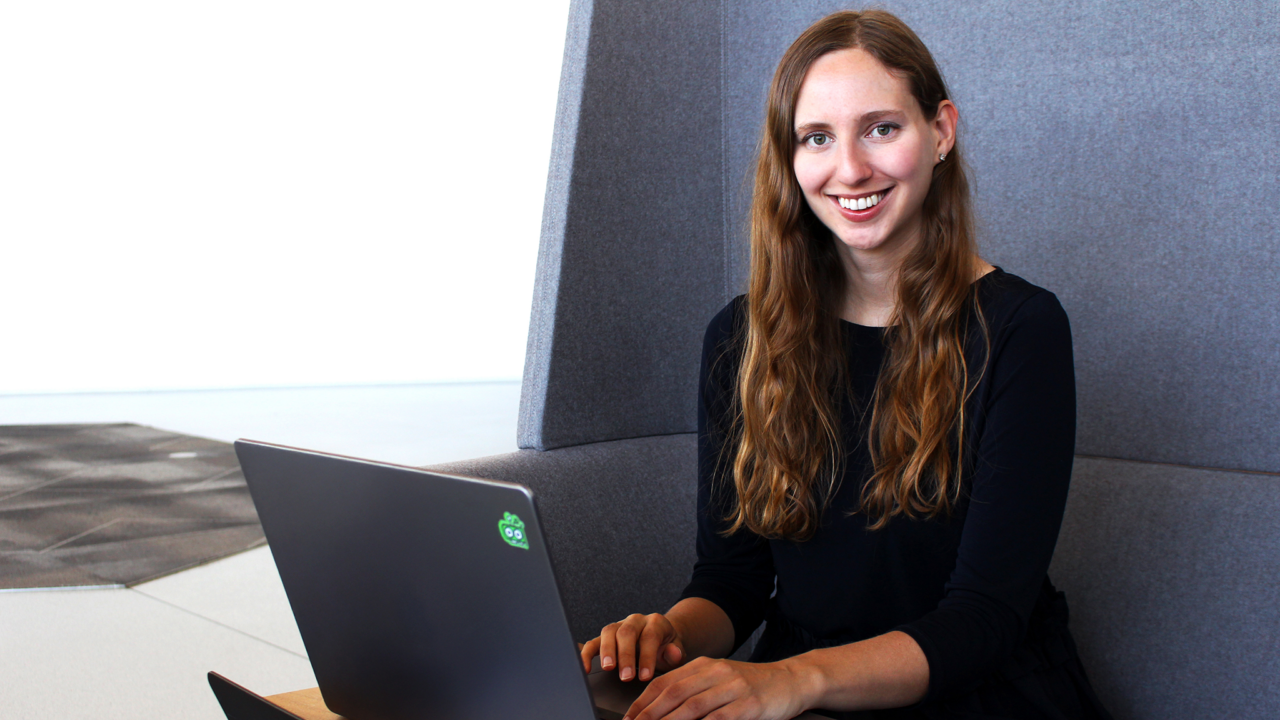
The eve of GTC, NVIDIA’s annual AI conference — and after a full day helping teach a workshop about large language models — Sidney Knowles got a message that changed the shape of her week: NVIDIA was looking for employees to help support Build-a-Claw, an event focused on giving developers hands-on experience with emerging AI tools.
What started as a two-hour volunteer slot turned into something closer to a weeklong front-row seat to the future of AI development. Shortly after stepping into the event tent, Knowles immediately knew she was in her element: moving fast and helping others work faster and smarter.
“Inside NVIDIA, AI work moves fast and tools evolve quickly,” said Knowles, a machine learning engineer in the IT organization’s enterprise AI and automation team, which builds internal AI tools, tests NVIDIA technologies in real employee workflows and helps turn early ideas into systems other teams can use to work faster and solve problems in new ways.
“The team’s goal is to use NVIDIA’s products to build tools that are helpful to employees in their day-to-day lives,” she said.
The work reflects NVIDIA’s philosophy of using the company’s own products internally, learning quickly from what works and feeding those lessons back into product teams.
This makes Knowles’ role more than a traditional engineering job. It’s part platform building, part product feedback and part internal enablement.
Delivering AI Solutions Across the Company
Since starting on NVIDIA’s enterprise AI and automation team as an undergraduate intern in 2022 — and returning as a full-time employee after graduating in 2023 — Knowles has seen the team’s scope grow and change, keeping pace with AI’s rapid evolution.
What began as a smaller set of projects has expanded into a portfolio that can include dozens of efforts at once — developing tools for a specific business function, experimenting with early product capabilities or providing feedback to product teams before those technologies reach customers.
Knowles works primarily on employee productivity tools such as an agentic AI-driven personal assistant and an AI chatbot for the company intranet, while the broader team supports projects ranging from IT support to supply chain optimization.
The work often begins with a real internal need. Teams in finance, HR, marketing, corporate communications or operations may come forward with a proof of concept and ask for help turning it into something more durable.
Other times, Knowles’ group sees an opportunity to test an emerging NVIDIA product against an internal use case. The intranet AI project, for instance, drew on NVIDIA’s retrieval-augmented generation research and became a proving ground for data flywheel concepts available to customers through the NVIDIA NeMo platform.
But Knowles’ team isn’t trying to build every solution itself. In a company full of technical teams, the bigger opportunity is often enablement.
“A lot of times within my team, we’re looking to empower other teams to help build their solutions long term,” Knowles said.
That philosophy shows up clearly in the internal personal assistant platform, which the team designed so NVIDIA groups can connect their own agents and workflows to shared interfaces, skills and automations.
The idea, Knowles said, is to “build a lot of those foundational building blocks and then get out of the way as fast as possible.”
Because the group is small, it can also stay close to users. When employees raise issues or ideas in Slack, engineers often respond directly within minutes.
The pace is demanding, but Knowles sees that speed as part of the moment.
“As the speed of things is ramped up, it’s gotten more chaotic, but the chaos is kind of part of the fun,” Knowles said.
Automating Tasks to Enable Innovation
While AI can automate repetitive work and create more room for thought, Knowles explains, it doesn’t ultimately decide what matters, making human judgment more important than ever.
“AI in a lot of ways enables you to say a lot more,” she said. “But you still have to mean what you say.”
That distinction runs through Knowles’ view of the work. The goal isn’t automation for its own sake. It’s freeing people to spend more time understanding problems, separating signal from noise and applying creativity where it counts.
One of the most rewarding parts of the job is how many teams Knowles gets to collaborate with and help empower, from healthcare and life sciences to infrastructure to field organizations.
“Some of the smartest people on the planet work for NVIDIA,” Knowles said. “And I get to help enable their work.”