country_code

AI’s New Frontier: From Daydreams to Digital Deeds

Entrepreneur Kanjun Qiu and NVIDIA’s Bryan Catanzaro discuss bridging the gap between imagination and automation at NVIDIA GTC.
by

Imagine a world where you can whisper your digital wishes into your device, and poof, it happens.

That world may be coming sooner than you think. But if you’re worried about AI doing your thinking for you, you might be waiting for a while.

In a fireside chat Wednesday at NVIDIA GTC, the global AI conference, Kanjun Qiu, CEO of Imbue, and Bryan Catanzaro, vice president of applied deep learning research at NVIDIA, challenged many of the clichés that have long dominated conversations about AI.

Launched in October 2022, Imbue made headlines with its Series B fundraiser last year, raising over $200 million at a $1 billion valuation.

Bridging the Gap Between ‘Idea and Execution’

The discussion highlighted not only Imbue’s approach toward building practical AI agents able to automate menial, unrewarding work, but also painted a vivid picture of what the next chapter in AI innovation might hold.

“Our lives are full of so much friction … every single person’s vision can come to life,” Qiu said. “The barrier between idea and execution can be much smaller.”

Catanzaro’s reflections on the practical difficulties of using AI for simple tasks, such as his own challenges trying to get his digital assistant to help him find his next meeting, underscored the current limitations in human-AI interaction.

It turns out that figuring out where and when to go to a meeting, while easy for a human assistant, isn’t easy to automate.

“We tend to underestimate the things that we do naturally and overestimate the things that require reasoning,” Catanzaro observed. “One of the things humans deal with well is ambiguity.”

This set the stage for a broader discussion of the need for AI to move beyond mere code generation and become a dynamic, intuitive interface between humans and computers.

Qiu said the idea that AI can be a magical assistant, one that knows everything about you “isn’t necessarily the right paradigm.”

That’s because delegation is hard.

“When I’m delegating something, even to a human, I have to think a lot about ‘okay, how can I package this up so that the person will do the right thing?’”

Instead, the better model might be telling your computer to do anything you want. So you’re “telling your computer to do stuff and the agent is a middle layer,” she said.

Such agents will need to be able to interact with people — something often described as “reasoning,” the two observed — and communicate with computers — or “code.”

A Vision for Empowerment Through Technology

Qiu and Catanzaro — who often completed each other’s sentences during the 45-minute conversation — compared AI’s potential to democratize software creation to the Industrial Revolution’s impact on manufacturing.

The parts needed for a steam engine, for example, once took years to create. Now they can be ordered off the shelf for a small sum.

Both speakers emphasized the importance of creating intuitive interfaces that allow individuals from nontechnical backgrounds to engage with computers more effectively, fostering a more inclusive digital landscape.

That means going beyond coding, which is done in text-heavy environments such as an Integrated Development Environment, or even using text-based chats.

“The interface to agents, a lot of them today, is like a chat interface. It’s not a very good interface, in a lot of ways, very restrictive. And so there are much better ways of working with these systems,” Qiu said.

The Future of Personal Computing

Qiu and Catanzaro discussed the role that virtual worlds will play in this, and how they could serve as interfaces for human-technology interaction.

“I think it’s pretty clear that AI is going to help build virtual worlds,” said Catanzaro. “I think the maybe more controversial part is virtual worlds are going to be necessary for humans to interact with AI.”

People have an almost primal fear of being displaced, Catanzaro said, but what’s much more likely is that our capabilities will be amplified as the technology fades into the background.

Catanzaro compared it to the adoption of electricity. A century ago, people talked a lot about electricity. Now that it’s ubiquitous, it’s no longer the focus of broader conversations, even as it makes our day-to-day lives better.

“I think of it as really being able to [help us] control information environments … once we have control over information environments, we’ll feel a lot more empowered,” Qiu said. “Every single person’s vision can come to life.”

  • Categories:
  • AI

NAIRR Science Program Reshapes Scientific Research, Powered by NVIDIA AI Infrastructure

by

For the past two years, the U.S. National Science Foundation’s National Artificial Intelligence Research Resource (NAIRR) pilot program has driven innovative research across the U.S. for over 700 projects — spanning protein prediction and infectious disease outbreak management. 

NVIDIA contributed to the NAIRR pilot through a cloud-based resource that gives researchers dedicated access to a minimum of four NVIDIA DGX nodes for at least a month. NVIDIA also provided technical support to onboard and assist the researchers throughout their projects. 

With NVIDIA’s AI infrastructure support and DGX reference architecture providing dedicated resources, researchers have collapsed workflow timelines and uncovered groundbreaking technologies that will reshape and advance industries such as healthcare, agriculture and energy. 

The potential for scientific exploration and discovery across the nation through NAIRR is boundless. Learn more about a few NAIRR projects below. 

Physical Simulations With Polymathic AI’s Well Dataset

Simulation-to-real pipelines are becoming increasingly common across industries as a safer, more cost-efficient deployment method. 

Polymathic AI — a coalition of international scientists from Flatiron Institute, Cambridge University and Lawrence Berkeley National Lab — with the help of NVIDIA GPUs and NVIDIA NVLink interconnect technology, is strengthening physical, fluidlike simulations with its large-scale dataset called the “Well.” The dataset will be used to train the largest and most broadly applicable foundation model for fluidlike behavior to date. 

This foundation model, named Walrus, has been made publicly available along with its data, code and pertained weights. 

Polymathic AI’s approach builds on previous work in physics pretraining environments — addressing current limitations in scale and pretraining diversity. The research group also plans to explore scaling laws to help accelerate the development of more powerful foundation models for scientific applications.

University of Michigan’s Fusion Model for Energy Storage

Energy, a foundation of society, requires designing novel and efficient materials for energy storage and conversion.

Researchers at the University of Michigan, led by Professor Venkat Viswanathan in the Department of Aerospace engineering, are developing a model-fusion framework that brings together domain-specific molecular AI and general-purpose large language models. The goal is to help computational scientists more easily explore chemical space, ask chemistry-specific questions in natural language and identify promising materials for next-generation energy technologies. 

The family of molecular foundation models, MIST (the Molecular Insight SMILES Transformers), is designed for discovery and exploration across chemical space. 

MIST models were pretrained on large unlabeled molecular datasets and use a novel tokenizer, Smirk, to better capture nuclear, electronic, geometric, isotopic and stereochemical information from molecular representations. MIST models have been fine-tuned on more than 400 structure-property relationships and can match or exceed state-of-the-art performance across benchmarks spanning electrochemistry, quantum chemistry, physiology and other domains. 

MIST was developed on a 40-GPU NVIDIA DGX cluster the researchers gained as part of a NAIRR allocation and an additional 200,000 NVIDIA GPU hours on ALCF’s Polaris cluster. The team used NVIDIA’s NGC PyTorch container to support reproducible GPU-accelerated development across the different clusters.

Fusing MIST with general-purpose LLMs makes accurate quantum-chemical calculations more broadly accessible and accelerates the design of energy storage and conversion systems needed to enable widespread electrification of transportation, such as in the heavy-duty and aviation sectors.

Boston University’s BEACON AI Pipeline for Infectious Disease Detection 

Infectious diseases can spread rapidly in communities, causing surges in outbreaks. 

Boston University’s Hariri Institute for Computing and the Center on Emerging Infectious Diseases is working to train and evaluate a LLM using NVIDIA accelerated compute, through an AI pipeline to support an outbreak monitoring program called BEACON — Biothreats Emergence, Analysis and Communications Network.  

This LLM is being trained using a large corpus of documents on infectious diseases and epidemic-prone priority pathogens to support the work of field experts and outbreak analysts working on BEACON.

The model will be capable of analyzing online posts of emerging disease outbreaks on a global scale to extract features for downstream categorization and prioritization. BEACON will process signals from a variety of sources — including global disease-tracking platform HealthMap, news and social media feeds, subject-matter experts and individual communications via community boards or social media — to generate concise outbreak reports.  

These comprehensive outbreak analyses can inform clinical practice guidelines for emerging infectious diseases and identify gaps where further data is needed. 

Internationally deployed doctors, government organizations and academic researchers are already using the BEACON model to quickly identify and treat infectious diseases. 

“When you talk to infectious disease experts about what they used to do before we developed this pipeline, it used to take several hours for them to compose a report,” said Ioannis Paschalidis, director of Boston University’s Hariri Institute. “Now, producing a report gets done in roughly two minutes.” 

NAIRR and NVIDIA Across the Nation 

The latest scientific research doesn’t end there. Many other universities — including Harvard, Stanford, Colorado State University and more — are pioneering scientific breakthroughs with the help of NAIRR and NVIDIA. 

With scientists gaining broader access to AI and accelerated computing, innovation for a safer and healthier nation are more tangible than ever. 

Learn more about the NAIRR pilot program and explore how NVIDIA is driving academic research.

Hotter Than a Hot Tub: The 45°C Breakthrough to Cool AI’s Biggest Machines

NVIDIA’s latest AI servers can run on coolant warmer than a hot tub — and that counterintuitive choice is one of the biggest efficiency leaps in data center history.
by

Hot tubs sit at about 38 to 40 degrees Celsius, warm enough that most people can only soak for about 15 minutes. NVIDIA’s newest AI servers can run their cooling liquid even hotter — up to 45 degrees Celsius, or 113 degrees Fahrenheit. That higher temperature limit is precisely what makes them more energy efficient.

The Rubin generation of NVIDIA AI infrastructure is the world’s first to achieve 100% liquid cooling — every chip, every networking component, cooled entirely by liquid in a closed loop with no fans anywhere in the system. This liquid cooling methodology is outlined in the NVIDIA DSX AI factory reference design, a guide that outlines best practices to design, build and operate the entire AI factory infrastructure stack.

Although each generation offers significantly more computing power for each watt, full liquid-cooled AI compute infrastructure enables data centers to dramatically reduce cooling energy consumption — making a meaningful difference to overall data center energy use at hyperscale.

“The NVIDIA DSX reference design for AI factories has zero water consumption — we have eliminated massive amounts of power usage and pretty much all water usage,” said Ali Heydari, director of data center cooling and infrastructure at NVIDIA. “With dry-cooler-based designs, it’s a closed-loop system with no evaporative water cooling — outside of maybe 1% of the year when we might need chillers in some climates.”

Historically, cooling alone has accounted for up to 40% of a data center’s electricity consumption, making it one of the most significant areas where efficiency improvements can drive down both operational expenses and energy demands.

Industry estimates suggest that raising chiller plant temperatures by just one degree can cut cooling energy costs by about 4%. At scale, those savings add up quickly. A 50-megawatt hyperscale facility can save over $4 million annually in cooling-related energy and water costs by moving to liquid-cooled infrastructure. 

In favorable climates, NVIDIA’s 45-degree liquid-cooling architecture can enable chiller-less operation with dry coolers, reducing facility cooling water consumption from roughly 2.6 million gallons per megawatt per year for conventional cooling-tower-based systems to near zero — up to a 100% reduction in water use. 

The reason: traditional air-cooled data centers depend on large volumes of cooled air to remove heat from IT equipment, often requiring energy-intensive cooling infrastructure during hot weather. With NVIDIA’s 45-degree liquid cooling, heat is captured directly at the chip and transported through liquid loops operating at much higher temperatures, allowing outdoor dry coolers to reject heat efficiently for much of the year while significantly reducing mechanical cooling requirements and facility water consumption. 

The data center ambient temperature is flexible — warm summer air is fine — because nothing in the server depends on cool air. The liquid does all the work — and the same liquid can be recirculated in a closed loop so no new water is consumed to cool the chips.


A New Standard for the Industry

Because the NVIDIA Rubin platform integrates 100% liquid-cooled infrastructure, every cloud provider and data center operator building for it is making the transition. 

The ecosystem is keeping pace. Motivair, the advanced cooling division of Schneider Electric, has worked alongside NVIDIA’s product roadmap for nearly a decade — and Richard Whitmore, its president and CEO, says the relationship only intensified as power densities crossed the threshold where air cooling was no longer a viable option.

“Once the watts per chip crossed a certain level, liquid cooling became mandatory,” said Whitmore.

Too Hot to Cool AI Infrastructure Is Hotter Than You’d Think

There’s a long-standing misconception in the industry that a cold data center is an efficient one. Decades ago, if a data center didn’t feel like a walk-in freezer, people would assume something was wrong. 

In reality, chips can sustain far warmer environments than that instinct suggests. Silicon processors generate enormous internal heat — the coolant entering a fully liquid-cooled chip at 45 degrees Celsius exits at roughly 55 degrees, having absorbed that heat load across the chip surface. Yet performance doesn’t degrade. 

The processors continue to operate at full performance because liquid-cooled cold plates keep device temperatures within validated operating limits, even with coolant entering the rack at 45 degrees Celsius. 

No Fans, No Cold Aisles — A Fundamentally Different Machine

Walk into a traditional data center and notice two things: the noise — cooling fans contribute to total noise levels at or above 85 decibels, loud enough to require ear protection — and the physical choreography of hot aisles and cold aisles, carefully managed to push cooled air across components. 

The Rubin architecture changes the picture.

Coolant — 75% water and 25% propylene glycol — flows through cold plates that sit directly on processors, pulling heat out at the source. Running that coolant at up to 45 degrees Celsius means that in many climates, the facility loop can reject heat without turning on mechanical chillers and noisy fans. 

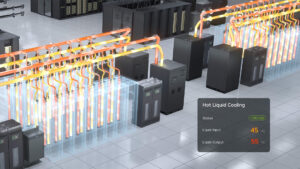
In an AI factory, coolant flows from a coolant distribution unit to the servers in a closed-loop cyle.

That unlocks something beyond energy savings: the possibility of eliminating water consumption entirely. 

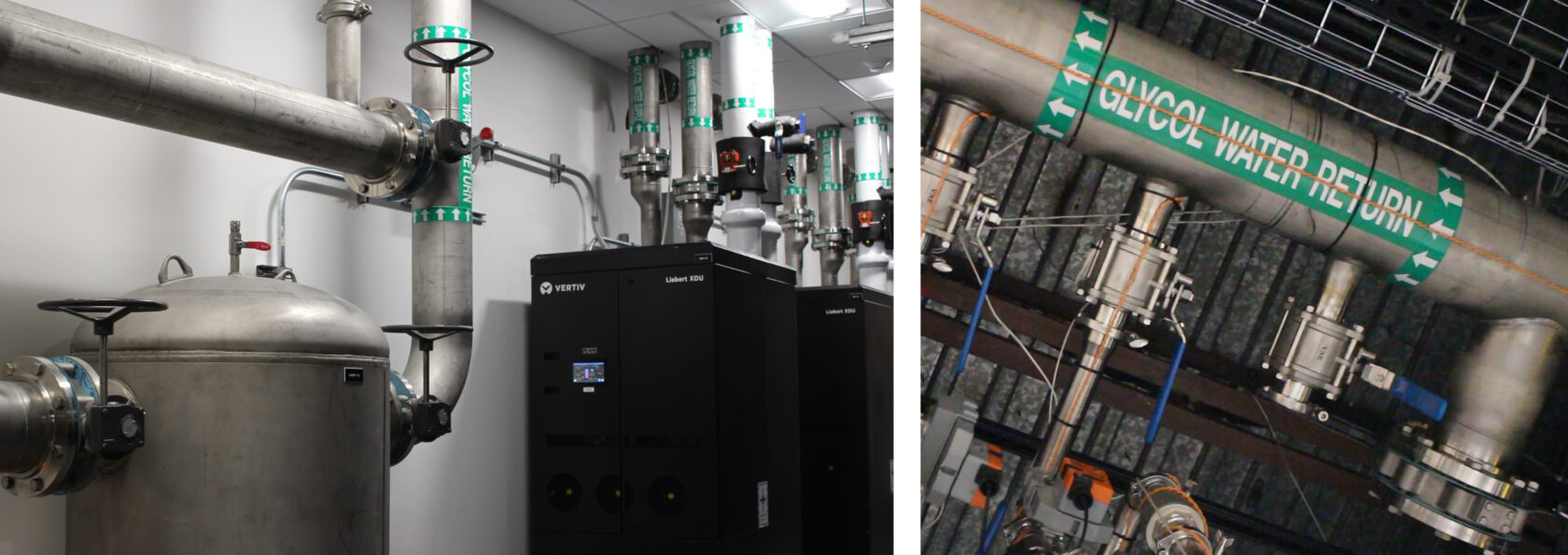
In the right geography — somewhere with reliably cool outdoor air — a liquid-cooled data center can reject its heat through coolant distribution units that capture heat directly at the source and transport it to outdoor dry coolers, essentially large radiator coils positioned outside the building. 

The loop is filled once and runs closed for the life of the facility. And it takes dramatically less space in the AI factory compared to traditional air-cooling infrastructure.

“In the right geographic location, with the right system design, you don’t need any refrigeration equipment,” Whitmore said. “You can just put big radiator coils outside and use the air temperature for all your cooling. It’s incredibly efficient.”

The geography caveat matters. A data center in the Scottish Highlands and one in Phoenix, Arizona, face very different realities. But even in warmer climates, the shift toward 45-degrees-Celsius coolant moves operators significantly closer to that chiller-less ideal — where chillers may turn on just a few days a year when the outside air temperature demands it.

Another key benefit of this new model for AI factories is the potential for waste heat recovery, where residual heat from AI factory operations can be repurposed to heat commercial or residential buildings nearby. 

The Engineering Problem Nobody Had Solved

Previous liquid-cooled servers were hybrid: GPUs and CPUs got cold plates, but the rest of the system stayed air-cooled, with finned heat sinks designed to shed heat into moving air. In a fully liquid-cooled server, the cooling for these components needed to be completely redesigned to use liquid.

NVIDIA’s thermal engineering team reworked how those components handle heat, designing cooling loops that simplify how liquid is routed to multiple high-power chips on the board using a single inlet and outlet, resulting in a cleaner tray-level cooling architecture.

One visible outcome: Rubin servers have clean, sealed front panels where air-cooled servers have perforated bezels. Another: fully liquid cooled servers enable higher rack density than air-cooled servers, so a system that previously occupied six rack units now fits in two — more compute, less space, less noise.

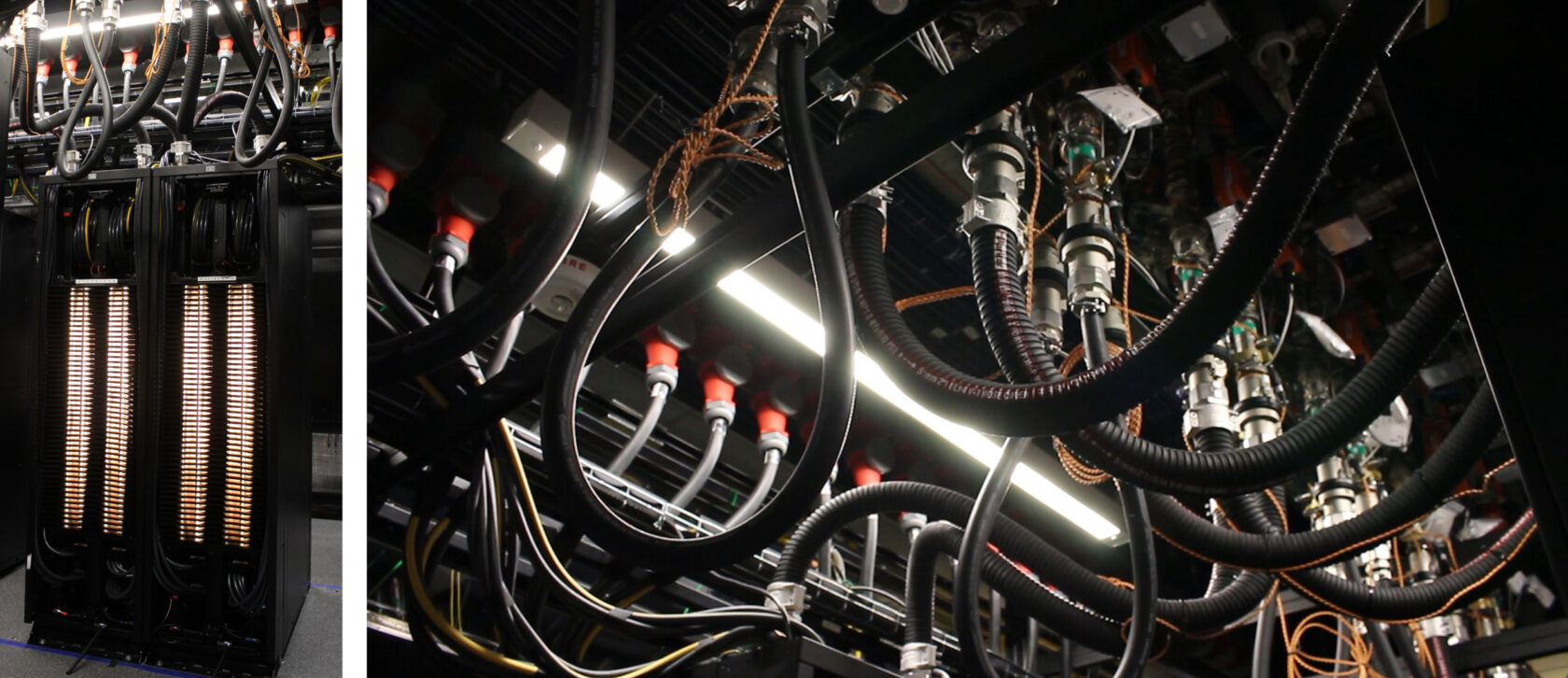
Liquid cooling infrastructure overhead pipes routes into powerful AI servers.

AI workloads are not getting lighter. The compute demand driving data center construction is growing faster than almost any other category of infrastructure investment. 

Without efficiency improvements in how that compute is cooled, the energy cost of running AI at scale would grow in lockstep with the hardware. Liquid cooling at up to 45 degrees Celsius — hotter than a hot tub, cooler for the planet — is one of the most important tools the industry has to close that gap.

Learn more about liquid cooling, the NVIDIA DSX platform for AI factories and NVIDIA’s approach to energy-efficient AI infrastructure.

How FERC’s Large-Load Interconnection Actions Help Address Grid Stress, Improve Affordability

The U.S. Federal Energy Regulatory Commission’s new actions on energy — a foundational layer of AI — are poised to reduce costs for ratepayers, grow the industrial base and strengthen the nation’s electrical grid.
by

In a consequential grid infrastructure decision, the Federal Energy Regulatory Commission (FERC) today issued a major milestone on large-load interconnection impacting how those building AI factories, semiconductor fabrication support systems and advanced manufacturing facilities can connect to the grid. 

In the era of AI, which NVIDIA founder and CEO Jensen Huang has described as a five-layer cake, energy is the critical foundation of technological innovation. 

FERC’s actions do more than modernize the grid interconnection queue — the approval process power developers must complete to safely connect new energy generation to the electrical grid. Following U.S. Secretary of Energy Chris Wright’s order directing FERC to address large-load interconnection, the actions establish national policy for how America can simultaneously lower energy costs, grow its industrial base, scale AI and strengthen the electrical grid.

For policymakers, utilities and technology partners, the message is clear: This is a pro-growth, pro-affordability and pro-reliability policy.

Faster Connections, Stronger Grid

At its core, the new framework cuts through burdensome bureaucratic red tape and aligns industry incentives.

Large customers are no longer passive entrants into an overburdened interconnection queue. They’re active participants in building the infrastructure they require. That means:

  • Funding their own network upgrades, reducing cost pressure on existing ratepayers.
  • Bringing new energy generation online, increasing supply alongside demand.
  • Offering flexible load, allowing grid operators to manage peaks more efficiently.

Customers that can demonstrate flexibility — shifting or curtailing load in response to grid conditions — can move through the process on accelerated timelines, with study periods potentially as short as 60 days, per Secretary Wright’s directive.

This is not just faster interconnection. It’s smarter interconnection.

The Math Adds Up

Electric grids are capital-intensive systems with high fixed costs. When more demand is added efficiently, those costs are spread across a broader base — lowering prices per unit.

The data backs this up.

Lawrence Berkeley National Laboratory found that every 10% increase in state electricity consumption correlates with an approximately 6-cents-per-kilowatt-hour reduction in retail electricity prices. In other words, grid growth — when done right — lowers costs.

This dynamic is already playing out at the state level:

  • North Dakota, after adding 23 data centers, saw the nation’s largest decrease in electricity prices.
  • Mississippi, Louisiana and Virginia moved early to attract large loads and are now seeing tangible ratepayer, grid modernization and investment benefits.
  • PG&E has forecast that, under the right conditions, each new 1 gigawatt of data center load could reduce electric rates by 1-2% by spreading fixed grid costs over more usage.

Inversely, states that fail to attract new load risk concentrating system costs on a shrinking customer base — putting upward pressure on rates for households and small businesses.

FERC’s actions create a national pathway to avoid that outcome. They build on the successes of communities across North Dakota, Mississippi, Louisiana and Virginia to create a national on-ramp, enabling every region to compete for and benefit from the next wave of industrial and technological investment.

Infrastructure That Powers the Modern Economy

This is not abstract infrastructure. It underpins the technologies shaping the next generation of American competitiveness.

The facilities enabled by this framework will power:

  • AI-driven drug discovery that accelerates breakthroughs in medicine.
  • Semiconductor design and advanced manufacturing that secure domestic supply chains.
  • Weather modeling and climate analytics that improve resilience.
  • Next-generation energy systems that are more adaptive and reliable.

The benefits extend beyond any single facility or industry. They can reach every American who visits a doctor, buys a product or pays an electricity bill.

The Moment to Engage in a Decade-Defining Opportunity

The framework is in place — but how it’s implemented, refined and scaled will depend on the stakeholders who engage now. Across government and industry, those who engage today will define what this system looks like for the next decade — how fast it grows, how resilient it becomes and how broadly its benefits are shared. 

NVIDIA is not waiting.

In parallel with FERC’s action, NVIDIA and Emerald AI are already working with partners across the ecosystem to build a new class of AI factories — designed from the ground up as flexible grid assets.

These facilities will:

  • Bring their own generation to the grid
  • Respond to grid conditions in real time
  • Act as stabilizing forces for surrounding communities

Commercial deployment begins later this year.

This is what the future of large-load interconnection looks like: not a burden on the grid, but a backbone of reliability and efficiency.

FERC has taken an important step forward, and NVIDIA welcomes this leadership.