country_code

Eco-System Upgrade: AI Plants a Digital Forest at NVIDIA GTC

Imagine a world where algorithms whisper to leaves and pixels sprout into towering digital trees — explore Refik Anadol’s ‘Large Nature Model,’ which turns the improbable into the incredible.
by

Editor’s note: As of June 6, 2025, NVIDIA Edify is no longer available as an NVIDIA NIM microservice preview. To explore available visual AI models, visit build.nvidia.com.

The ecosystem around NVIDIA’s technologies has always been verdant — but this is absurd.

After a stunning premiere at the World Economic Forum in Davos, immersive artworks based on Refik Anadol Studio’s Large Nature Model will come to the U.S. for the first time at NVIDIA GTC.

Offering a deep dive into the synergy between AI and the natural world, Anadol’s multisensory work, “Large Nature Model: A Living Archive,” will be situated prominently on the main concourse of the San Jose Convention Center, where the global AI event is taking place, from March 18-21.

Fueled by NVIDIA’s advanced AI technology, including powerful DGX A100 stations and high-performance GPUs, the exhibit offers a captivating journey through our planet’s ecosystems with stunning visuals, sounds and scents.

These scenes are rendered in breathtaking clarity across screens with a total output of 12.5 million pixels, immersing attendees in an unprecedented digital portrayal of Earth’s ecosystems.

Refik Anadol, recognized by The Economist as “the artist of the moment,” has emerged as a key figure in AI art. His work, notable for its use of data and machine learning, places him at the forefront of a generation pushing the boundaries between technology, interdisciplinary research and aesthetics. Anadol’s influence reflects a wider movement in the art world towards embracing digital innovation, setting new precedents in how art is created and experienced.

Exhibition Details

  • Location: Main concourse at the San Jose McEnery Convention Center, ensuring easy access for all GTC attendees.
  • Total experience hours: Available from 5-7 p.m., providing a curated window to engage with the installation fully.
  • Screen dimensions: The installation features two towering screens, each four meters high. The larger, four-by-12-meter screen displays the “Large Nature Model: Living Archive,” showcasing Anadol’s centerpiece. A second, four-by-six-meter screen offers a glimpse into the process of building the Large Nature Model.

A Gateway to Digital Nature

Large Nature Model is a generative AI model focused exclusively on nature.

This installation exemplifies AI’s unique potential to capture nature’s inherent intelligence, aiming to redefine our engagement with and appreciation of Earth’s ecosystems.

Anadol has been working with nature-based datasets throughout his career, and began working with rainforest data years ago.

The Large Nature Model, on which the work being shown at GTC is based, continues to evolve. It represents the work of a team of 29 data scientists, graphic designers and AI specialists from around the world, all working under the umbrella of the Refik Anadol Studio.

The Large Nature Model showcased at GTC is fine-tuned using the Getty Images foundation model built using the NVIDIA Edify architecture. The model is fine-tuned on an extensive dataset of approximately 750,000 images, comprising 274,947 images of flora, 358,713 images of fauna and 130,282 images of fungi — showcasing the rich biodiversity of the Amazonian rainforest.

Insights Into the Making

Alongside the visual feast, a panel discussion featuring Anadol and colleagues from the Refik Anadol Studio will provide insights into their research and design processes.

Moderated by Brian Dowdy, a senior technical marketing engineer at NVIDIA, the discussion will explore the collaborative efforts, technical challenges and creative processes that make such pioneering art possible.

The creation of the Large Nature Model represents six months of rigorous development and collaboration with NVIDIA researchers, underscoring the dedication and interdisciplinary effort required to bring this innovative vision to life.

Register for GTC today to join this immersive journey into the heart of nature, art and AI innovation.

  • Categories:
  • AI

NVIDIA Powers Over 400 of the World’s 500 Fastest Supercomputers

by

News Highlights:

  • NVIDIA technology runs 81% of the TOP500 and 90% of the systems new to the list.
  • 26 systems on the TOP500 adopted the NVIDIA Grace CPU, up eight from the previous list.
  • The top eight systems on the Green500 run on NVIDIA GPUs and nine of the top 10 use NVIDIA technologies.
  • No. 1 on the Green500, KAIROS, uses a single NVIDIA Grace Hopper Superchip.
  • 376 of the TOP500 systems are interconnected using NVIDIA networking.

NVIDIA technologies power more than 400 of the world’s 500 fastest supercomputers — 81% of the TOP500 — according to the latest rankings released this week at the ISC High Performance conference in Hamburg, Germany.

That’s a gain of 17 systems from the previous list, with the momentum in new deployments: nearly nine of every 10 systems new to the ranking are built on NVIDIA technologies.

That percentage reflects a deliberate preference for machines built for AI, simulation and science together. And it’s compounding: NVIDIA systems across the TOP500 now deliver more than 2x the AI training and nearly 3x the AI inference throughput of every other platform combined.

GPU and networking adoption each hit new highs, with NVIDIA GPUs accelerating a record 238 systems and NVIDIA networking connecting a record 376 — the vast majority on NVIDIA Quantum InfiniBand, the backbone of large-scale AI and high-performance computing, and the rest on Ethernet. 

The trend behind the numbers is bigger than any one list: Accelerated computing is becoming the foundation for the systems taking on the world’s most demanding work, across AI and science.

Updated twice a year, the TOP500 ranks the world’s fastest supercomputers, while the Green500 list measures how much computing each delivers per watt.

A Full-Stack Footprint

NVIDIA’s reach now spans the full system — GPU, networking and, increasingly, the CPU — with NVIDIA Grace CPU adoption reaching 26 systems, up eight from the previous list, with nearly 2.5 million Grace CPUs shipped.

NVIDIA Grace-based machines sit atop both rankings: JUPITER at No. 5 and Alps at No. 10 on the TOP500, and KAIROS at No. 1 on the Green500.

Each pairs an NVIDIA GPU with the Grace CPU in a single NVIDIA Grace Hopper Superchip, letting the two share memory with minimal overhead — a design built for the memory-intensive demands of modern AI.

The NVIDIA Vera CPU, announced earlier this year, builds on the success of Grace, taking CPU performance and energy efficiency to new levels for the most demanding AI workloads in modern data centers — where agents move from answering basic questions to taking actions, running code, using tools and evaluating results.

Topping the Efficiency List

NVIDIA swept the Green500 ranking of the most energy-efficient supercomputers: The top eight all run on NVIDIA GPUs and nine of the top 10 use NVIDIA technologies. 

Leading the list is KAIROS, an NVIDIA Grace Hopper system at France’s University of Toulouse, at 73.3 gigaflops per watt — with Grace Hopper systems taking the top four spots, across France, Germany and the U.K.

From Exascale Science to the Next Wave

A record 35 NVIDIA AI HPC supercomputers are in development across Europe — equipping more than 3 million researchers with next-generation infrastructure for continental AI, accelerated science and industrial innovation.

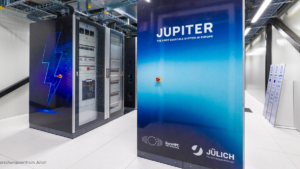
Among these systems is JUPITER, Europe’s fastest supercomputer and its first to reach exascale, at the Jülich Supercomputing Centre in Germany.

JUPITER is mapping the human brain at cellular scale, simulating Earth’s climate and advancing the AI behind next-generation 6G networks.

The newest arrivals to the list run on the NVIDIA Blackwell architecture, with B200 and GB200 systems entering the rankings across Asia, Europe and the U.S. — and the first GB200 systems debuting in Japan.

The buildout is global, from a new AI factory in South Africa to national AI systems in Saudi Arabia, Singapore and Vietnam.

It’s the same story up and down the list: the world’s AI buildout is running on NVIDIA.

NAIRR Science Program Reshapes Scientific Research, Powered by NVIDIA AI Infrastructure

by

For the past two years, the U.S. National Science Foundation’s National Artificial Intelligence Research Resource (NAIRR) pilot program has driven innovative research across the U.S. for over 700 projects — spanning protein prediction and infectious disease outbreak management. 

NVIDIA contributed to the NAIRR pilot through a cloud-based resource that gives researchers dedicated access to a minimum of four NVIDIA DGX nodes for at least a month. NVIDIA also provided technical support to onboard and assist the researchers throughout their projects. 

With NVIDIA’s AI infrastructure support and DGX reference architecture providing dedicated resources, researchers have collapsed workflow timelines and uncovered groundbreaking technologies that will reshape and advance industries such as healthcare, agriculture and energy. 

The potential for scientific exploration and discovery across the nation through NAIRR is boundless. Learn more about a few NAIRR projects below. 

Physical Simulations With Polymathic AI’s Well Dataset

Simulation-to-real pipelines are becoming increasingly common across industries as a safer, more cost-efficient deployment method. 

Polymathic AI — a coalition of international scientists from Flatiron Institute, Cambridge University and Lawrence Berkeley National Lab — with the help of NVIDIA GPUs and NVIDIA NVLink interconnect technology, is strengthening physical, fluidlike simulations with its large-scale dataset called the “Well.” The dataset will be used to train the largest and most broadly applicable foundation model for fluidlike behavior to date. 

This foundation model, named Walrus, has been made publicly available along with its data, code and pertained weights. 

Polymathic AI’s approach builds on previous work in physics pretraining environments — addressing current limitations in scale and pretraining diversity. The research group also plans to explore scaling laws to help accelerate the development of more powerful foundation models for scientific applications.

University of Michigan’s Fusion Model for Energy Storage

Energy, a foundation of society, requires designing novel and efficient materials for energy storage and conversion.

Researchers at the University of Michigan, led by Professor Venkat Viswanathan in the Department of Aerospace engineering, are developing a model-fusion framework that brings together domain-specific molecular AI and general-purpose large language models. The goal is to help computational scientists more easily explore chemical space, ask chemistry-specific questions in natural language and identify promising materials for next-generation energy technologies. 

The family of molecular foundation models, MIST (the Molecular Insight SMILES Transformers), is designed for discovery and exploration across chemical space. 

MIST models were pretrained on large unlabeled molecular datasets and use a novel tokenizer, Smirk, to better capture nuclear, electronic, geometric, isotopic and stereochemical information from molecular representations. MIST models have been fine-tuned on more than 400 structure-property relationships and can match or exceed state-of-the-art performance across benchmarks spanning electrochemistry, quantum chemistry, physiology and other domains. 

MIST was developed on a 40-GPU NVIDIA DGX cluster the researchers gained as part of a NAIRR allocation and an additional 200,000 NVIDIA GPU hours on ALCF’s Polaris cluster. The team used NVIDIA’s NGC PyTorch container to support reproducible GPU-accelerated development across the different clusters.

Fusing MIST with general-purpose LLMs makes accurate quantum-chemical calculations more broadly accessible and accelerates the design of energy storage and conversion systems needed to enable widespread electrification of transportation, such as in the heavy-duty and aviation sectors.

Boston University’s BEACON AI Pipeline for Infectious Disease Detection 

Infectious diseases can spread rapidly in communities, causing surges in outbreaks. 

Boston University’s Hariri Institute for Computing and the Center on Emerging Infectious Diseases is working to train and evaluate a LLM using NVIDIA accelerated compute, through an AI pipeline to support an outbreak monitoring program called BEACON — Biothreats Emergence, Analysis and Communications Network.  

This LLM is being trained using a large corpus of documents on infectious diseases and epidemic-prone priority pathogens to support the work of field experts and outbreak analysts working on BEACON.

The model will be capable of analyzing online posts of emerging disease outbreaks on a global scale to extract features for downstream categorization and prioritization. BEACON will process signals from a variety of sources — including global disease-tracking platform HealthMap, news and social media feeds, subject-matter experts and individual communications via community boards or social media — to generate concise outbreak reports.  

These comprehensive outbreak analyses can inform clinical practice guidelines for emerging infectious diseases and identify gaps where further data is needed. 

Internationally deployed doctors, government organizations and academic researchers are already using the BEACON model to quickly identify and treat infectious diseases. 

“When you talk to infectious disease experts about what they used to do before we developed this pipeline, it used to take several hours for them to compose a report,” said Ioannis Paschalidis, director of Boston University’s Hariri Institute. “Now, producing a report gets done in roughly two minutes.” 

NAIRR and NVIDIA Across the Nation 

The latest scientific research doesn’t end there. Many other universities — including Harvard, Stanford, Colorado State University and more — are pioneering scientific breakthroughs with the help of NAIRR and NVIDIA. 

With scientists gaining broader access to AI and accelerated computing, innovation for a safer and healthier nation are more tangible than ever. 

Learn more about the NAIRR pilot program and explore how NVIDIA is driving academic research.

NVIDIA Vera CPU Opens the Way for Agentic Scientific AI at Los Alamos National Laboratory

Mission, Vision and Veritas supercomputers with Vera CPUs to advance materials simulation, scientific AI agents and molecular design.
by

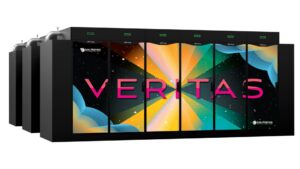
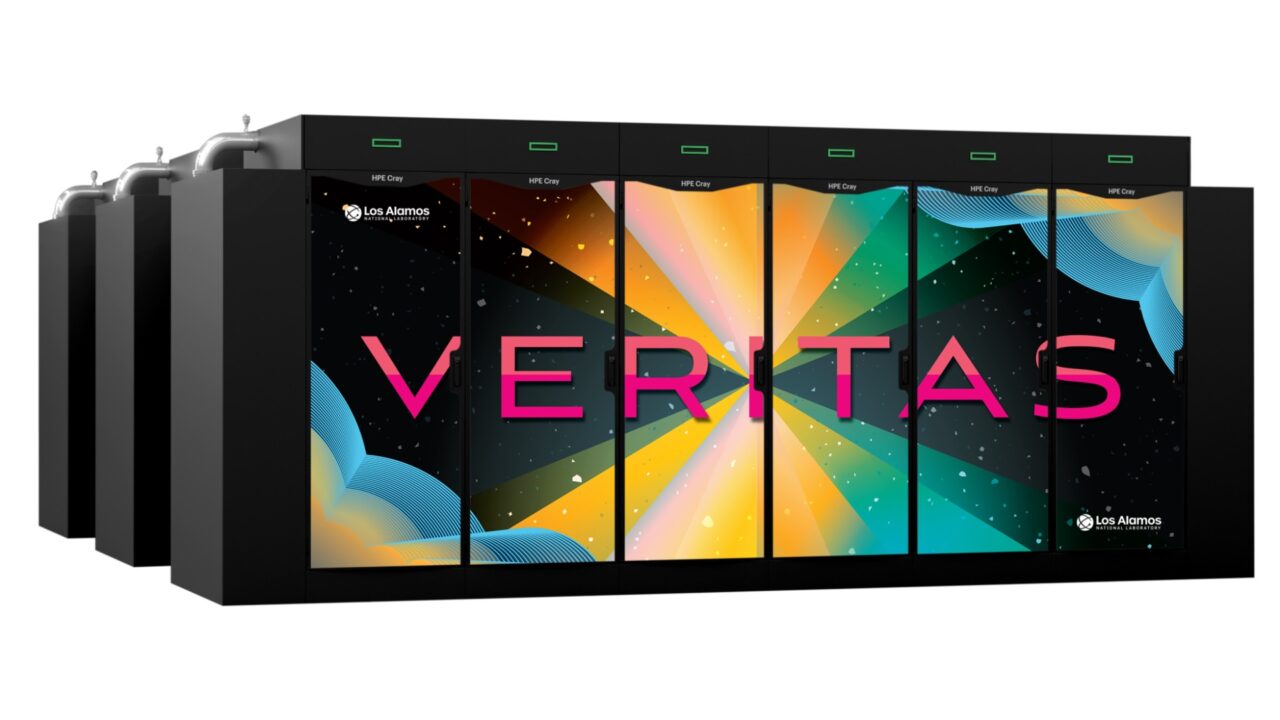
Mission, Vision and Veritas — new Los Alamos National Laboratory (LANL) supercomputers to be built with HPE and NVIDIA — are tapping NVIDIA Vera CPUs to accelerate scientific discovery, unlocking agentic AI for science.

The supercomputers will use the HPE Cray Supercomputing GX5000 architecture with the NVIDIA Vera Rubin platform, combining NVIDIA Vera CPUs, NVIDIA Rubin GPUs and NVIDIA Quantum-X800 InfiniBand networking.

Under the planned configuration, Mission will include NVIDIA Vera Rubin GPU nodes and 2,300 standalone NVIDIA Vera CPUs using the HPE Cray Supercomputing GX240 blade. Veritas will feature approximately 1,150 standalone NVIDIA Vera CPUs to complement NVIDIA Vera Rubin nodes. 

Veritas will arrive alongside Mission and Vision and serve the Laboratory Directed Research and Development program, helping accelerate agentic AI for science. The system will test these technologies for use in larger systems being built out at LANL. 

Researchers are adding a new tool for science with AI agents that can form hypotheses, choose tools, launch simulations, analyze outputs and refine the next step. LANL’s public work on URSA, the Universal Research and Scientific Agent — running on Venado and soon Mission and Vision — points in this direction: a modular, feedback-driven AI framework designed to help scientists brainstorm hypotheses, plan experiments, run simulations and analyze results. 

LANL demonstrated that the Vera CPU delivered 7x higher performance on URSA workloads than the CPUs in the Crossroads x86 supercomputer.

Vera CPU for Agents and Simulation

In LANL’s early testing of NVIDIA Vera CPUs on Branson — an open source Monte Carlo heat transfer simulation tool — Vera outperforms the CPUs used in the Crossroads x86 supercomputer by over 3x. 

These results were made possible by Vera, including its custom Olympus core, LPDDR5 memory and fast on-chip fabric. 

A single Vera CPU outperforms a single socket x86-based CPU by more than 3x while providing more than 4x the memory per core and 6x the memory per node. Ultimately, this means faster  scientific results for LANL.

All of the lab’s supercomputers were codesigned by hardware architects, system software developers, domain scientists, computer scientists and applied mathematicians — helping ensure systems are shaped by real scientific workloads, not abstract benchmarks alone. 

Building on Generations of LANL Systems

Mission, expected to be operational in 2027, will be the fifth Advanced Technology System in the National Nuclear Security Administration’s Advanced Simulation and Computing program and will replace Crossroads for classified national security workloads. 

Vision, also expected to be operational in 2027, will serve as a resource for fundamental science, including materials and nuclear science, energy modeling, biomedical research and AI — letting more scientists test methods, train models and explore ideas before moving into higher-consequence work.

The work extends more than a decade of LANL and NVIDIA’s deep collaboration on CPUs, from Grace to Vera, using extreme codesign for LANL simulation workloads.

The three new supercomputers build on Venado, the HPE Cray EX supercomputer installed at Los Alamos in 2024 with NVIDIA GH200 Grace Hopper Superchips and NVIDIA Grace CPU Superchips. 

Learn more about the NVIDIA Vera CPU.