Thanks to earbuds, people can take calls anywhere, while doing anything. The problem: those on the other end of the call can hear all the background noise, too, whether it’s the roommate’s vacuum cleaner or neighboring conversations at a café.
Now, work by a trio of graduate students at the University of Washington, who spent the pandemic cooped up together in a noisy apartment, lets those on the other end of the call hear just the speaker — rather than all the surrounding sounds.
Users found that the system, dubbed “ClearBuds” — presented last month at the ACM International Conference on Mobile Systems, Applications and Services — improved background noise suppression much better than a commercially available alternative.
AI Podcast host Noah Kravitz caught up with the team at ClearBuds to discuss the unlikely pandemic-time origin story behind a technology that promises to make calls clearer and easier, wherever we go.
Audio Analytic has been using machine learning that enables a vast array of devices to make sense of the world of sound. Dr. Chris Mitchell, CEO and founder of Audio Analytic, discusses the challenges and the fun involved in teaching machines to listen.
Overjet, a member of the NVIDIA Inception program for startups, is moving fast to bring AI to dentists’ offices. Dr. Wardah Inam, CEO of Overjet, talks about how her company improves patient care with AI-powered technology that analyzes and annotates X-rays for dentists and insurance providers.
Maya Ackerman is the CEO of WaveAI, a Silicon Valley startup using AI and machine learning to, as the company motto puts it, “unlock new heights of human creative expression.” She discusses WaveAI’s LyricStudio software, an AI-based lyric and poetry writing assistant.
Subscribe to the AI Podcast: Now Available on Amazon Music
Built for Vera Rubin, NVIDIA Spectrum-6 Arrives in Gigascale AI Factories
Next-generation NVIDIA Spectrum-X Ethernet connects hundreds of thousands of GPUs with the performance, resilience and efficiency needed for gigascale AI, with AI infrastructure leaders already adopting.
The world’s most advanced AI factories are bringing together hundreds of thousands of GPUs and CPUs to train frontier models, power agentic AI and generate intelligence at unprecedented scale. At this level, networking becomes a critical computing power multiplier in driving token generation.
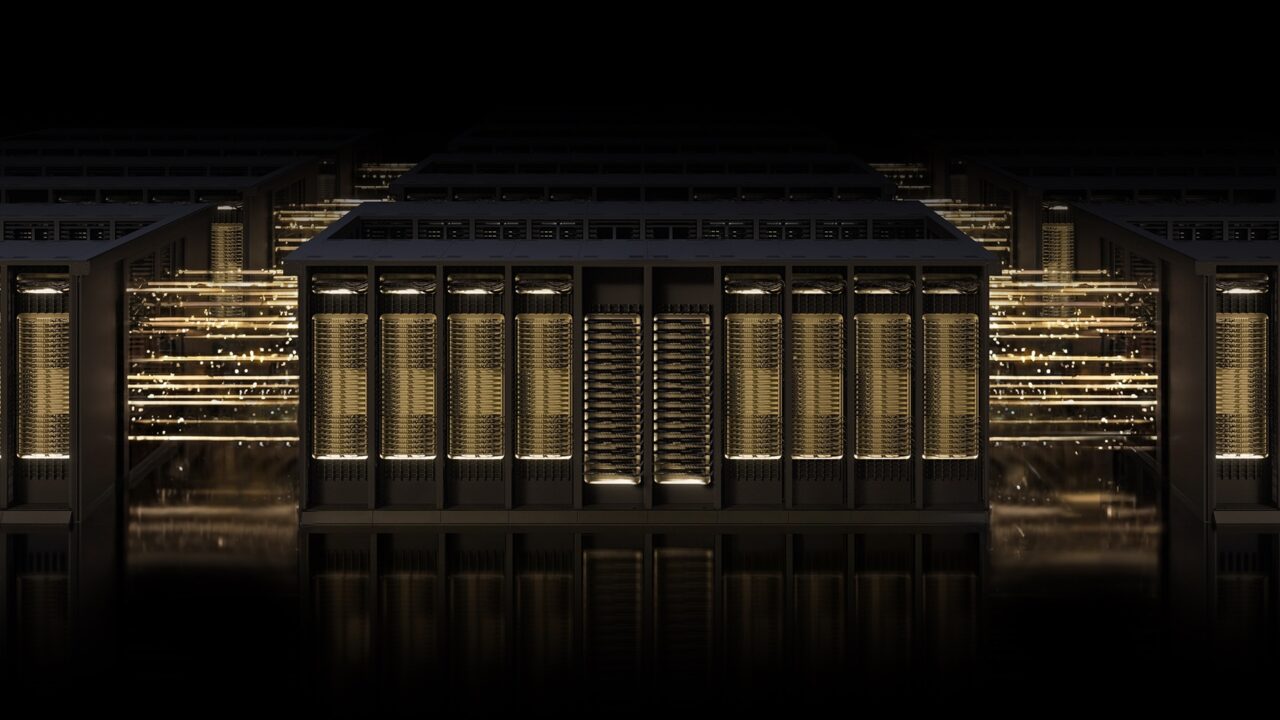
Marking a networking milestone, NVIDIA Spectrum-6 — a 102.4-terabit-per-second Ethernet switch system delivering 2x the capacity of previous-generation systems and built as part of the NVIDIA Vera Rubin platform — is arriving across the world’s gigascale AI factories.
Spectrum-6 anchors the next generation of theNVIDIA Spectrum-X Ethernet platform, delivering the bandwidth, scale and intelligence needed to operate an AI factory as one end-to-end computing system.
Leading AI Builders Move First
The world’s leading AI infrastructure builders — including CoreWeave, Microsoft, Nebius, SpaceXAI and Tesla — will be among the first to bring in Spectrum-6 to accelerate their AI factories.
For cloud providers, Spectrum-6 means more compute capacity can operate as a unified, high-performance resource, helping customers train models and deploy inference services faster.
“CoreWeave is built for the most demanding AI workloads, and networking is central to delivering that performance at scale,” said Min Jun, director of product for networking at CoreWeave. “Bringing NVIDIA Spectrum-6 and liquid-cooled Spectrum-X Ethernet infrastructure into our AI factories will help us deliver the bandwidth, resilience and efficiency customers need to train frontier models and deploy inference faster.”
“At gigascale, performance comes down to coordination: keeping every GPU in lockstep so one slow link doesn’t stall an entire job,” said Laurelle Roseman, vice president of global partnerships at Nebius. “That’s what NVIDIA Spectrum-6 goes after, and why we brought it in early — a fabric that stays fast and resilient as our customers’ most demanding workloads scale.”
For AI pioneers building their own infrastructure, Spectrum-6 means more GPUs working in lockstep, higher utilization during demanding collective operations and greater resilience for long-running jobs.
Across use cases, the outcome is faster time to results and better economics at extraordinary scale.
CoreWeave, Microsoft and Nebius will be among the first providers to deploy NVIDIA Vera Rubin-based infrastructure with Spectrum-6, extending access to the platform across a broad community of developers, startups and enterprises.
AI Performance Is a Network Problem
Peak GPU performance alone no longer predicts the performance of an AI factory.
Large-scale training and inference workloads depend on thousands of accelerators exchanging data continuously. Collective communications are the fundamental operations that synchronize work across GPUs and generate intense east-west traffic, often with many systems transmitting simultaneously.
Ethernet was designed primarily for enterprise applications and north-south traffic moving between users, servers and storage. It wasn’t created for the synchronized, collective-heavy communication patterns of gigascale AI.
Spectrum-X Ethernet changes that. Purpose-built for AI, it transforms Ethernet into a high-performance scale-out fabric engineered to keep every GPU fed with data.
The Next Generation of Spectrum-X Ethernet
The Spectrum-6 switch chip combines with the NVIDIA ConnectX-9 SuperNIC to form the next generation of Spectrum-X Ethernet, and is engineered as part of NVIDIA Vera Rubin, bringing together the NVIDIA Vera CPU, Rubin GPU, NVLink 6 Switch, ConnectX-9 SuperNIC, BlueField-4 DPU and Spectrum-6 Ethernet switch.
Spectrum-6 supports both pluggable and co-packaged optics form factors. In addition, Spectrum-6 offerings support liquid cooling, enabling a comprehensive, end-to-end cooling approach for the entire AI factory while increasing network power efficiency.
Unlike off-the-shelf Ethernet, the NVIDIA Spectrum-X Ethernet networking platform for AI factory scale-out combines intelligent switches, NVIDIA ConnectX-9 SuperNICs and full-stack networking software, all engineered together for AI. The platform’s advanced features continuously optimize how traffic moves through the fabric.
In addition, NVIDIA Spectrum-X technology intelligently balances traffic across available paths, rapidly bypasses failures and precisely recovers when data traveling across a network fails to reach its destination. Plus, support for open network operating systems and a choice of RDMA transport models gives AI builders flexibility without compromising performance.
Spectrum-X Ethernet is inherent to NVIDIA’s vertically integrated, horizontally open approach: codesigning silicon, systems and software across the full computing platform while supporting standard Ethernet, open network operating systems, open protocols and a broad ecosystem of cloud providers, system makers and infrastructure partners. Instead of needing to assemble a collection of parts and optimize them afterward, customers gain a complete AI factory platform designed to deliver the fastest time to train and the lowest cost per token.
Demonstrating this approach, Spectrum-X Ethernet delivers up to 1.6x higher AI networking performance than off-the-shelf Ethernet and sustains up to 95% network efficiency across deployments exceeding 100,000 GPUs.
Hardware-accelerated Spectrum-X multiplane topologies reduce the number of switches required for data centers by 1.7x to further accelerate network efficiency. Further layering on the benefits achieved via Spectrum-X Ethernet Photonics, including 5x higher power efficiency and 10x improved mean time between incidents, network fabric enhancements continue to deliver workload accelerations beyond component-level optimization.
Home to leading manufacturers, robotics pioneers, infrastructure builders and iconic gaming companies, of course, Japan is one of the world’s centers of AI — building across the full stack with NVIDIA technologies. This week NVIDIA and its partners in Japan are showcasing the AI ecosystem’s latest advancements. Check back here for updates.
This week, NVIDIA founder and CEO Jensen Huang met with Japan’s AI leaders and enthusiasts — together showcasing the future of technology in the nation.
The first thing Huang did after landing in Tokyo wasn’t a press conference or a CEO meeting. It was a surprise visit to a room full of builders.
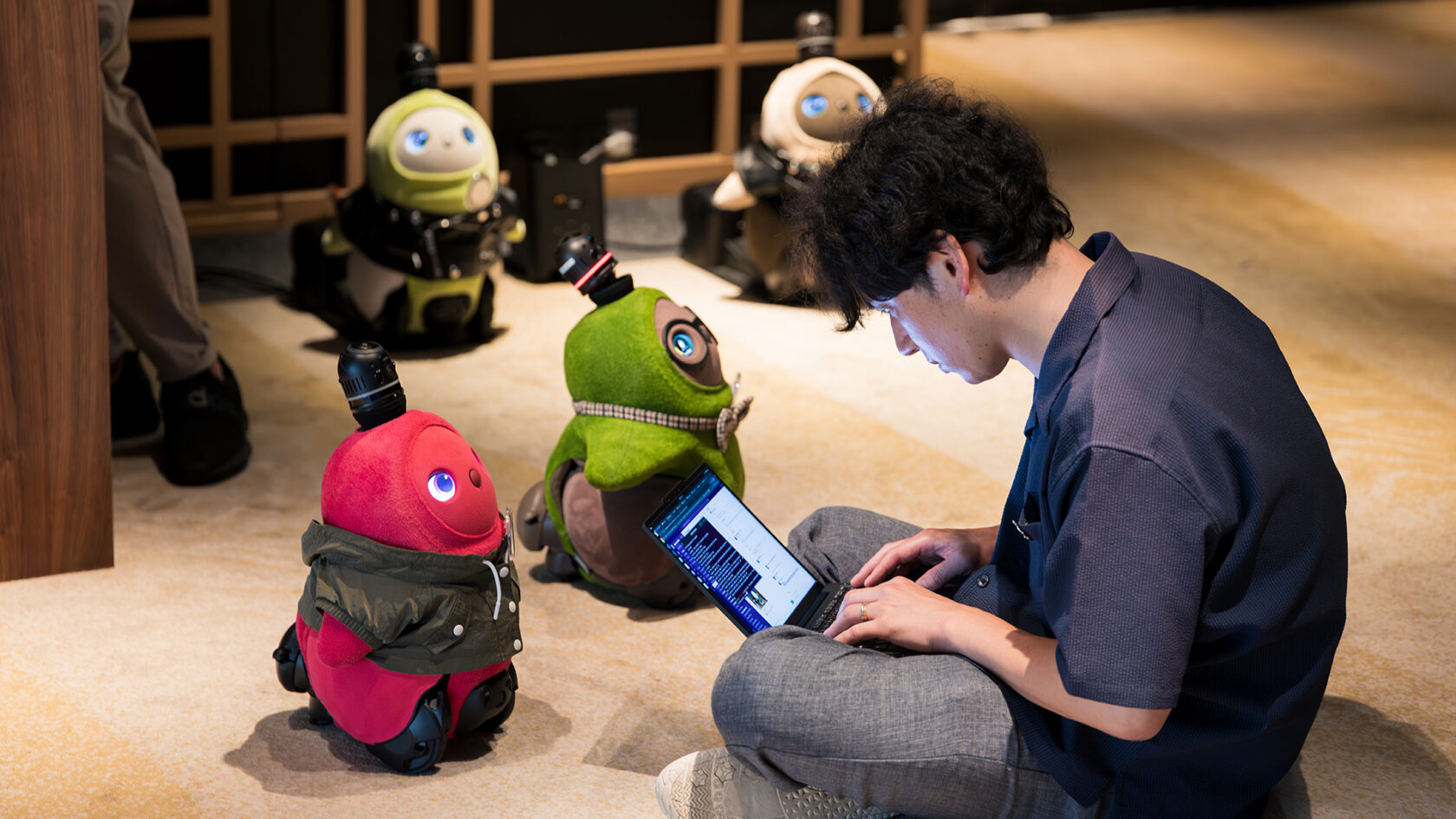
Happo-en is a traditional Japanese garden in the heart of Tokyo — moss, still water, centuries-old trees — and Studio Koku is the modern event space built within it. On Wednesday afternoon, it was full of robots.
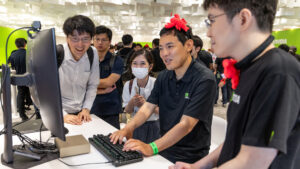
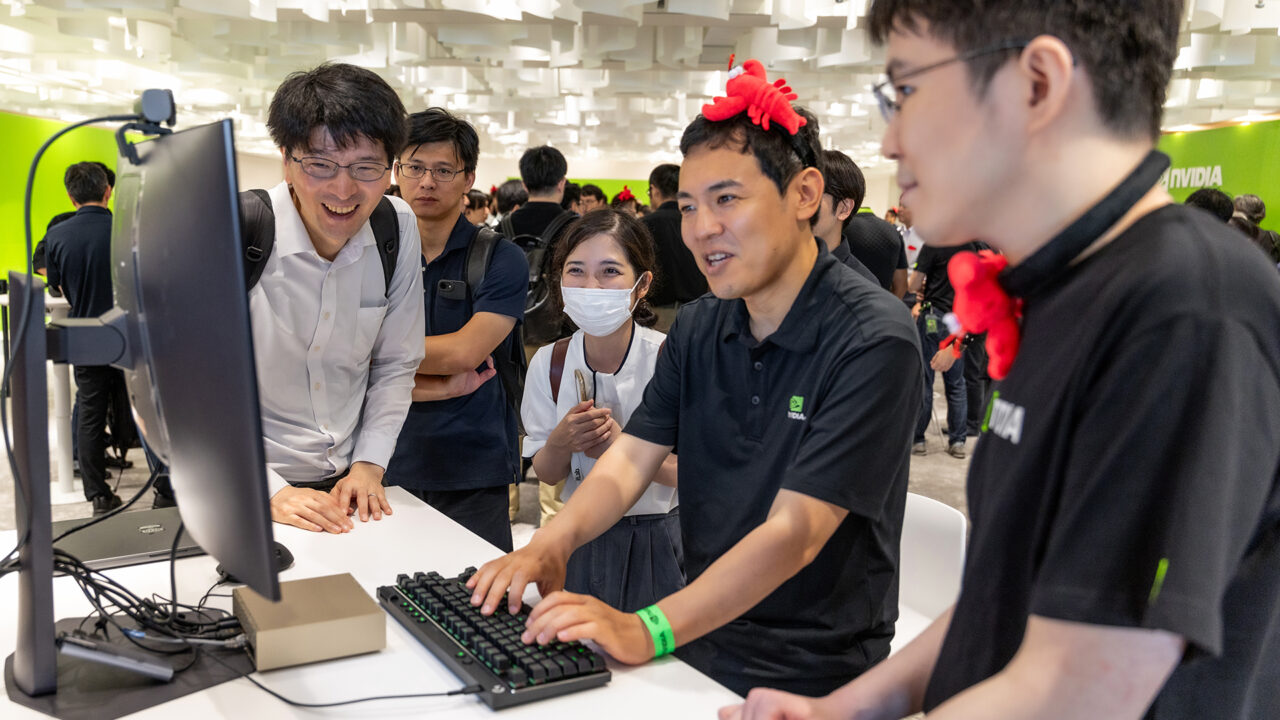
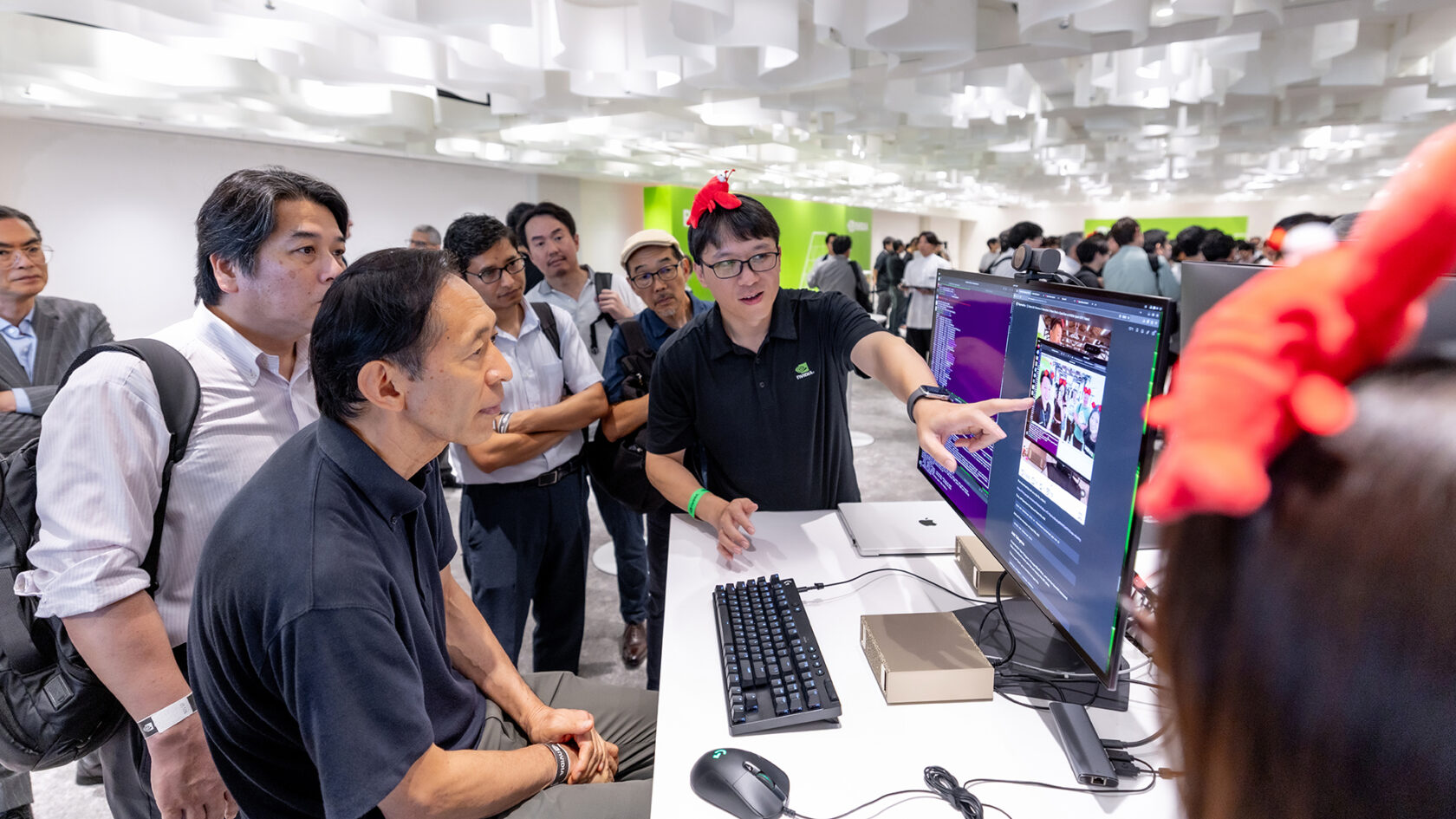
At NVIDIA’s Build-a-Claw event, Japan’s developers had been putting physical AI through its paces — using open models and NVIDIA’s platform to build robots that can pick things up.
When Huang walked in unannounced, what followed was the kind of moment that’s hard to engineer: a founder on the floor, talking to builders, watching the technology work.
“Forty years ago was the beginning of the PC revolution. Now, forty years later, instead of a personal computer, you can now have your own personal AI,” he said. “I’m happy that all of you are here to build your own claw, your own agent.”
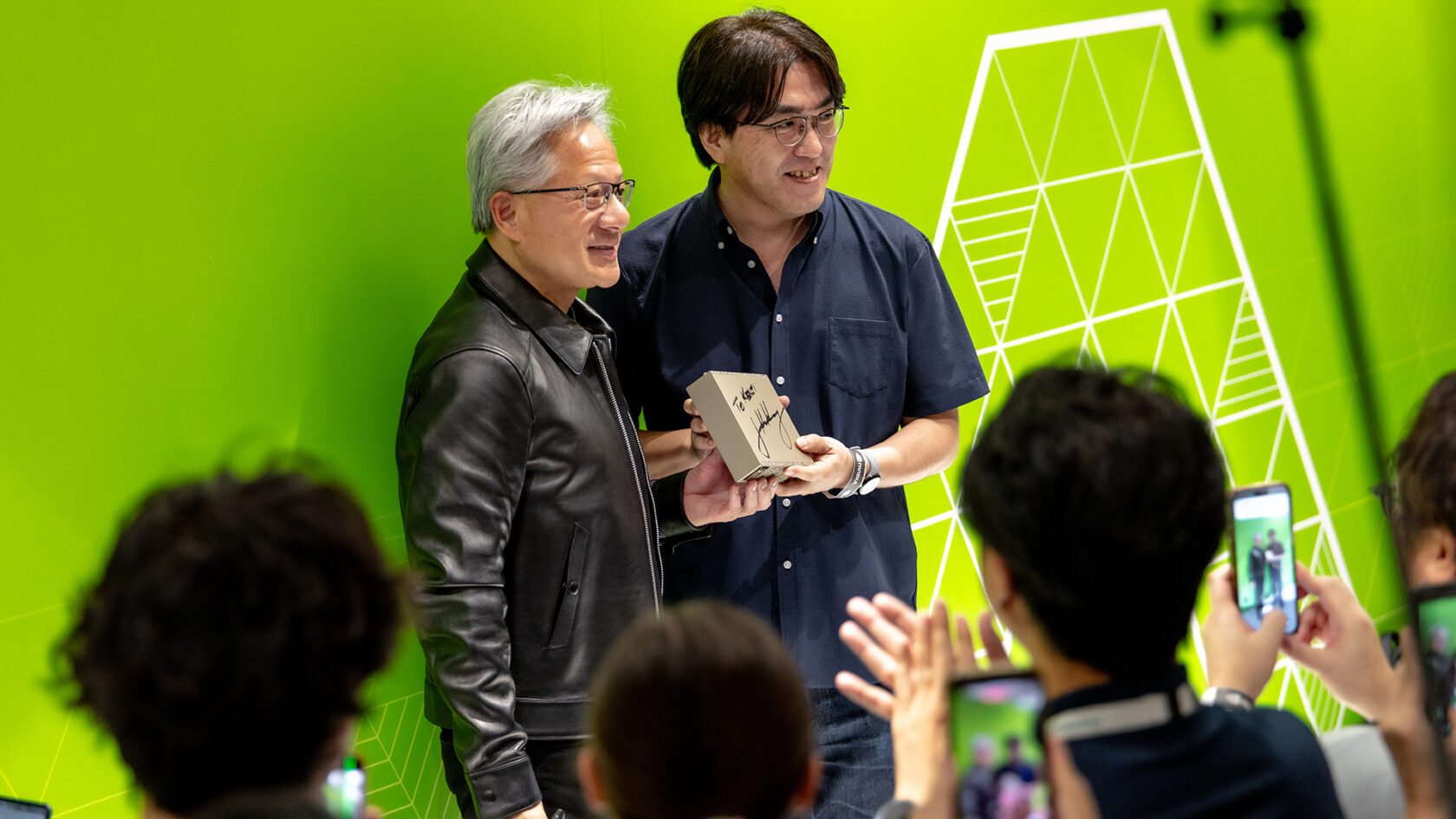
Huang gave away two autographed NVIDIA DGX Spark personal AI supercomputers to winners of a lucky draw.
“With this computer, you can build your own personal AI,” he said. “This is a work of love of mine.”
This is what NVIDIA’s physical AI platform looks like in practice: a claw that moves, a model that responds, a builder who made it happen. Japan’s open model ecosystem is a central part of NVIDIA’s global physical AI story, and Build-a-Claw showcased that story.
At a press event later that day, Huang spoke about Japan’s long leadership in global technology manufacturing — and why the nation is in an excellent position to apply that expertise to AI and robotics to create a new economic engine for the country.
“Japan has historically been very good at precision manufacturing and very large-scale manufacturing, but now we have AI,” Huang said to gathered reporters. “You can combine the two technologies and create robotics. The future of intelligent manufacturing, the future of robotics can now start.”
This combination can also help address Japan’s worker shortage, Huang added.
“With AI and robotics, you can augment the workers you have and increase national productivity,” Huang said. “AI is manufacturing intelligence. It’s manufacturing all the time, and it’s running all the time.”
Supply Chain Leaders Key to Building AI Future for Japan and Beyond
Japan sits in an extraordinary position as AI brings a reset to industries across economies and the globe. That was the message NVIDIA founder and CEO Jensen Huang delivered Wednesday in Tokyo to developers, scientists, entrepreneurs and investors.
With world-leading manufacturing, mechatronics, physical sciences, quantum physics and more, Japan has the opportunity to fuse its strengths with the help of AI and build the future.
But the future needs a supply chain. Japan’s is exceptional — and hungry.
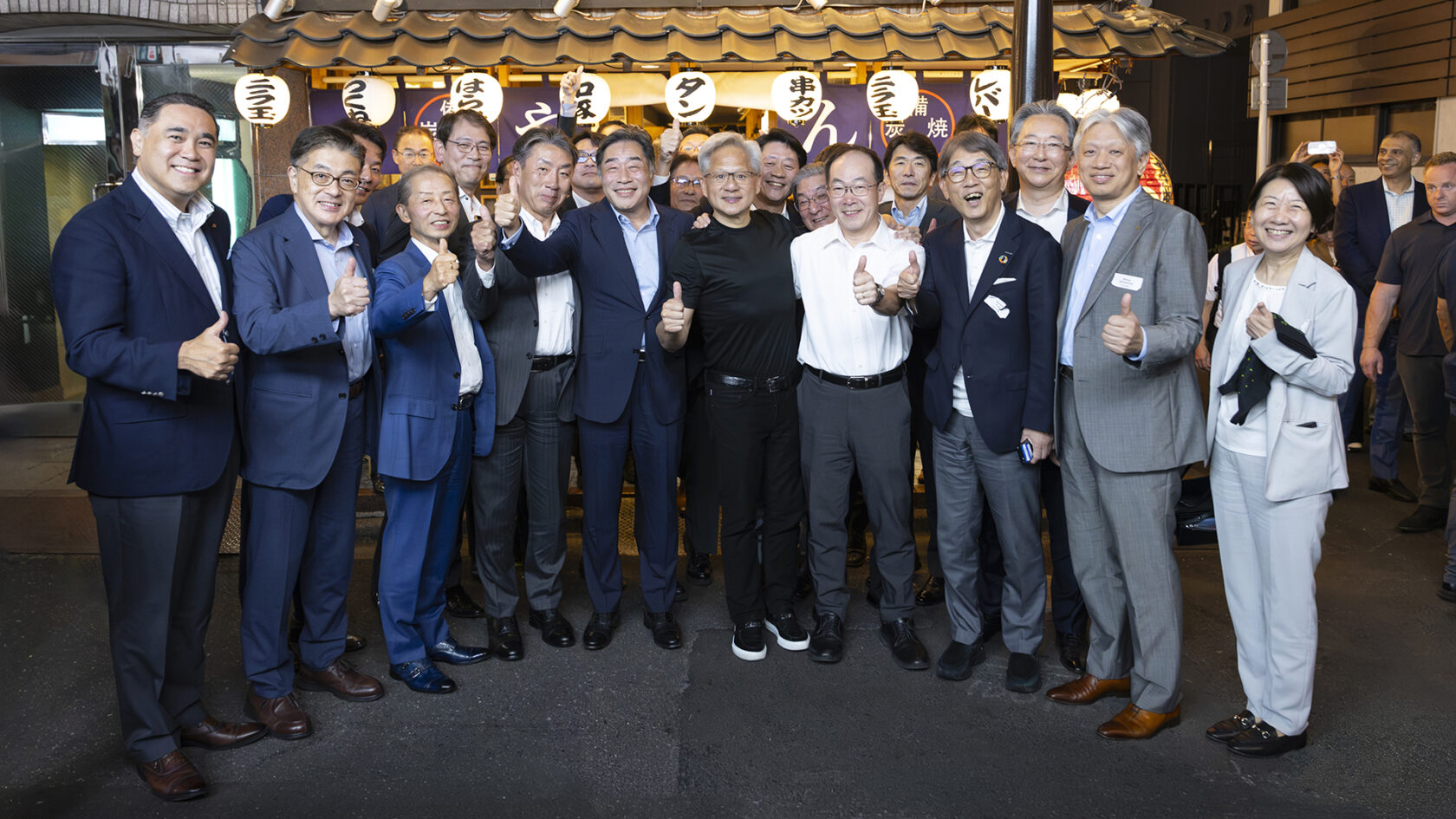
At an izakaya in Tokyo’s Kanda district, Huang hosted more than 30 senior executives from 16 of Japan’s premier supply chain companies spanning semiconductor equipment, memory, materials, and electronic components.
Over many skewers (there might have been beer too) leaders from ADVANTEST Corporation, Tokyo Electron (TEL), KYOCERA Corporation, Mitsubishi Electric, Murata Manufacturing, Panasonic, Renesas Electronics Corporation, Sumitomo Electric Industries, TAIYO YUDEN, TDK Corporation, Kioxia Corporation, Mitsui, Asahi Kasei, Nittobo, Shin-Etsu Chemical and Shibaura discussed building that AI-led future for Japan and the rest of the world.
CEOs Gather to Discuss Building Physical AI Into Japan’s Factories
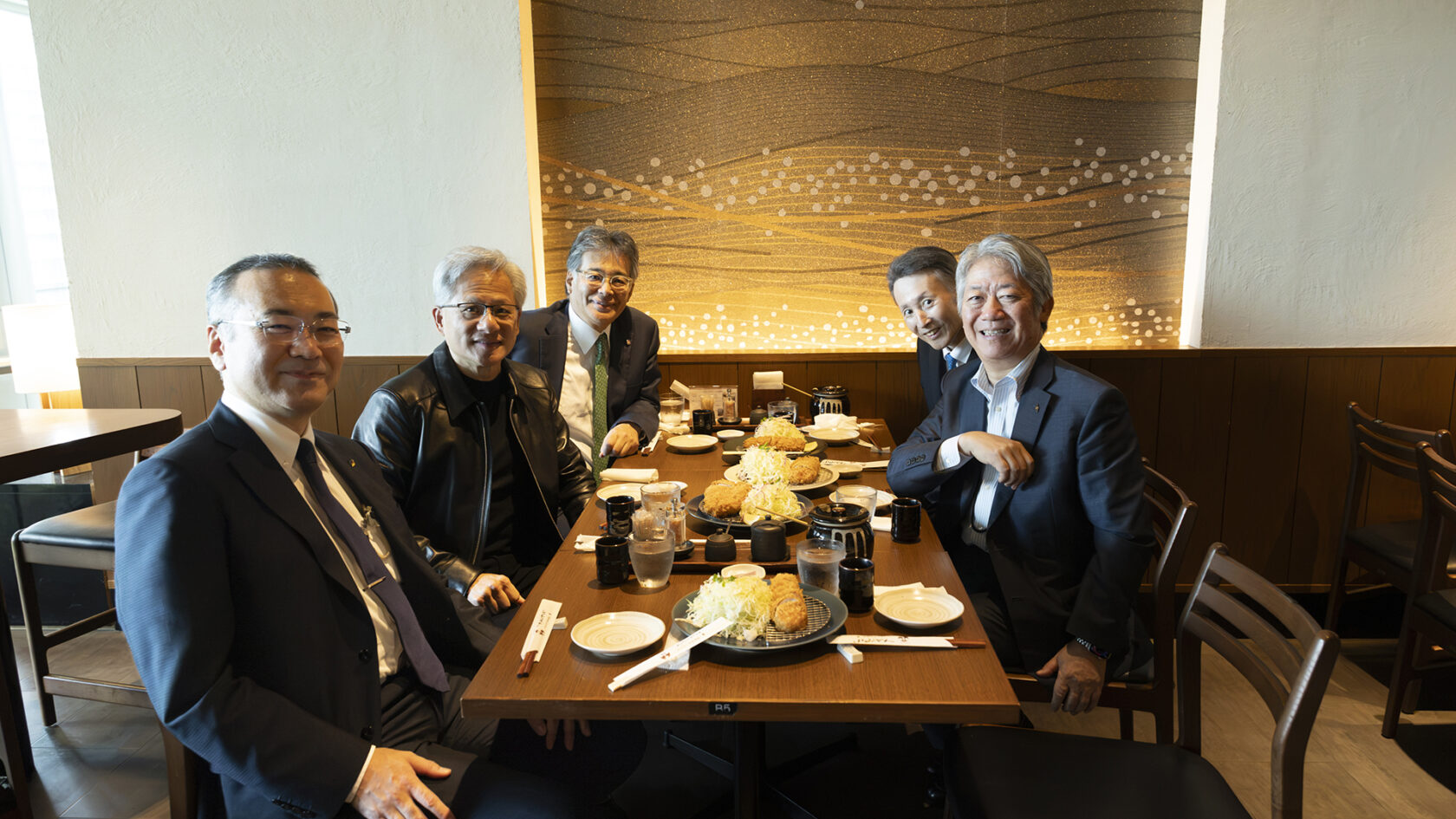
At Tokyo restaurant Tonkatsu Fumizen, Huang sat down for lunch Thursday with the CEOs of Fujitsu, Kawasaki Heavy Industries, FANUC and Yaskawa — four companies building robots and industrial systems that run in factories across Japan and the world.
These are the companies that will move physical AI from national ambition into the manufacturing floor. Fujitsu brings enterprise scale and AI infrastructure. Kawasaki, FANUC and Yaskawa are the robotics backbone of Japanese industry. Each is now building on the NVIDIA platform. Each is announcing its commitment to that path.
“Just before coming into this venue, the five of us enjoyed a wonderful tonkatsu lunch together,” said Takahito Tokita, the president and CEO of Fujitsu Limited, at a press event that followed. “Although we come from different countries and industries, we share the same values. We make business decisions not only for the benefit of our own companies, but also with the sustainable development of our industries and ultimately the world in mind.”
Japan’s Physical AI Initiative — A National Commitment
Prince Park Tower sits in the shadow of Tokyo Tower — the city’s most recognizable landmark. It was the right place for a national commitment.
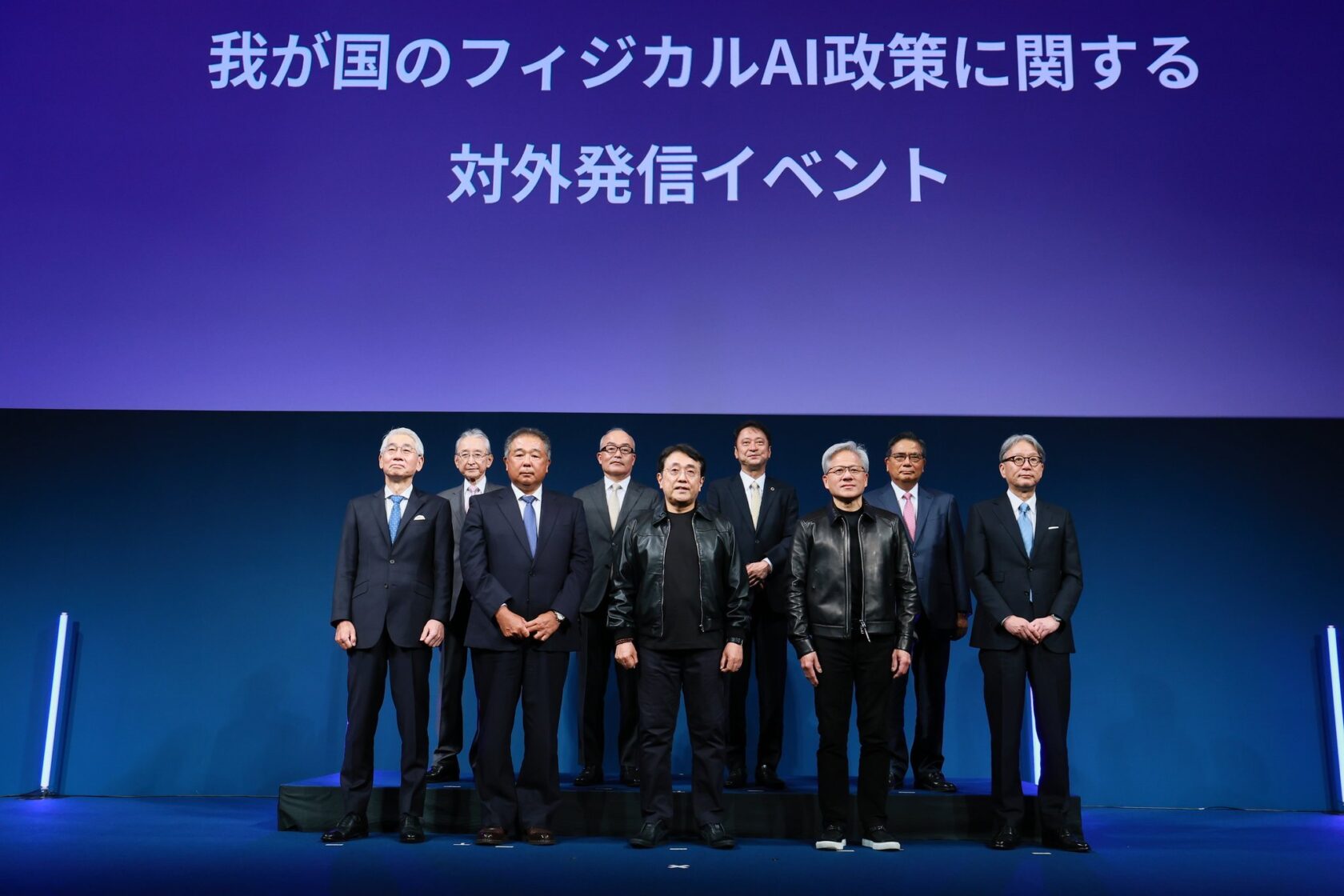
At the Physical AI Initiative kick-off event, NVIDIA CEO Jensen Huang joined Ryosei Akazawa, Japan’s Minister of Economy, Trade and Industry, as the country launched a government-backed physical AI initiative.
Bringing together manufacturing expertise, real-world industrial data and global technology leaders, the initiative will develop open multimodal foundation models for AI agents, digital twins, robotics and physical AI applications.
Japan’s AI Startup Ecosystem, Together in One Room
Later, Huang moved to Happo-en — meaning “beautiful from all angles” — a garden that has hosted gatherings of consequence for centuries.
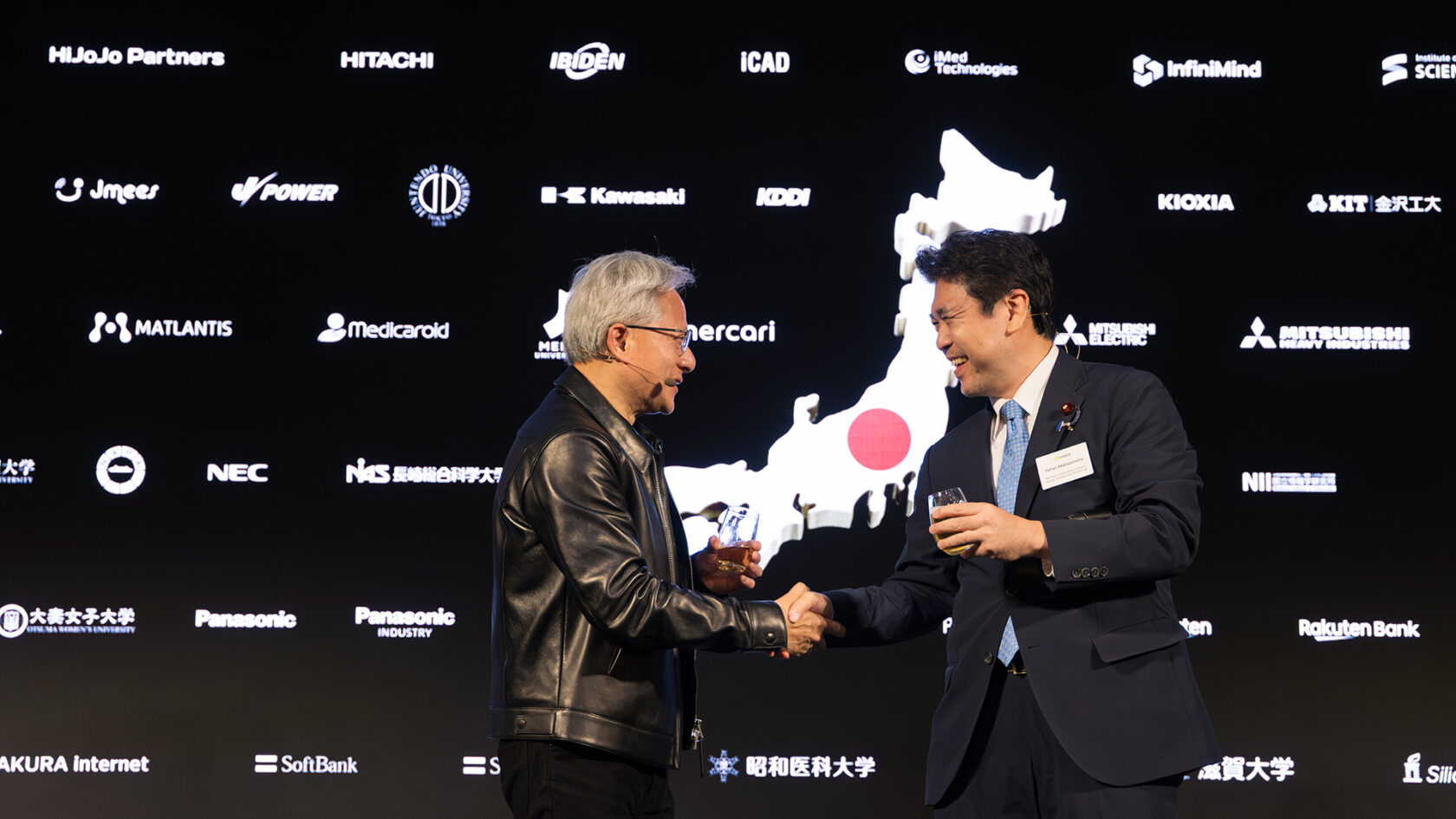
There, an NVIDIA Japan AI ecosystem celebration brought together startups, partners, government officials, policymakers and press for Huang’s remarks and a startup showcase.
Huang and Japan’s Minister of Education, Culture, Sports, Science and Technology offered a toast.
The room held the full arc of Japan’s AI ecosystem — from early-stage founders building on NVIDIA’s platform to the institutions shaping Japan’s AI policy.
SoftBank and NVIDIA Advance AI‑Native Network Collaboration
During his visit, Huang met with SoftBank Corp. President and CEO Junichi Miyakawa and the company’s leadership team to align on the next stage of their work on AI-native networks and physical AI in Japan.
The companies also confirmed joint initiatives to drive Japanese innovation using open models such as NVIDIA Nemotron, together with SB Intuitions’ homegrown generative AI model series Sarashina, while advancing physical AI with partners such as Yaskawa Electric Corporation using NVIDIA Cosmos and Isaac GR00T.
Japan’s Leaders Advance Healthcare and Life Sciences With NVIDIA Agentic and Physical AI
Japan built the world’s most trusted names in medical technology and biopharma. Now the country’s healthcare leaders are engineering the next generational leap with AI, powered by NVIDIA.
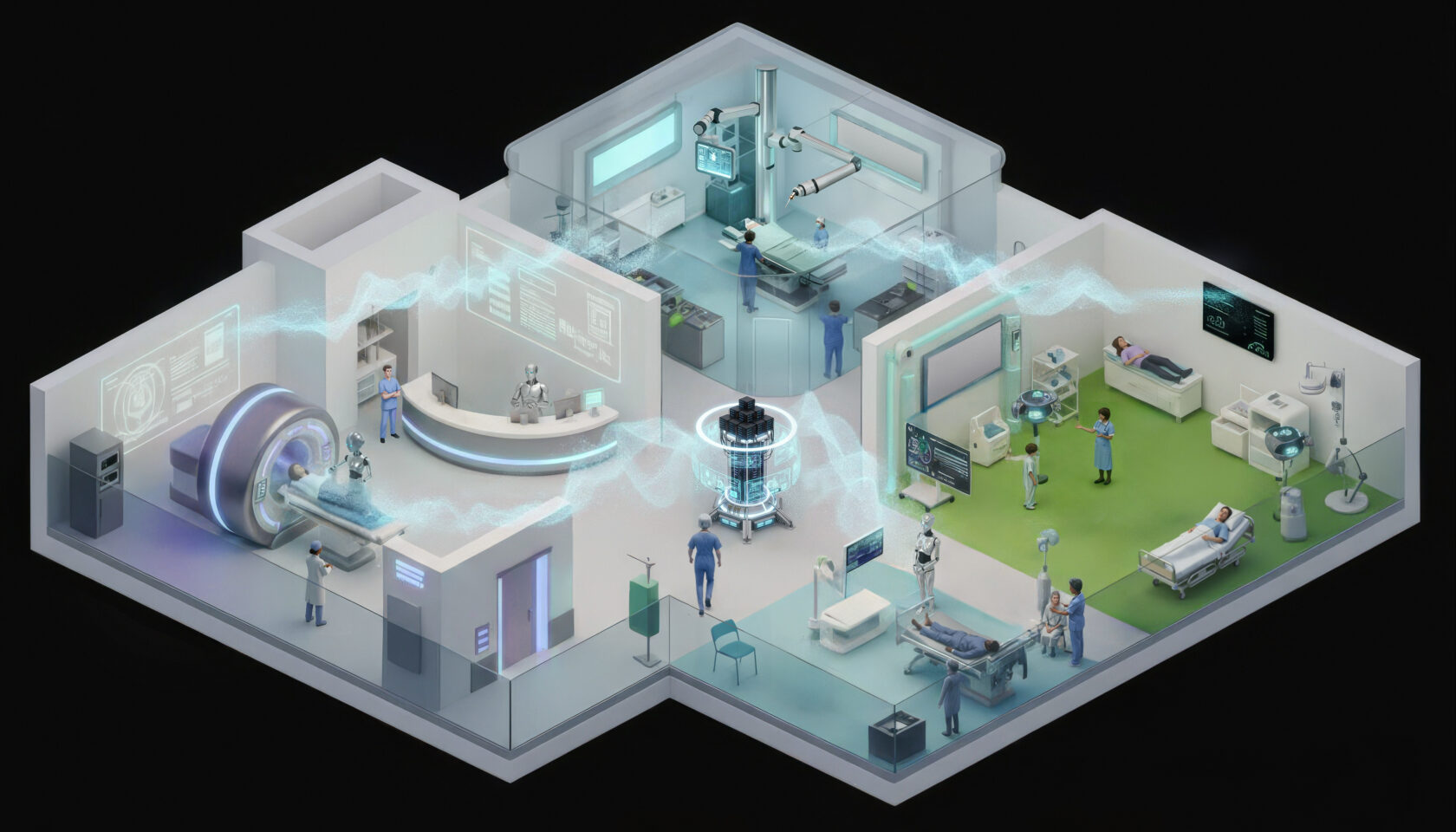
From autonomous surgical robots to AI-accelerated CT systems, and from agentic drug discovery platforms to virtual cell models, Japanese innovators are deploying NVIDIA technology to reshape medicine at every level.
Agentic AI Accelerates Japanese Drug Discovery
Japan’s pharmaceutical leaders are uniting around AI-powered drug discovery. Tokyo-1, the AI drug discovery consortium and platform operated by Xeureka, continues to expand, with Eisai joining this past April, bringing together leading pharma companies — Astellas, Daiichi Sankyo and Ono Pharmaceuticals — all advancing drug discovery using NVIDIA BioNeMo.
Astellas has deployed nearly all BioNeMo NIM microservices within NVIDIA’s digital biology portfolio and is running BioNeMo Agent Toolkit, NVIDIA’s open platform that turns any AI agent into an autonomous life sciences scientist. It gives AI agents, software platforms and biopharma systems immediate access to NVIDIA’s full life sciences stack.
Ono Pharmaceuticals is using the Boltz-2 NIM microservice to streamline and accelerate internal drug discovery. Daiichi Sankyo is conducting ultralarge-scale virtual screening on Tokyo-1 and leveraging NVIDIA RAPIDS to accelerate large-scale data processing. Xeureka is using NVIDIA BioNeMo to power its AI-driven drug discovery efforts, enabling researchers the flexibility to use the most appropriate models and tools across diverse discovery programs.
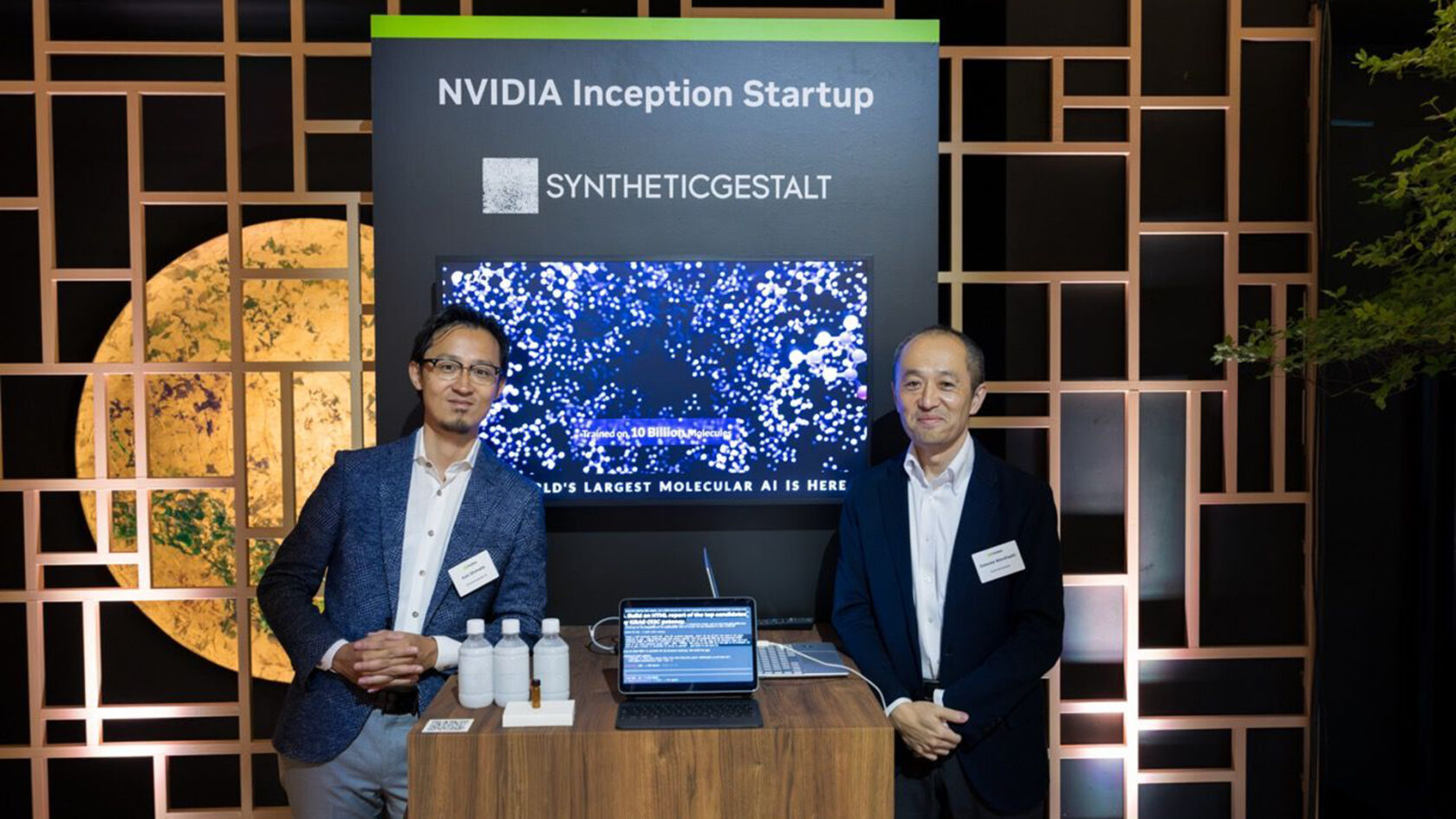
SyntheticGestalt announced two products: the molecular AI foundation model ZAO and the molecular generative model KOYA. ZAO is a foundation model that converts small molecules into data AI can use, through a “4D” representation that captures the multiple 3D conformations a molecule actually adopts; as a single general-purpose model, it ranked No. 1 on nine public drug-discovery benchmark tasks, achieving the world’s best performance.
KOYA is a molecular generative model that designs novel, high-affinity ligands for a target protein while closely reflecting the user’s intent. Both products can be called from the NVIDIA BioNeMo Agent Toolkit, enabling AI agents to carry out everything from evaluating molecules to designing them, and to accelerate drug discovery in collaboration with researchers.
Biomy is pioneering a virtual cell foundation model with a massive clinical dataset from the Japanese Foundation for Cancer Research. Using NVIDIA single-cell RAPIDS, Biomy achieved 90% faster spatial transcriptomics analysis. Biomy will use NVIDIA Nemotron-powered agents to autonomously propose and orchestrate complex virtual experiments for drug development.
Takeda recently announced a collaboration with Boltz to deploy the BoltzMol-1 and BoltzProt-1 biomolecular models across its research organization, giving scientists tools for structure prediction, affinity estimation and generative design that integrate into existing discovery workflows. NVIDIA accelerates these models through NVIDIA BioNeMo with libraries such as cuEquivariance.
Physical AI Enters the Operating Room
Kawasaki Heavy Industries provides technology designed to improve the overall efficiency of hospital operations, including with its FORRO, Nyokkey and NURABOT robots.
The company plans to use NVIDIA Holoscan IGX, Isaac for Healthcare, Isaac GR00T and Cosmos to develop surgical support functions, nursing assistant and hospital transport robots.
Direava is developing a surgical vision language model for real-time surgical video understanding and natural language interaction with surgical scenes. Direava aims to evolve this technology into an intelligence layer for future surgical AI and physical AI in the operating room.
Two of Japan’s leading medical imaging companies are now shipping next-generation CT systems built on NVIDIA GPUs.
Canon launched Japan’s first NVIDIA-accelerated photon-counting CT system, marking a step forward for the country’s next generation of medical imaging.
Fujifilm has commercialized Japan’s first whole-body CT system powered by NVIDIA Blackwell, using diffusion-based deep learning reconstruction to improve image quality.
The integration of AI and accelerated computing into medical imaging equipment contributes to improved image quality, enhanced accuracy, early detection and higher standards of medical care.
Together, these advances signal a new era: AI, and not just accelerated computing, is no longer an experiment in Japanese healthcare. It’s infrastructure.
NVIDIA Metropolis Provides Developers Agent-Ready Libraries to Build NVIDIA Cosmos-Powered Vision AI Agents Faster
As enterprises capture more video data across the physical world, vision AI is transforming beyond passive perception and dashboards into agentic systems that can understand, reason and act in real time. Powered by reasoning vision language models (VLMs) such as the NVIDIA Cosmos of open models, these agentic systems extract rich insights from video, whether on operations, environmental context or root causes for issues.
Japan’s industrial and smart-space leaders including Asilla, AWL, Fujitsu, Hitachi, OMRON, Shimizu Corporationand Yazaki North America are using Metropolis to bring vision AI agents into factories, construction sites, stories, buildings and public spaces.
Metropolis Open Libraries and Skills Span the Vision AI Lifecycle
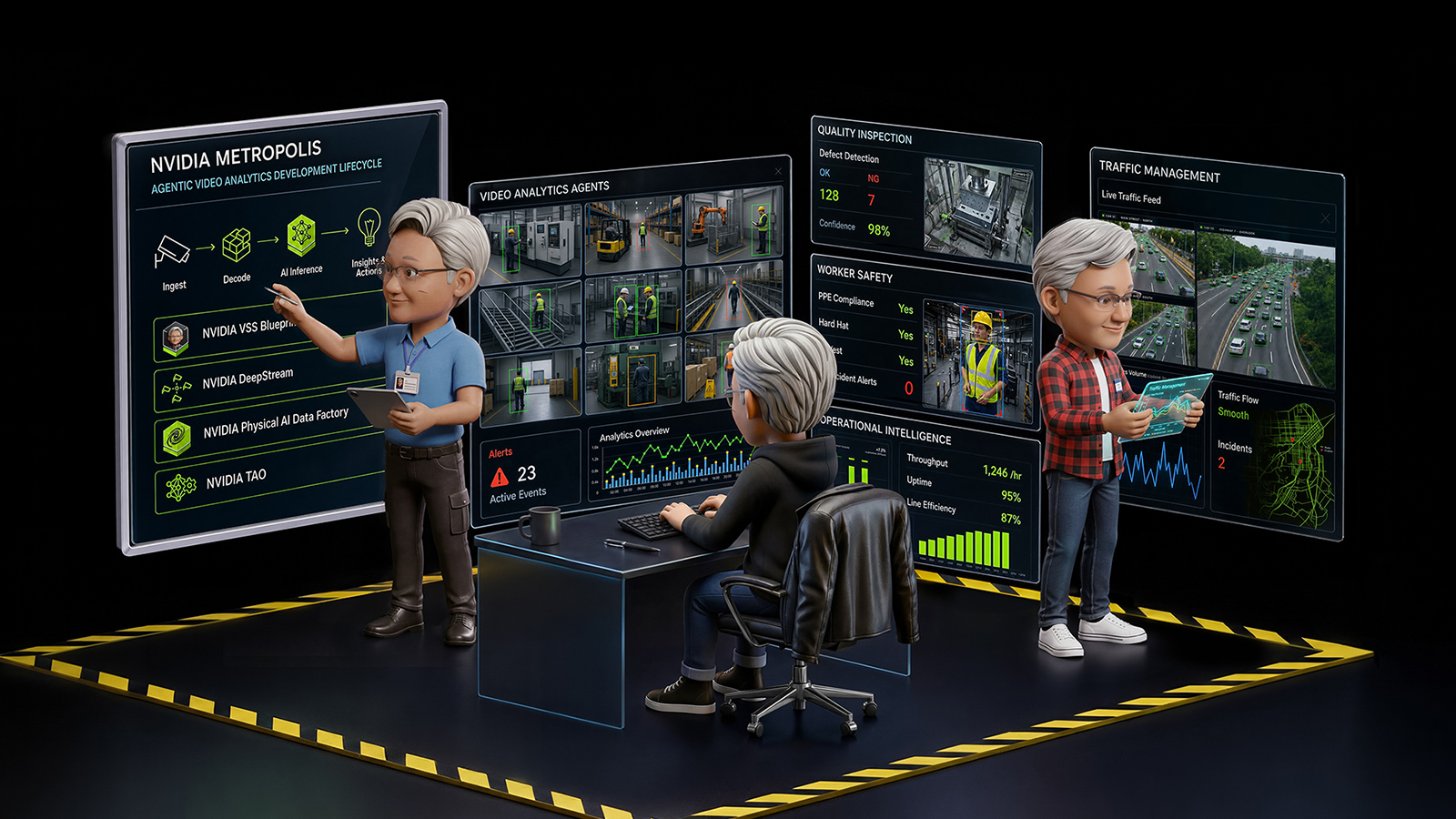
Metropolis provides a comprehensive set of open libraries and skills that span the entire vision AI development lifecycle, from creating data pipelines to generating synthetic data, fine-tuning models and deploying agents at scale.
New libraries include:
NVIDIA VSS Blueprint 3.2 helps developers build and operate vision AI agents that can see, reason and act over live or recorded video using natural language. New skills for coding agents make it faster to build and operate custom, always-on video agents that alert, summarize and search across large camera networks.
NVIDIA DeepStream 9.1 helps developers create and deploy real-time, multi-sensor video analytics pipelines from edge to cloud for large-scale ingestion, multi-camera tracking and operations analytics.
NVIDIA TAO 7 helps developers customize and optimize NVIDIA Cosmos and other vision AI models with agent skills for labeling, performance diagnostics, fine-tuning, data generation and automated machine learning.
NVIDIA Physical AI Data Factory skills help developers use NVIDIA Cosmos to automatically generate and augment synthetic image and video data to fill training gaps for rare or new product defects, environmental changes and other edge cases, pushing vision model accuracy to new levels.
Companies Advance Agentic Vision AI With NVIDIA Metropolis
Japan-based companies are using the new NVIDIA Metropolis technologies to bring real-time intelligence to physical operations.
For industrial inspection and operations, OMRON is enhancing automated inspections with VSS-powered video analytics agents.
DeepHow is helping Yazaki North America automate time and motion studies, reducing the current process from weeks to days and unlocking millions of dollars in annual savings.
For smart spaces and public transportation, several Hitachi HMAX solutions use VSS-powered agents to identify issues and generate actionable insights in buildings and rail infrastructure. FujitsuKozuchi AIplatform combines VSS with its Agentic Memory technology to transform long-duration video into operational knowledge, accelerating decision-making across manufacturing, logistics, retail and smart spaces. Meanwhile, Shimizu Corporationis piloting VSS for construction worker safety.
With DeepStream and VLMs, Asilla is monitoring public spaces and commercial facilities to detect incidents and improve response time, while AWL is building retail and manufacturing solutions with DeepStream.
Japanese Megabanks Build Financial Intelligence With NVIDIA Nemotron and NVIDIA Agent Toolkit
Across Japan, leading banks and financial technology companies are building AI factories and models to deliver financial intelligence. NVIDIA Nemotron open models and NVIDIA Agent Toolkit are helping them turn regulated financial data into valuable intelligence.
In banking, the most powerful AI applications may not look like chatbots. They look like safer payments, smarter fraud detection, faster software development and more personalized financial services, all built on trusted data.
Mizuho plans to build what is expected to be the largest on-premises AI factory in Japan’s financial industry, starting with NVIDIA DGX B200 systems and scaling toward a larger cluster. For a bank handling sensitive financial workloads, being on premises matters: it gives teams a foundation to develop agents with NVIDIA Agent Toolkit and NVIDIA NemoClaw blueprints, while keeping critical data close and secure.
With this secure foundation, Mizuho aims to safely expand the operational scope of these autonomous agents into core workflows, including information gathering, document creation, analysis and system development support, while ensuring rigorous governance and auditability.
As the core IT company of SMBC Group, the Japan Research Institute (JRI) deployed an AI factory to transform financial data into intelligence using NVIDIA Nemotron open models. As one of Japan’s largest financial groups, SMBC Group’s adoption shows how open models and accelerated infrastructure can help established institutions move AI from experimentation into production-ready enterprise workflows. The initiative serves as a foundation for scaling AI adoption across the SMBC Group, improving productivity, accelerating innovation and delivering better financial services to customers.
Rakuten Bank brings digital-native scale to the same transformation. Using the Rakuten Group’s ecosystem, which spans more than 70 services and includes over 18 million banking accounts, 33 million credit cards and 14 million brokerage accounts, Rakuten Bank will develop transaction foundation models built with NVIDIA Agent Toolkit, helping turn high-volume consumer financial data into specialized intelligence for banking services.
Ippu Senkin is collaborating with a financial institution to build sovereign financial intelligence with NVIDIA Blackwell GPUs and Local AI Agent, a local coding agent developed by Ippu Senkin using NVIDIA Agent Toolkit, Nemotron and NemoClaw for secure payment operations within the institution’s group. The effort points to a broader ecosystem motion with AI-native partners helping financial services companies build local agents and applications that can run on local AI factories.
Japan’s financial services industry is moving from model pilots to AI infrastructure that can support regulated, domain-specific intelligence. Banks need performance, governance and proximity to data; digital banks need model-building capacity at transaction scale; and AI-native partners need a platform for local financial agents.
NVIDIA provides a full stack across those paths, from accelerated computing and AI factory architecture to Nemotron open models and Agent Toolkit for building agents and specialized financial intelligence.
Learn more about how financial institutions are transforming financial data into intelligence with transaction foundation models.
NVIDIA Advances Japan’s World-Class Quantum and AI for Science Capabilities
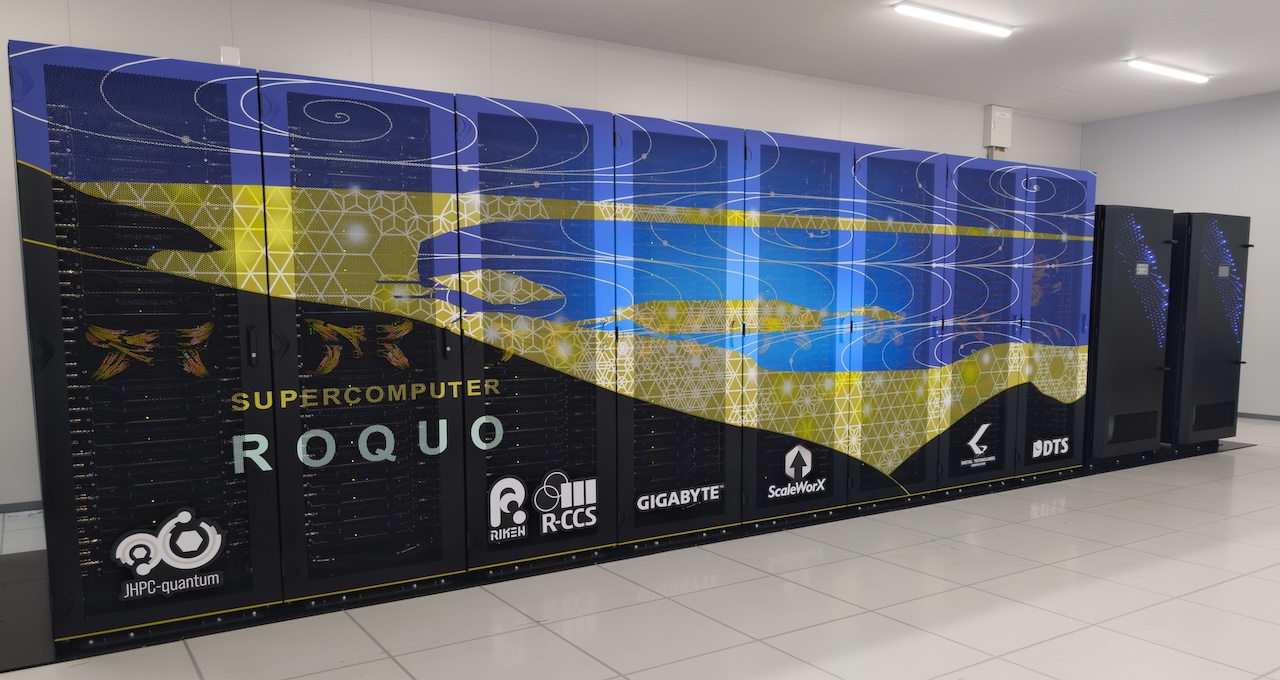
ROQUO supercomputer at RIKEN powered by 540 Blackwell GPUs and accessed through the GB200 NVL4 platform.
NVIDIA is advancing a historic partnership between the U.S. and Japan, its first international partner in the Genesis Mission.
Genesis Mission’s large-scale initiative to harness AI for scientific discovery calls on U.S. labs and industry, as well as international collaboration.
NVIDIA and Japan are answering the call — from AI to quantum computing.
NVIDIA and RIKEN Driving AI for Science
At RIKEN, Japan’s leading national comprehensive research institute, two supercomputers driven by NVIDIA GB200 and NVIDIA Quantum-X800 are beginning operations.
RIKYU, a new supercomputer for “AI for Science” development, deploying 1,600 NVIDIA Blackwell GPUs using the GB200 NVL4 platform, will support RIKEN’s development of open foundation models and contribute to accelerating AI adoption across broad fields, including life sciences, materials science and laboratory automation.
JHPC-quantum GPU supercomputer “ROQUO” is a quantum-HPC system tightly integrating quantum processors with accelerated computing from 540 Blackwell GPUs accessed through the GB200 NVL4 platform. ROQUO is connected to on-premises quantum computers at RIKEN’s facilities in Wako and Kobe, Japan — including Quantinuum’s trapped-ion Reimei system, enabling hybrid quantum-HPC workloads. In ROQUO’s first months of operation, researchers are beginning to explore an evolutionary AI framework, developed with NVIDIA and integrated with the NVIDIA CUDA-Q platform for quantum-classical computing, to generate quantum circuits for the Reimei system.
Building an Ecosystem That Brings AI to Quantum
AI is the unlocking technology for scaling quantum processors into useful quantum-GPU supercomputers, but the adoption of AI in quantum computing workflows remains a key challenge.
At the National Institute of Advanced Industrial Science and Technology’s (AIST)Global Research and Development Center for Business by Quantum-AI Technology (AIST G-QuAT), NVIDIA is working to bring state-of-the-art AI to the center’s current and future quantum processor systems. NVIDIA NVQLink provides the low-latency connection between GPUs and quantum processors, while NVIDIA Ising open models support automated QPU calibration and AI-based decoding for quantum error correction.
Advancing Quantum Chemistry
High-accuracy simulations of chemical systems are fundamental for next-generation research in areas such as materials science and drug discovery. AI approaches can expand what quantum algorithms are capable of, improving how these simulations scale.
Mitsubishi Chemical,Mizuho Bank,Keio University, AIST, the University of Toronto and NVIDIA have demonstrated an AI- and GPU-driven workflow for harnessing quantum processors in molecular spectral analysis — a key tool for understanding the electronic structure and properties of molecules and materials. NVIDIA GPUs achieved a 13.4x speedup for this workflow over CPU-only nodes. Accelerating this analysis lets researchers apply it more quickly to early targets, like extreme ultraviolet photoresist for semiconductor manufacturing.
Developing useful quantum chemistry applications also means building workflows suitable for tomorrow’s large-scale hybrid quantum-GPU supercomputing systems. Fujitsu and NVIDIA are now investigating efficient ways to use NVIDIA CUDA-Q for large-scale quantum-chemistry simulation. Through the collaboration, Fujitsu has started the trial of NVQLink to determine if it can be utilized to realize efficient control of their quantum-classical hybrid computing environment.
Together, the U.S. and Japan are building on the NVIDIA platform to develop a shared foundation for useful, large-scale quantum computing and AI-driven science, and uniting industry, academia and government.
NVIDIA Expands Partnership With Toyota to Advance Physical AI Across Automotive, Robotics and Cities
From self-driving cars to cities, the next era of mobility will be defined by AI-enabled systems that can perceive, reason and safely act in the physical world. Toyota and NVIDIA are working together to build that future — connecting AI across vehicles, infrastructure and industrial operations.
This builds on last year’s announcement that Toyota will develop next-generation vehicles with advanced driver-assistance capabilities (L2++) built on NVIDIA DRIVE AGX and running the safety-certified NVIDIA DriveOS operating system.
NVIDIA has enabled Toyota to tap into NVIDIA accelerated computing, AI software and simulation technologies to develop safer, more intelligent vehicles, optimize automotive engineering workflows, fine-tune factory operations and power urban intelligence systems, in support of the company’s vision for safer mobility.
“Physical AI will bring intelligence to every moving machine from cars, robots and trucks to the cities and factories they operate in,” said Rishi Dhall, vice president of automotive at NVIDIA. “Together, Toyota and NVIDIA are building the AI infrastructure for a new era of mobility, where vehicles can become more autonomous, manufacturing more AI-defined and urban environments more intelligent, responsive and safe.”
NVIDIA and Toyota’s latest work spans:
Accelerating safe, intelligent vehicles: Toyota is building next-generation vehicles with advanced driver assistance capabilities using NVIDIA DRIVE AGX running the safety-certified NVIDIA DriveOS operating system. These vehicles will deliver L2++ functionality, enabling more intelligent, context-aware driving while maintaining Toyota’s rigorous safety standards.
Software engineering: As vehicles become increasingly software-defined, Toyota is accelerating vehicle software engineering with a MISRA-compliant Code Assistant AI model, trained and fine-tuned using NVIDIA Megatron-LM, and referencing various datasets including NVIDIA Nemotron. By applying a custom automotive AI model to improve automotive-specific code generation and review, Toyota engineers can generate, review and validate safety-critical code more efficiently, accelerating development while adhering to stringent automotive compliance.
Factory simulation: Toyota is bringing simulation to the manufacturing floor using NVIDIA Omniverse libraries and the NVIDIA Isaac Sim open framework for factory and robotics workflows, robot movement simulation and broader digital twin environments to optimize manufacturing operations. This simulation-first approach reduces downtime, improves efficiency, lowers costs and enables continuous optimization across production environments.
Multimodal Vision Language Model: Woven by Toyota (a Toyota subsidiary) has developed a multimodal vision language model for urban traffic intelligence, using NVIDIA H100 Tensor Core GPUs and Megatron-Core. The model is designed to help interpret real-world conditions, anticipate what happens next and support responses across mobility and infrastructure systems.
NVIDIA and SEGA Celebrate 30 Years of Innovation, Bringing ‘VIRTUA FIGHTER CROSSROADS’ and Other Legendary SEGA Games to NVIDIA RTX Spark
NVIDIA and SEGA are celebrating more than three decades of collaboration by bringing VIRTUA FIGHTER CROSSROADS and future SEGA titles to NVIDIA RTX Spark — a new superchip for slim Windows laptops and compact desktop PCs.
This builds on the companies’ long-standing relationship, which began 30 years ago when NVIDIA worked with SEGA on burgeoning graphics technology for arcade systems and gaming consoles — with the NVIDIA NV1 chip powering the first Virtua Fighter title on PC, among the world’s first 3D fighting games.
SEGA will support RTX Spark, giving gamers new ways to experience SEGA’s iconic franchises, including the upcoming VIRTUA FIGHTER CROSSROADS.
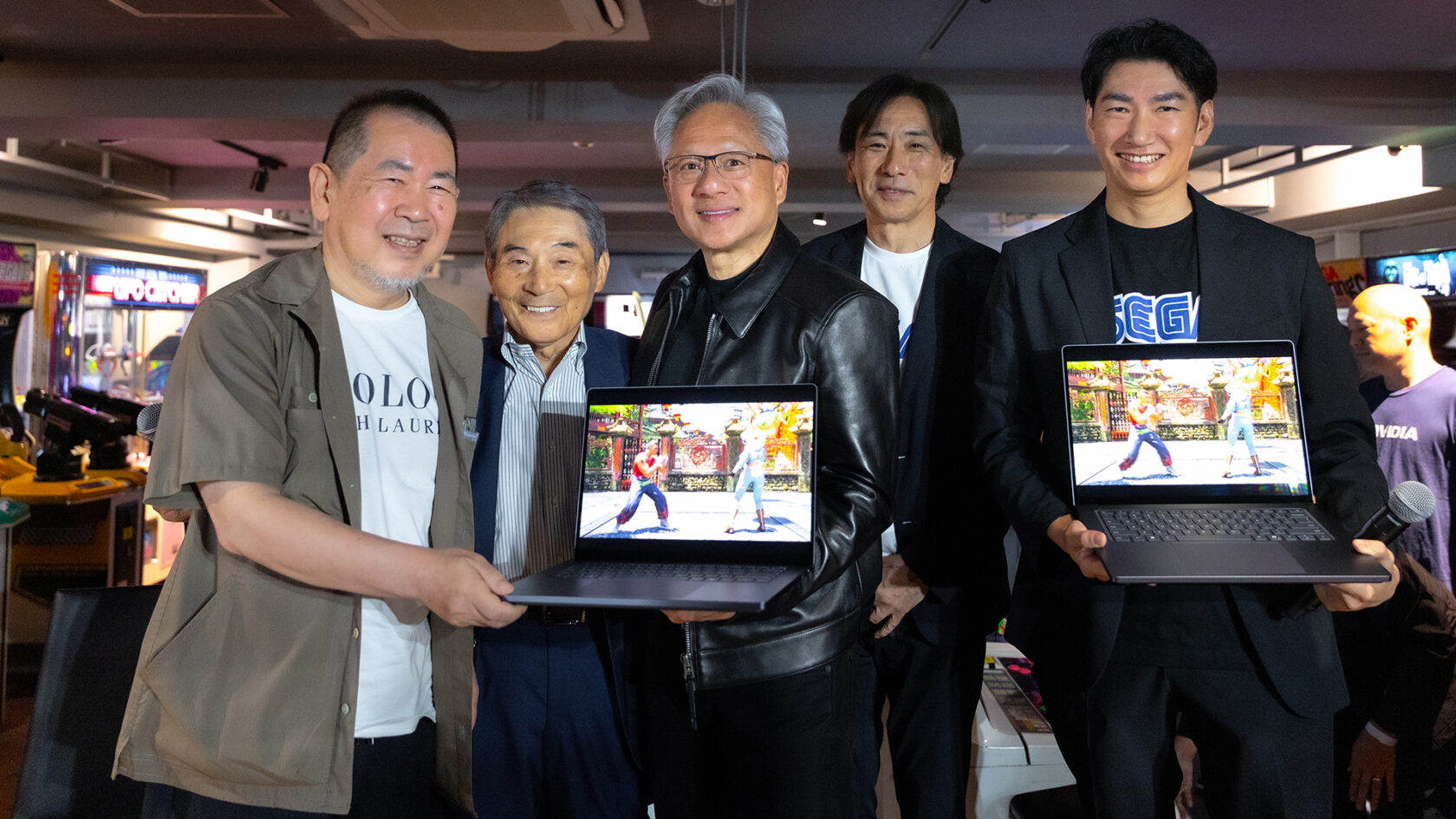
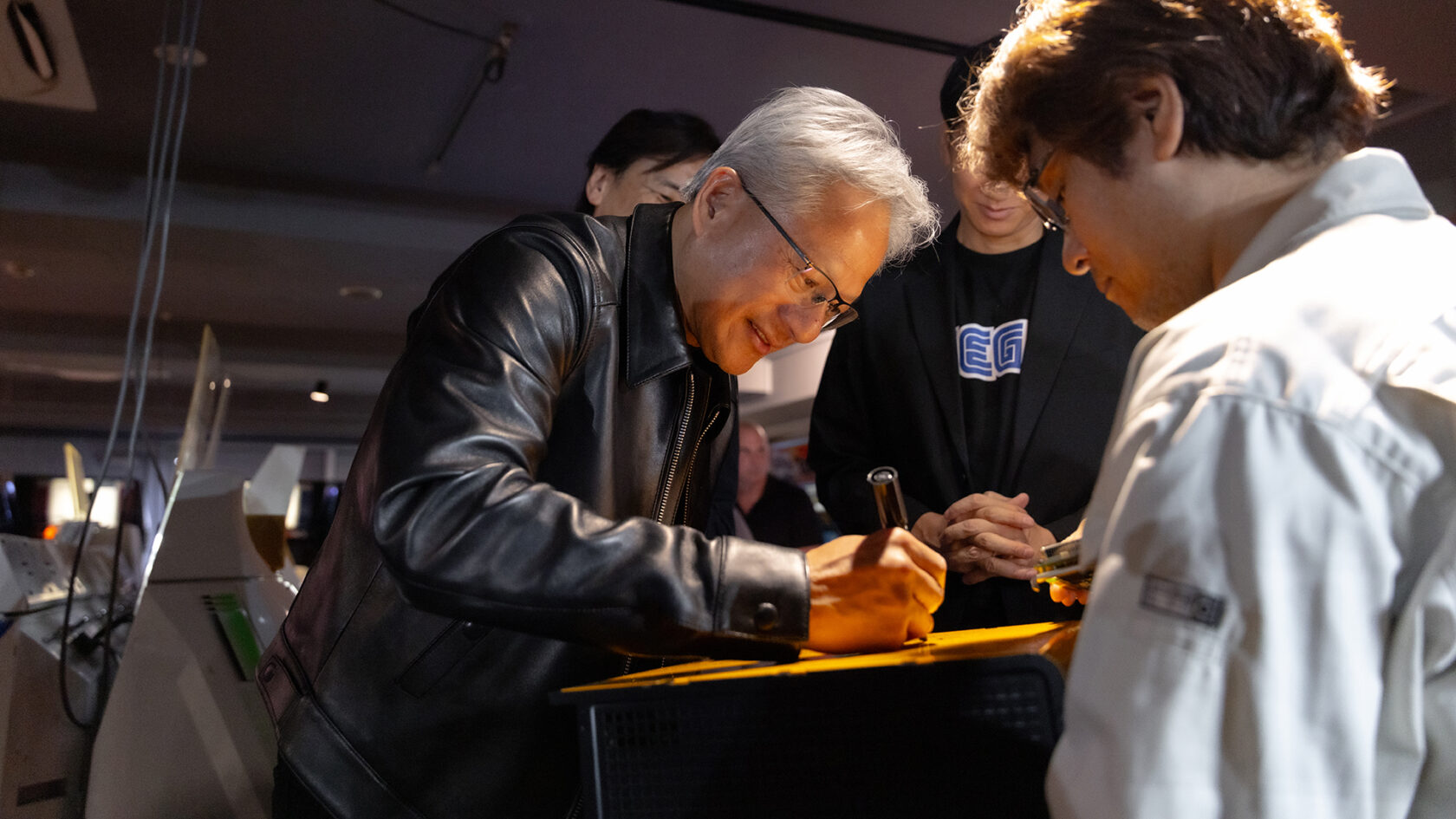
Announced from the heart of Akihabara, a global gaming technology hub, at the original SEGA Akihabara Arcade (now GiGO Akihabara 3), VIRTUA FIGHTER CROSSROADS coming to RTX Spark reinforces the companies’ commitment to innovation and shows a glimpse of the future of gaming on a new era of Windows PCs designed for personal agents, AI, creating and gaming.
NVIDIA founder and CEO Jensen Huang joined SEGA CEO Haruki Satomi; SEGA chief operating officer Shuji Utsumi; Yu Suzuki, creator of Virtua Fighter; and former SEGA President Shoichiro Irimajiri, at the birthplace of countless arcade memories to celebrate the milestone.
They showcased how technology partnerships can evolve across generations of hardware and software, connecting the gaming industry’s heritage with its future.
The expanding NVIDIA RTX Spark ecosystem — including SEGA and other industry leaders — will offer gamers new experiences harnessing NVIDIA ray tracing, DLSS and AI technologies, while preserving and celebrating the iconic franchises they know and love.
Why Performance per Watt Is the Ultimate Metric for AI Infrastructure Efficiency
From benchmark to production, NVIDIA Blackwell NVL72 delivers the highest performance per watt to maximize revenue and the lowest token cost to maximize profit margins.
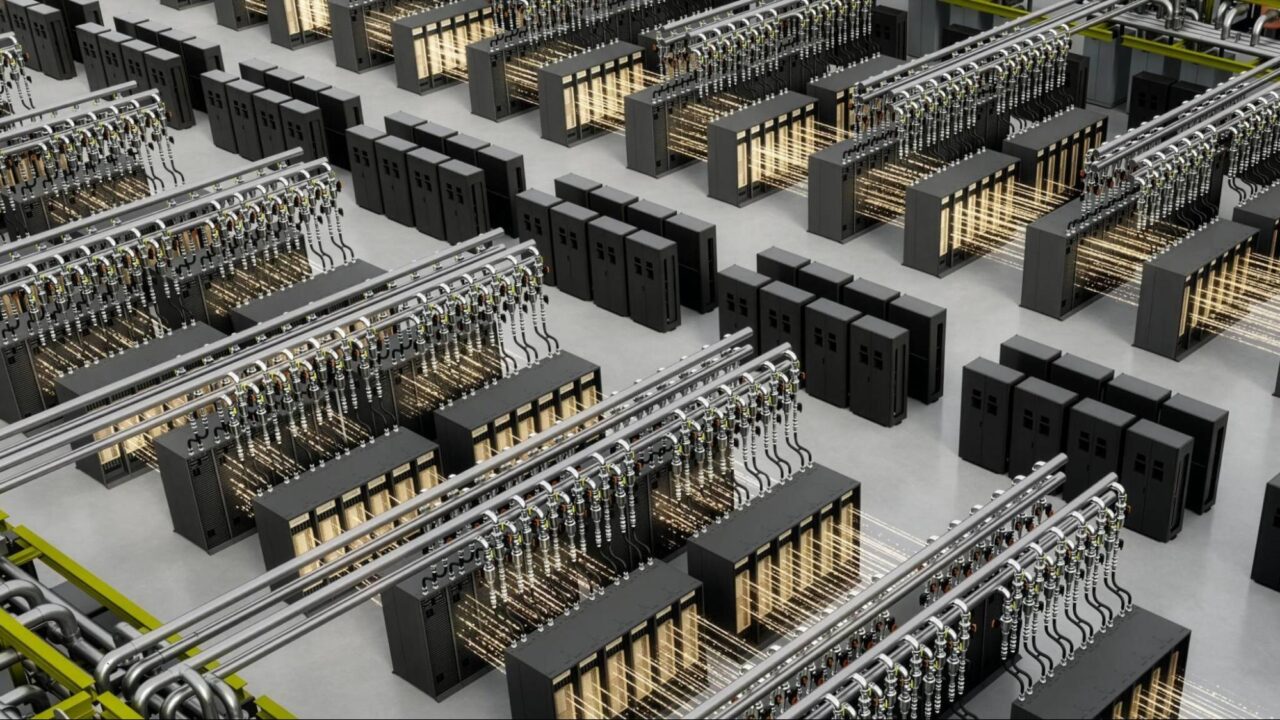
Power is AI infrastructure’s inescapable constraint. How many tokens an AI factory can generate within a fixed power budget determines its revenue and profitability. Because of this, performance per watt — a metric that can’t be gamed, only earned through real-world results — is the foundation for AI factories.
As agentic AI drives token demand higher, the infrastructure decisions organizations make today will determine who scales and who doesn’t in a power-constrained world.
Virtually every frontier AI model today runs on a mixture-of-experts (MoE) architecture. Serving these large-scale models efficiently means GPU domain size — the number of GPUs connected over an ultrafast, scale-up interconnect — matters, and bigger is better.
While the NVIDIA Hopper generation set the standard with an eight-GPU domain, the scale of frontier AI today has outgrown it. Serving MoE with a 72-GPU domain demands full-stack codesign and the operational depth earned from running these models under real production load.
With the NVIDIA Blackwell NVL72 platform, thatfoundation is already built and proven, delivering the highest performance per watt to maximize revenues and the lowest token cost to maximize profit margins. It’s this foundation that the NVIDIA Vera Rubin platform builds upon next to further elevate rack-scale energy efficiency.
Maximizing Performance per Watt for Frontier AI
Each new generation of frontier models brings architectural changes that unlock greater intelligence while demanding new optimizations to run efficiently at scale.
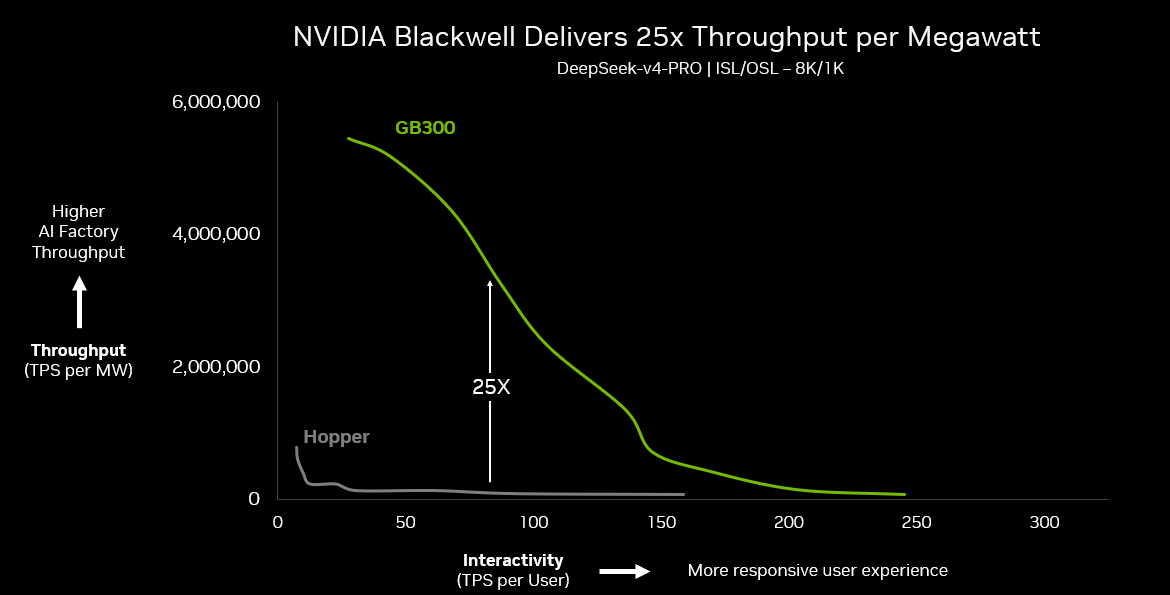
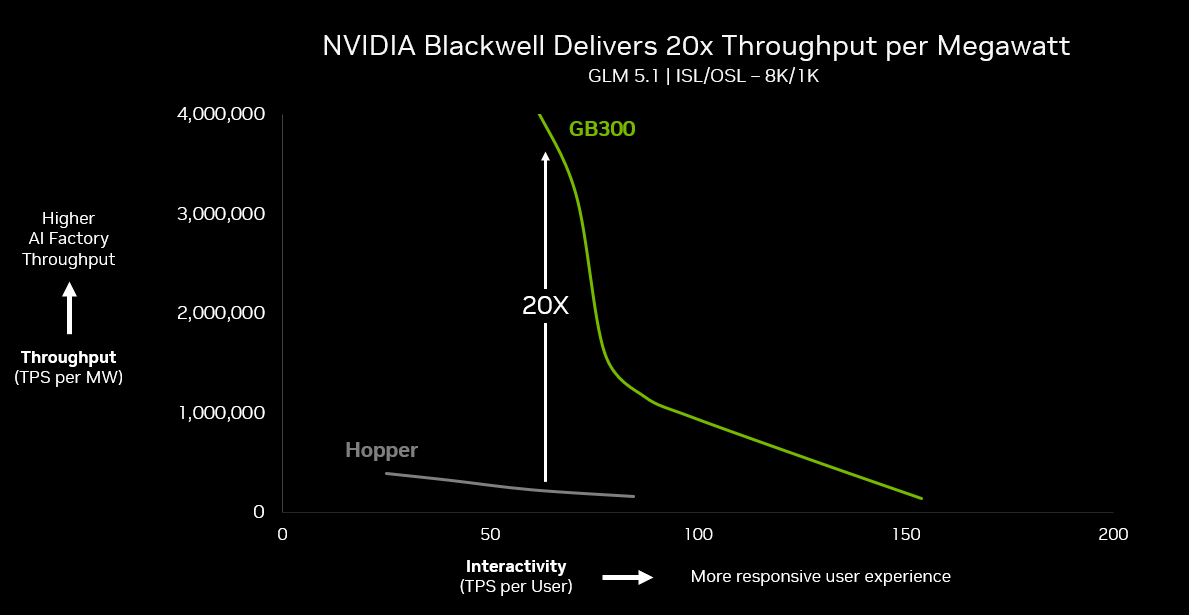
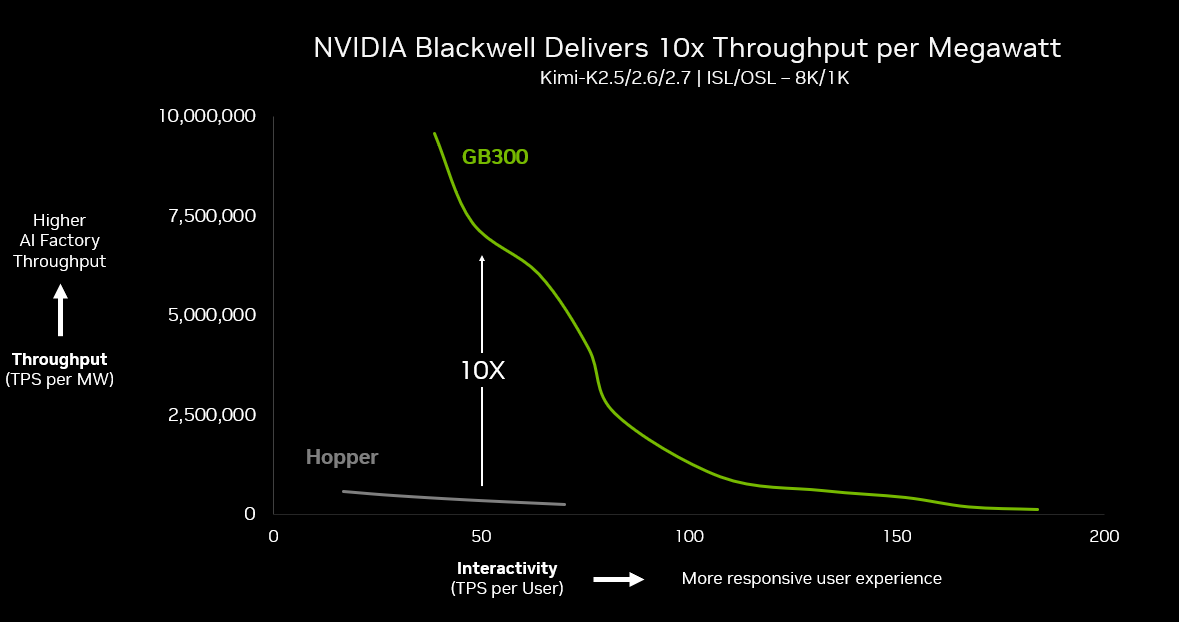
Across the newest generation of leading open models, NVIDIA GB300 NVL72 delivers up to 25x performance per watt compared with the NVIDIA Hopper generation — showcasing that MoE performance improves when moving from an 8-GPU to 72-GPU domain size. These numbers reflect where Blackwell stands today, a starting point that continues to improve.
Any single number only tells part of the story. Different workloads demand different operating points: some optimize for latency, others for throughput and cost — and most need to move between the two.
To best represent these operating points, NVIDIA showcases Pareto curves for each model rather than a single point and provides tools such as DynoSim to help teams find their optimal point on the Pareto frontier before spending a single GPU-hour on validation.
NVIDIA GB300 NVL72 systems deliver up to 25x performance per watt over NVIDIA Hopper on DeepSeek V4 Pro. Source: SemiAnalysis InferenceXOn GLM5.1 NVIDIA GB300 NVL72 systems deliver up to 20x performance per watt over NVIDIA Hopper. Source: SemiAnalysis InferenceXNVIDIA GB300 NVL72 systems deliver up to 10x performance per watt over NVIDIA Hopper for Kimi K2.6, a model purpose-built for long-horizon agentic tasks. Source: SemiAnalysis InferenceX
The performance per watt NVIDIA Blackwell delivers is a result of extreme codesign: every component of the rack-scale system, from silicon to software, designed together to maximize token throughput for AI inference workloads. That codesign touches every layer of the stack.
For example, NVIDIA NVLink Switch, critical for rack-scale performance, is purpose-built to unlock massive scale-up GPU domains, not adapted from general-purpose networking. Now in its sixth generation with the Vera Rubin platform, its capabilities are designed specifically for AI workloads such as SHARP, which performs in-network computing directly in the switch, offloading work from the GPUs themselves.
NVIDIA’s inference software stack, including NVIDIA Dynamo and TensorRT LLM, as well as SGLang and vLLM, is built to run the full range of optimizations: NVFP4 quantization, disaggregated serving, large-scale expert parallelism, KV-aware routing, KV cache offloading and more. These stack together to multiply the performance each GPU delivers. Moreover, software keeps improving performance over time: On DeepSeek V4, performance per watt improved by up to 5x in a single month.
In AI factories, power lost to cooling and rack-level inefficiencies can mean only about 60% of the electricity pulled from the grid turns into useful AI work. NVIDIA DSX MaxLPS, the power-and-efficiency software in the NVIDIA DSX platform, closes that gap by shifting power between GPUs and racks in real time, supporting warm-water liquid cooling and using techniques like power steering to wring more performance. This enables operators to run up to 40% more GPUs within the same power budget.
Production Is Where It Counts
Rack-scale reliability at AI factory scale is hard-won. Rack-scale systems introduce failure modes that single-node deployments never encounter, and handling them requires engineering rigor and time in production.
NVIDIA Blackwell NVL72 systems continues to set the standard across a diverse range of models and production use cases delivering sustained performance, rack-level reliability and economics that hold under real traffic day after day.
That’s why leading AI labs such as Anthropic, OpenAI and SpaceXAI use NVIDIA Blackwell NVL72 systems to run inference.
In addition, a variety of inference service providers and AI natives use the Blackwell platform to deploy open models in production.
CoreWeave has deployed Kimi K2.6 on NVIDIA GB300 NVL72, combining NVFP4 quantization and EAGLE3 speculative decoding to maximize inference performance.
Perplexity runs Qwen3 235Band post-trained Qwen3.5-397B-A17Bon NVIDIA GB200 NVL72 for its AI agent platform, serving millions of queries daily with the latency and reliability that consumers need.
Fireworks AI deploys GLM 5.2 on the NVIDIA Blackwell platform, enabling production deployments for customers including Cursor and Factory AI.
This accumulated production experience, built across generations of frontier models and real-world deployments, is what gives NVIDIA Vera Rubin its head start.