country_code

New GeForce RTX 40 Series Studio Laptops, Omniverse Updates Accelerate AI-Powered Content Creation ‘In the NVIDIA Studio’

NVIDIA Ada Lovelace architecture powers new high-performance, ultra-portable Studio laptops, plus additional Studio software updates for Broadcast, Canvas and new RTX Video Super Resolution feature unveiled at CES.
by

The future of content creation was on full display today during NVIDIA’s virtual special address at CES.

Fueled by powerful NVIDIA RTX technology and backed by the NVIDIA Studio platform for creators, a creative revolution is underway as a wave of 2D artists moves to 3D, video workflows move to real time and AI tools help artists create content faster.

For them, and the 110 million professional and hobbying PC creators, there’s NVIDIA Studio. It’s a platform for content creators that supercharges 110 creative apps with RTX GPUs, provides lasting stability with NVIDIA Studio Drivers, and includes a powerful suite of Studio apps — Omniverse, Canvas, Broadcast and RTX Remix.

Creators can access all of this with any RTX GPU, including the new 40 Series laptops and GeForce RTX 4070 Ti graphics cards, powered by the ultra-efficient Ada Lovelace GPU architecture, which were introduced today at CES.

The heartbeat of the Studio platform lies in NVIDIA Omniverse, a platform where creators can connect their 3D apps and collaborate in real time. Omniverse is expanding with Blender enhancements, a new suite of experimental generative AI tools for 3D artists and thousands of new, free Universal Scene Description (USD) assets available in the content browser in Omniverse Create.

Built on Omniverse, NVIDIA RTX Remix is a free modding platform to quickly create mods for classic games with full ray tracing, enhanced materials, DLSS 3 and NVIDIA Reflex. We’ve enabled two amazing community modders to bring RTX to Portal’s most famous mod, Portal Prelude, preserving the timeless gameplay, while relighting it with full ray tracing.

The NVIDIA Broadcast and Canvas apps, also in the exclusive Studio software suite, have upcoming upgrades. Broadcast is adding a new Eye Contact feature, and Canvas will introduce 360-degree images that can be used as environment maps in 3D apps.

Coming to GeForce RTX 40 and 30 Series GPUs next month, the RTX Video Super Resolution feature uses AI to improve the quality of any video watched in a browser by removing blocky compression artifacts and upscaling video resolution. This improves video sharpness and clarity, and lets people watch online content in its native resolution on high-resolution displays. RTX Video Super Resolution will be available in February for Chrome and Edge browsers.

And to celebrate CES, influential Blender artist CG Geek will take on a three-day design challenge, powered by NVIDIA Studio technologies. Plus, explore how seven freelance artists from across the world created an experimental short film together, in real time, using Studio hardware, Omniverse and the Nucleus Cloud — this week In the NVIDIA Studio.

From Concept to Completion, Faster With New NVIDIA Studio Laptops

GeForce RTX GPUs provide massive speedups in 3D, video and broadcast workflows, as well as a myriad of AI tools, thanks to dedicated ray tracing, AI and video-encoding hardware. New Studio laptops with GeForce RTX 40 Series Laptop GPUs use the NVIDIA Ada Lovelace architecture — with support for DLSS 3, AV1 and more — and fifth-generation Max-Q technologies for maximum performance and efficiency.

The new laptops provide a quantum leap in performance over the last generation, and a massive boost in efficiency that allows OEMs to include more powerful GPUs in thinner, more portable systems. NVIDIA Studio laptops are purpose-built for creators, with the right combination of hardware for creative workflows, color-accurate displays, and preinstalled Studio Drivers and Studio software.

The Razer Blade 16 is available with up to a GeForce RTX 4090 Laptop GPU.

The instantly recognizable Razer Blade laptop gets an RTX 40 Series upgrade with up to a GeForce RTX 4090 Laptop GPU. The 16-inch, HDR-capable, dual-mode, mini-LED display boasts 1,000 nits peak brightness, which pairs nicely with a Creator mode that enables sharp, ultra-high-definition+ native resolution at 120Hz.

The MSI Stealth 17 Studio A13V is available with up to a GeForce RTX 4090 Laptop GPU.

MSI’s Stealth series will launch with a wide range of Studio options. With 14- to 17-inch models and up to GeForce RTX 4090 Laptop GPUs, creators can pick the laptop that best suits their needs.

Powered by a GeForce RTX 4070 Laptop GPU, the ASUS Zenbook Pro 14 showcases a new level of performance for a 14-inch laptop.

The increased efficiency of RTX 40 Series Laptop GPUs and fifth-generation Max-Q Technologies deliver high performance to laptops as slim as 14 inches, with up to GeForce RTX 4070 Laptop GPUs, a new milestone. The ASUS Zenbook Pro 14 OLED is one example, with a GeForce RTX 4070 Laptop GPU in a super-thin 14-inch design, and accompanied by an all-new, cutting-edge 2.8K 120Hz OLED NanoEdge Dolby Vision display.

GeForce RTX 4070 Ti: 40 Series Benefits and Faster Than a 3090 Ti

For artists who prefer to create from their desktops, the new GeForce RTX 4070 Ti graphics cards, available starting Thursday, Jan. 5, offers incredible performance that’s up to 15% faster than a GeForce RTX 3090 Ti in 3D rendering. Like the RTX 4090 and 4080, the newest RTX 40 Series GPU features dual AV1 video encoders. When enabled in top video-editing and livestreaming apps — such as Adobe Premiere Pro (via the Voukoder plug-in), DaVinci Resolve, OBS and Jianying — export times are cut in half with improved video quality.

GeForce RTX 4070 Ti graphics cards.

3D creators see up to a 70% increase in performance compared to the GeForce RTX 3070 Ti in popular apps like Autodesk Maya, Blender, Chaos V-Ray, Epic Games Unreal Engine and Unity. Users can also unlock creative freedom by unifying 3D assets, libraries and tools in Omniverse.

And all creators can benefit from the new fourth-generation Tensor Cores for AI tools, providing up to 2x increased performance compared to the previous generation.

The January Studio Driver, supporting the GeForce RTX 4070 Ti launch, will be available for download later this week.

Create Easily With Studio Software

NVIDIA RTX GPUs unlock exclusive software for creators: Omniverse, RTX Remix, Canvas and Broadcast. They’re all getting upgrades early this year.

Based on the USD framework, Omniverse enables artists to connect their favorite tools from Adobe, Autodesk, Epic Games, SideFX and more. Creators can see their scenes instantly come together without lengthy import or export cycles. Changes happen in real time across the connected apps — whether a single artist is working in multiple apps simultaneously or collaborating with another artist from across the globe.

The Blender alpha branch release, part of a series of updates to Omniverse, is now available in the Omniverse Launcher. It enables users to repair geometry, generate automatic UVs and decimate high-resolution CAD data to more usable polycounts.

Performance updates to Audio2Face, Audio2Gesture and Audio2Emotion — powerful AI tools within Omniverse — better enable instant, realistic animation of characters. The AI ToyBox of experimental tools is now available in the Omniverse Extension Manager. Thousands of new, free 3D assets have also been made available worldwide for users to build and create within Omniverse.

‘Portal: Prelude RTX’ is coming soon to mod sites ModDB and Nexus Mods.

RTX Remix, which is built on Omniverse and was used to create the jaw-dropping Portal with RTX, is approaching its early-access release. Nicolas “NykO18” Grevet — the original creator of Portal: Prelude — is using RTX Remix to remaster his unofficial Portal prequel from 2008. Grevet is working with modder David “Kralich” Driver-Gomm to modernize the assets and relight the game with stunning, full ray tracing. Portal: Prelude RTX will soon become free to download from mod sites like ModDB and Nexus Mods.

Canvas allows creators to paint by material, rather than color, using simple brushstrokes and AI to quickly conceptualize a beautiful image. Canvas is getting a new 360 image feature, which will become available in an upcoming free update for RTX users, helping artists create panoramic scenes and export them into any 3D app to use as an environment map. Such maps are used to change the ambient lighting of a 3D scene and appear in reflections for added realism.

Later this month, Broadcast will add a new Eye Contact feature that can change the position of the subject’s eyes to appear focused on the camera, as well as a new vignette effect. The update also improves the popular virtual background feature, adding temporal information for increased stability. The virtual background improvements can also be found in the recent OBS Studio 29.0 software release, and will be updated SDKs for developers later this week.

3D Need for Speed

To showcase the speed at which Studio creators flow, talented 3D artist CG Geek has been challenged to create an animated Blender scene during CES. He’ll have just three days, starting Thursday, Jan. 5, to blitz through tough, typically time-consuming tasks.

He’s equipped with a GeForce RTX 4090 GPU, RTX acceleration and AI features throughout his entire workflow.

Follow his progress on his YouTube channel or NVIDIA Studio profiles on Instagram and Twitter. Look for the final render and a deep dive on his process in next week’s In the NVIDIA Studio blog.

In the NVIDIA Studio With Omniverse

Several 3D creators, including In the NVIDIA Studio artist Jae Solina, are showcasing the collaborative elements of Omniverse. Ashley Goldstein, Edward McEvenue, Jeremy Lightcap, Pekka Varis, Rafi Nizam and Shangyu Wang joined Solina — each using their favorite 3D tools, NVIDIA Studio laptops, new GeForce RTX GPUs and Omniverse Nucleus Cloud — to build an experimental short film together in real time.

The group started by pulling in a pair of Nizam’s characters: “3D” built in ShapesXR and “Figgy” in Maya. Both were dropped into Omniverse seamlessly as USD files. Prompted by Lightcap, Nizam added knitted textures to “3D” using Adobe Substance 3D Painter, and the group immediately saw this through the cloud.

Solina then offered to help with motion capture using Xsens. As he added the rigging, Lightcap brought in a background created in Blender. Lightcap noted that “RTX is insane,” as his animated western landscape rendered nearly instantly.

Anticipation for precipitation, McEvenue’s Houdini-based rainy day simulation.

With the scene coming together, Varis changed lighting elements, looking to make things “more epic,” he said. To incorporate a storm into the scene, McEvenue added a rain simulation created in Houdini. The film’s characters make a quick escape, hijacking the hot air balloon of Toy Jensen, the AI avatar of NVIDIA founder and CEO Jensen Huang.

For the ascent, Goldstein used her GeForce RTX 4090 GPU to add steam thrusters using OmniGraph.

With the characters now in outer space, Wang imported a satellite created in Autodesk Maya. The scene concludes as the space adventurers take off for Jupiter.

While showcasing their talents, these 3D artists displayed the capabilities of the NVIDIA Studio platform. Powerful RTX GPUs, acceleration in popular 3D apps and exclusive Omniverse software that enabled collaboration from all over the world in real time.

The future of creativity is shining bright. And the NVIDIA Studio ecosystem is lighting the scene.

Download monthly NVIDIA Studio Drivers for the latest reliability and performance improvements. Access tutorials and more on the Studio YouTube channel; follow Studio on Instagram, Twitter and Facebook; and get updates directly in your inbox by subscribing to the Studio newsletter.
Vera Delivers the Best of Both Worlds: Highest Throughput and Fastest Agents

by

AI agents do more than generate answers. They search for information, query databases, write and test code and take action. 

Each of those steps relies on a CPU, with agents moving between GPU reasoning and CPU execution throughout a task. 

As businesses put more agents to work, AI factories need CPUs that can execute those steps quickly and support many agents at once, all within the limits of available power.

What this means: AI infrastructure providers need to support more agents without making each one wait longer to get work done. And critically, AI factories are power limited. This means operators need to choose infrastructure that maximizes the work done for every watt. 

Why it matters: NVIDIA Vera delivers both fast agent performance and high capacity per watt within a single CPU. That gives providers one CPU for a range of agent workloads, rather than having to mix and match fast and dense x86 parts to balance speed and capacity.

The data that proves it: In a 100-megawatt data center comparison, NVIDIA found that a single Vera CPU performs better than the fastest x86 CPU and the most energy-efficient x86 CPU.

  • Vera delivers industry-leading agent speed while enabling 1.6x more agents per watt versus the fastest x86 CPU.
  • Vera delivers 2x faster agent speed with leading energy efficiency compared with the most energy-efficient x86 CPU.

Partners are already putting Vera to work. Early adopters see the same exceptional performance in production-style tests:

  • Perplexity: Ran agentic coding tasks 1.5x faster with Vera than on traditional CPUs. Perplexity plans to deploy Vera in an upcoming production system.
  • DeepInfra: Delivered up to 2.2x speed of the best x86 processor on agentic orchestration for its production agent workload, achieving the fastest of the four architectures tested.
  • ClickHouse: Its standard binary, with no Vera-specific tuning, scaled near-linearly across 176 cores and topped the ClickBench hardware leaderboard.
  • DuckLabs: Achieved about 1.5x the median TPC-H SF1000 performance of an Intel Xeon 6 baseline.
  • Daytona: Brought 1,000 agent sandboxes online in 10.8 seconds, and achieved 12.7 completed jobs per second at 2,000 concurrent sandboxes, using Vera versus 88.4 seconds with x86.
  • Modal: Achieved up to 2x sandbox throughput per core versus comparable x86 hardware, with gains that grow under heavy load.

Learn more about the NVIDIA Vera CPU.

Building Trusted AI Infrastructure for Safe and Secure AI

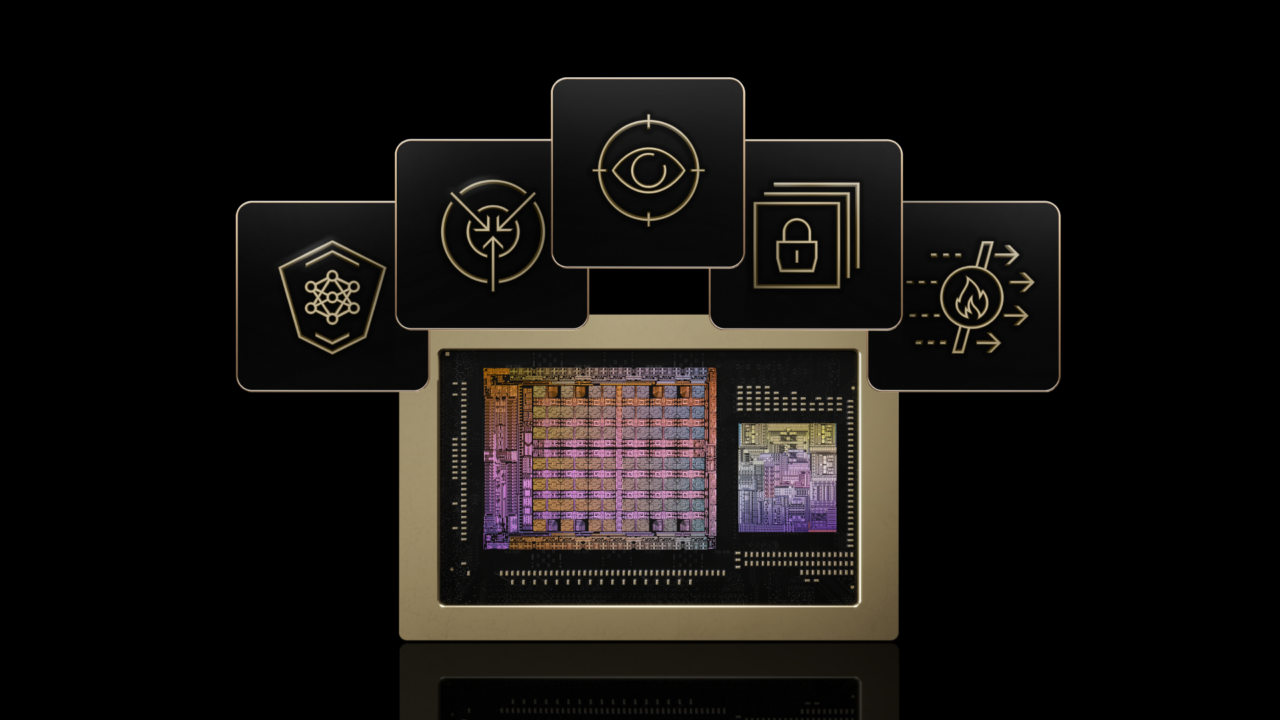
NVIDIA and cybersecurity partner Eclypsium are advancing infrastructure security for cloud computing and agentic AI with NVIDIA BlueField and Eclypsium infrastructure assurance.
by

AI is transforming how organizations build applications, process information and automate decisions. As AI agents become increasingly autonomous, access sensitive data, interact with tools and take actions across enterprise systems, securing the infrastructure that powers them becomes more important than ever.

AI security extends beyond models and applications. It encompasses the compute, networking, storage, firmware and management systems that execute workloads and enforce security controls.

Trusted AI must therefore be anchored in trusted infrastructure. That means moving from assumed trust to verifiable trust: evidence that critical infrastructure is in a known-good state, remains correctly configured and has not drifted because of vulnerabilities, unauthorized modifications, supply-chain compromise or persistent threats.

NVIDIA and cybersecurity partner Eclypsium are advancing infrastructure security for cloud computing and agentic AI

NVIDIA’s built-in platform protections and Eclypsium’s infrastructure provide the trust layer for building and maintaining trust in the infrastructure powering AI. The result is a stronger chain of trust, from verified hardware and firmware to independently enforced AI agent execution.

NVIDIA BlueField DPUs provide a foundation for securing this infrastructure, combining programmable acceleration with hardware-rooted trust, isolation and configurable security boundaries. Every cloud provider builds their infrastructure around DPUs. These capabilities help cloud providers and enterprises build secure, scalable infrastructure tailored to their operational requirements.

A growing cybersecurity ecosystem extends this foundation with additional capabilities. Eclypsium brings expertise in continuous infrastructure security, firmware integrity assessment, configuration analysis and monitoring, helping organizations strengthen visibility and operational assurance across their environments.

Security by Design With NVIDIA BlueField 

Modern cloud and AI infrastructure relies on specialized processors that accelerate networking, storage, security and management.

NVIDIA BlueField DPUs combine high-performance networking, programmable computing and in-silicon acceleration to run critical infrastructure services independently of host workloads.

This separation establishes distinct trust domains, allowing infrastructure operators to manage and protect underlying resources independently of the applications and operating systems running on their servers.

BlueField runs NVIDIA Sentry, part of the NVIDIA OpenShell Reference Architecture. This role in protecting autonomous AI agents makes securing the DPU increasingly important. BlueField has dedicated Arm CPU cores, an operating system, firmware and a management controller, and it moves data directly into host and GPU memory as part of its normal function. That privileged position makes BlueField an effective independent control point, and is why the DPU belongs in every operator’s security model, asset inventory and monitoring.

BlueField is engineered with defense in depth, beginning with a hardware root of trust and extending across firmware, operating systems, software and device management.

Its security architecture incorporates authenticated boot, hardware-enforced isolation, protected key management, secure firmware updates, rollback protection and device attestation. These mechanisms work together to protect platform integrity and enforce security boundaries.

Security also extends throughout the product lifecycle. NVIDIA follows rigorous secure development practices, including threat modeling, architecture and code reviews, automated security analysis, vulnerability management, fuzzing and offensive security research.

No complex computing platform is immune to vulnerabilities. That’s why NVIDIA maintains a continuous commitment to security engineering, vulnerability response and software and firmware updates throughout the supported product lifecycle.

Configurable Security for Different Infrastructure Trust Models

No two infrastructure environments have identical security requirements.

A hyperscale cloud supporting multiple tenants operates under different trust assumptions than a single-tenant enterprise AI cluster or an air-gapped AI environment.

These differences influence how administrative privileges, management interfaces, device access and isolation boundaries should be configured.

A defining advantage of DPUs is their combination of in-silicon acceleration and programmable computing. Unlike conventional high-speed network adapters, DPUs provide dedicated compute resources capable of running sophisticated infrastructure services and policies independently of the host.

NVIDIA BlueField uses this programmability to support different deployment models through configurable security boundaries. Operators can determine which capabilities to enable, how interfaces are exposed and how infrastructure access is controlled.

For example, a cloud provider can place tenant workloads and the host operating system in one trust domain while operating infrastructure services in a separate domain controlled by the provider.

BlueField supports configurations that can be locked into cryptographically attestable trust profiles, helping operators establish and verify intended security boundaries.

The presence of a capability or interface does not mean every deployment must expose or enable it. Secure infrastructure design requires defining the appropriate trust model and configuring the platform accordingly.     

Memory-access protections are an important example. DPUs, GPUs and management controllers can read and write system memory directly through direct memory access. Eclypsium’s research demonstrates the importance of host controls such as IOMMU translation, PCIe access control services and address translation services. Eclypsium enables operators to verify the configuration of critical hardware settings rather than assume it. 

This flexibility enables organizations to balance security, performance and operational requirements without imposing a one-size-fits-all architecture.

Extending Infrastructure Security Through the Ecosystem

Security capabilities built into infrastructure provide the foundation for protection. Cybersecurity partners can build on that foundation to address additional operational requirements.

Eclypsium brings complementary capabilities focused on infrastructure visibility, firmware integrity, configuration assessment and ongoing monitoring. Eclypsium AI Infrastructure Assurance verifies hardware and firmware against known-good baselines, identifies vulnerabilities and insecure configurations, monitors device and firmware posture, and detects drift, unauthorized modifications and persistent threats below the operating system.

For organizations seeking visibility across their environments, Eclypsium’s technologies can help identify infrastructure components, assess firmware, and detect threats, malware, vulnerabilities and configuration risks, as well as changes that may affect their security posture.

These capabilities give operators additional tools to evaluate and manage infrastructure security. Together, these capabilities independently check hardware integrity and establish trust in the underlying infrastructure based on verifiable evidence.

For example, an organization can establish an approved infrastructure configuration during deployment, use BlueField’s built-in security mechanisms to protect platform integrity and use Eclypsium’s assessment capabilities to identify unexpected configuration changes or emerging firmware risks.

The value extends beyond any single device. Modern AI infrastructure includes GPUs, DPUs, management controllers, networking equipment and other components, each contributing to the overall security posture.

Eclypsium’s broader infrastructure assessment capabilities can help organizations maintain visibility across these components as environments grow and evolve.

No single security control can establish trust across the entire AI stack. Defense in depth requires platform security, independent verification and continuous assurance working together, each providing evidence that the other layers are operating on a trusted foundation. BlueField provides security by design, while Eclypsium provides additional verification and monitoring across AI infrastructure.

Maintaining Security Throughout the Infrastructure Lifecycle

Infrastructure security does not end when a system enters production.

Devices move through manufacturing, provisioning, deployment, operation, updates, recovery, and eventual reassignment or decommissioning. Each transition introduces operational considerations that organizations must manage.

BlueField incorporates security protections throughout these stages, including secure provisioning, authenticated firmware updates, rollback protection and device attestation.

These mechanisms help establish and maintain platform integrity as infrastructure evolves.

Organizations can complement these protections with Eclypsium’s lifecycle assessment and monitoring capabilities to maintain component visibility, detect threats, malware and vulnerabilities, evaluate firmware risks and identify configuration changes over time.

This can support repeatable operational practices, including establishing an approved configuration before deployment, monitoring infrastructure during operation and reassessing relevant device state after updates or recovery. 

In practice, that means treating each DPU, GPU and management controller as a first-class asset with its own firmware versions, configuration and owner, bringing it into vulnerability management alongside the host operating system, and including management-interface telemetry such as baseboard management controller and Redfish logs in security monitoring. Because these components persist across operating system reinstalls, reassessment should also follow incident response and precede reassigning hardware to a new tenant.

Different mechanisms contribute different forms of assurance. Secure boot authenticates boot components, attestation provides evidence about measured platform state and configuration assessment helps operators evaluate how systems are deployed and managed.

Each of these is necessary, and none is sufficient on its own. Boot-time measurements confirm how a system started, not how it is behaving now, and an integrity check on a model file confirms the artifact on disk, not the copy running in memory. Continuous runtime verification can help detect runtime changes. Collecting the same state from independent vantage points, such as host configuration of hardware settings, PCIe topology, management controller firmware and change history, forces an attacker to keep every view consistent, which makes compromise substantially harder to hide.

Advancing Infrastructure Security Through Research and Collaboration

Security is a continuous process of engineering, evaluation and improvement.

As infrastructure grows more complex, independent security research plays an important role in identifying potential weaknesses, challenging assumptions and advancing industry security practices.

NVIDIA brings deep product expertise, secure development practices and established vulnerability response processes. Eclypsium contributes independent security research and expertise in assessing infrastructure components, firmware and configurations.

These complementary perspectives can help translate security research into practical improvements in product protections, deployment guidance and operational practices.

The purpose of that research is to make the ecosystem stronger. NVIDIA partnered with Eclypsium to demonstrate how compromised AI infrastructure could affect a model and its reasoning while remaining undetected by stored-model integrity checks: the model file, its hash and its signature all remained valid while the model running in memory behaved differently. 

This challenge is not unique to any one vendor or architecture. GPU-based, alternative-accelerator and custom ASIC systems all depend on privileged components, including host processors, accelerator firmware, management controllers, smart NICs and the mechanisms that move model data between them, that sit beneath the model and can reach the memory where it runs.

NVIDIA continues to invest in BlueField security throughout the product lifecycle, evaluating reported findings and delivering updates or guidance as appropriate.

Collaboration across technology providers, cybersecurity partners, researchers and infrastructure operators helps strengthen the broader ecosystem and supports the continued evolution of trusted infrastructure. Through efforts such as the Open Secure AI Alliance, researchers, technology providers and security teams can turn research findings into shared evaluation methods, verification checks and defenses that raise the assurance baseline for AI infrastructure.

Extending Trusted Infrastructure to Agentic AI

The next major computing transformation is already underway.

AI agents are evolving from systems that generate information into autonomous systems capable of reasoning, accessing sensitive data, interacting with tools and taking actions on behalf of people and organizations.

Protecting these systems requires infrastructure that can independently observe agent behavior, govern access, and enforce security policies in real time.

With the NVIDIA OpenShell Reference Architecture, NVIDIA is extending hardware-isolated infrastructure security into the age of autonomous AI.

NVIDIA BlueField-4 provides the infrastructure foundation for NVIDIA Sentry, a unified security software framework built on NVIDIA DOCA. Operating independently of the host and beyond the agent’s reach, NVIDIA Sentry enables out-of-band monitoring of agent behavior and real-time, in-silicon policy enforcement to help detect and contain threats.

This approach complements NVIDIA OpenShell’s software execution boundaries with an independent layer of infrastructure protection.

As organizations deploy agentic AI at scale, the security of the underlying infrastructure becomes even more critical. NVIDIA provides the mechanisms to govern and enforce safe agent behavior. Eclypsium offers additional tools to verify and monitor hardware and firmware across AI infrastructure. 

The result is an operational model for trusted AI: verify the infrastructure, enforce AI execution from independent security boundaries, govern what agents can access and do, and continuously monitor each layer for changes that could break the chain of trust. Together, the companies are continuously evaluating potential attack scenarios and strengthening AI infrastructure security.

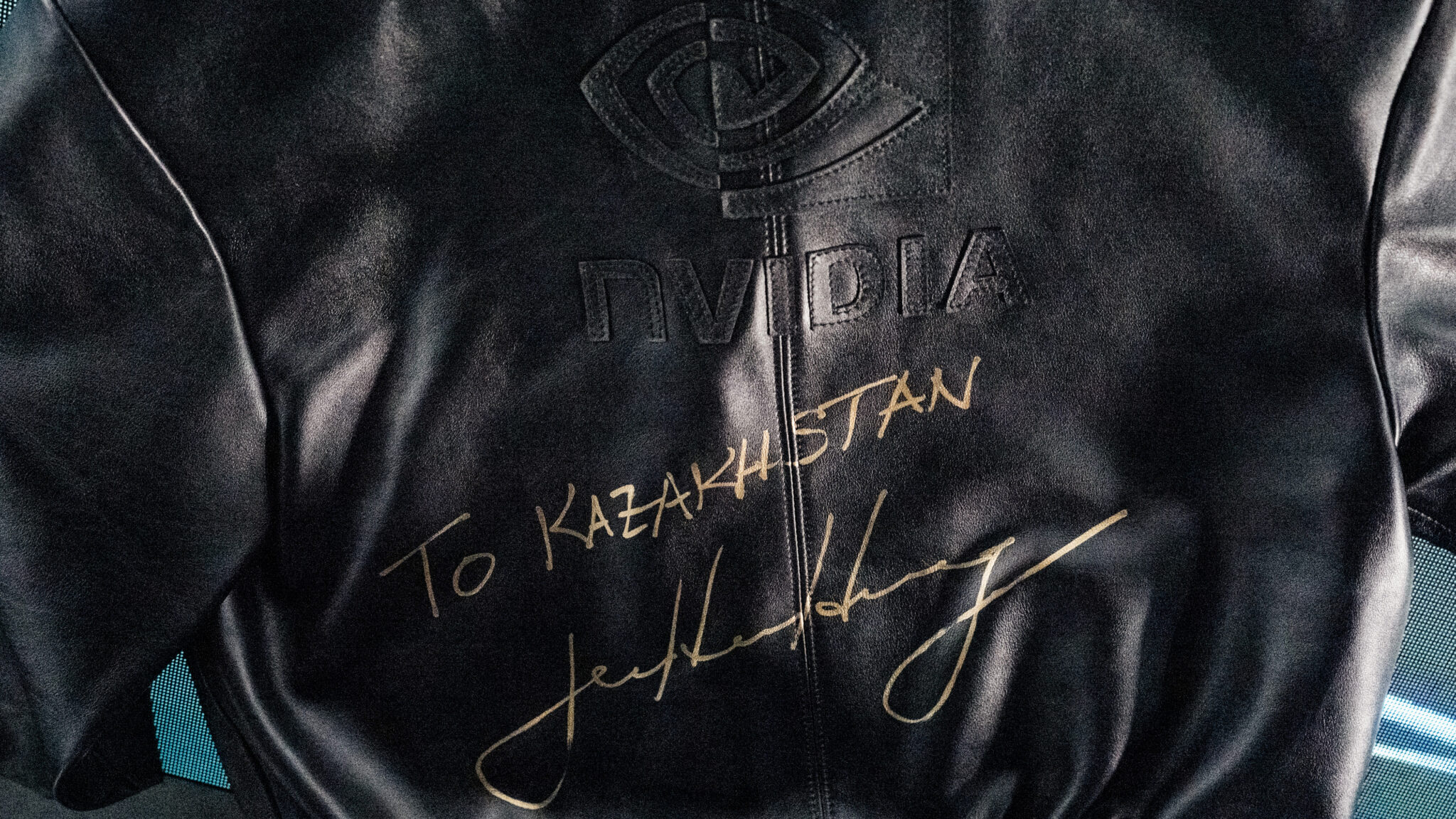
Kazakhstan Expands Compute for Its AI Future

Jensen Huang’s visit to the nation’s capital, Astana — including a presidential meeting and public fireside chat — coincided with new AI infrastructure commitments anchored by NVIDIA compute.
by

Kazakhstan’s AI ecosystem is moving from infrastructure plans to deployment. 

The shift is visible across the full AI stack — from infrastructure to models to applications.

The announcements below — coinciding with a visit to Astana by NVIDIA founder and CEO Jensen Huang — point to the nation’s increasing supply of accelerated computing, along with its growing demand for what comes next.

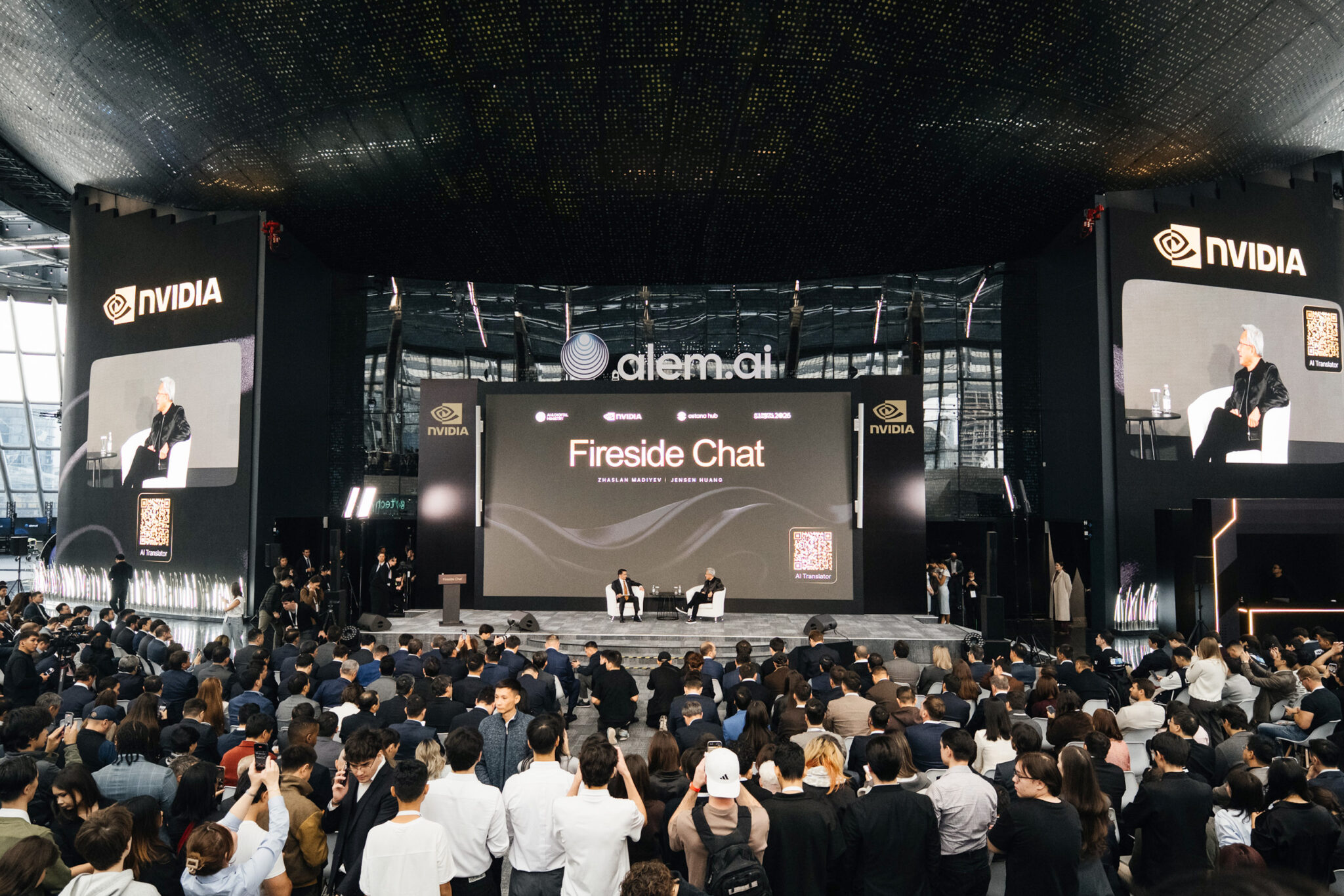
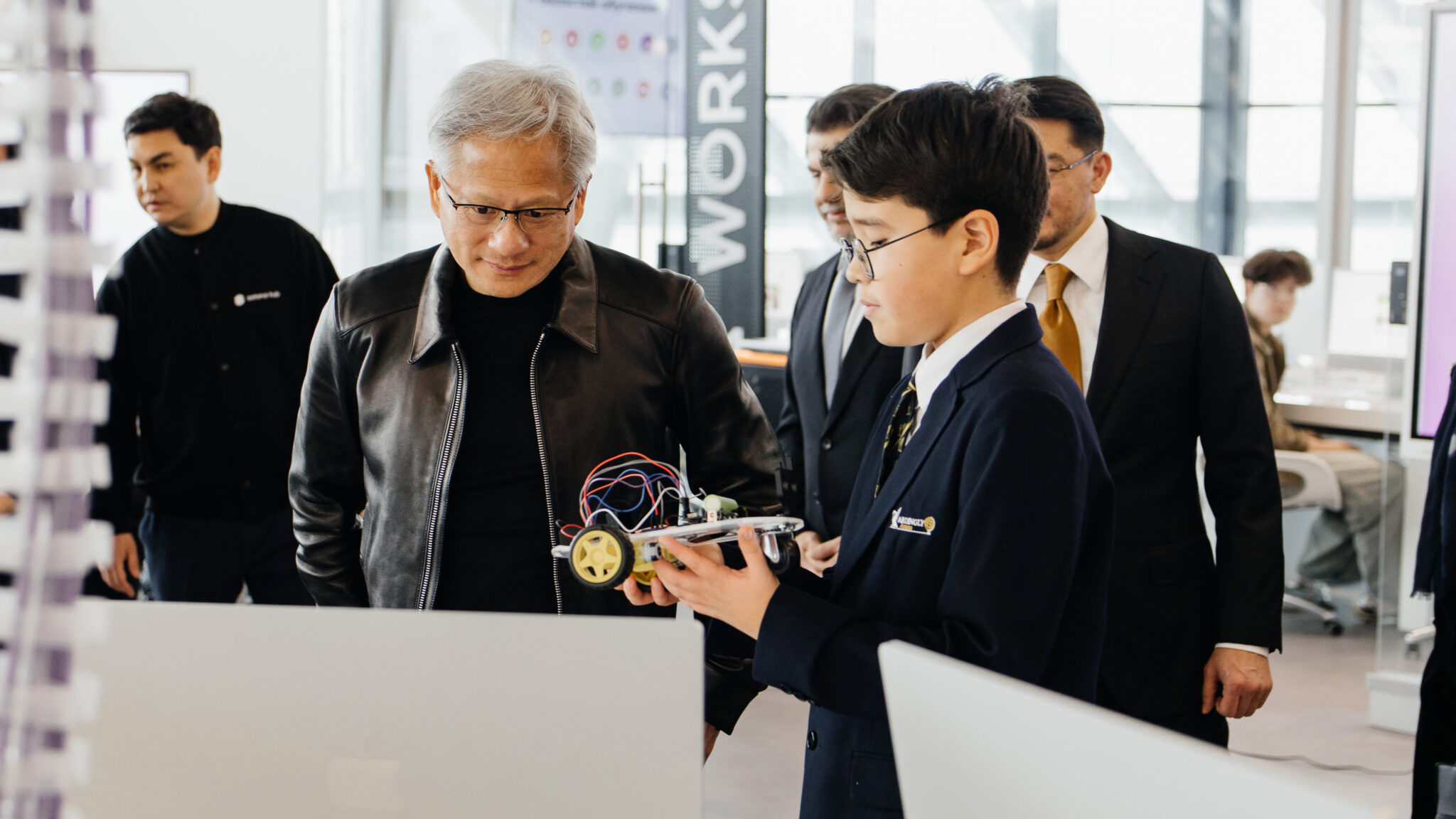
On Friday, Oct. 23, NVIDIA founder and CEO Jensen Huang visited Astana, meeting with President Kassym-Jomart Tokayev at the Akorda Presidential Palace and joining Deputy Prime Minister Zhaslan Madiyev — Kazakhstan’s minister of AI and digital development — for a public fireside chat at the Alem.AI program. 

Jensen Huang and Kazakhstan’s AI Minister Speak at Alem.AI

In their fireside chat at Alem.AI, Kazakhstan’s international center for artificial intelligence, Madiyev and Huang discussed the country’s push to become an AI nation — building the energy and computing infrastructure to support homegrown AI and applying it across the economy.

Madiyev said Kazakhstan wants AI that reflects its language and culture. “We want AI that understands and speaks Kazakh and captures cultural contexts and cultural specifics,” he said, describing the country’s work on Kazakh-language models. 

Huang said Kazakhstan could turn its energy resources into a foundation for AI production — and a new kind of export. “Instead of just exporting energy, in the future, you could transform energy into intelligence and export intelligence,” he said.

He also argued that local data is central to that ambition: it embodies a country’s culture, history and values. “Your country’s data is your natural resource. It belongs to you.” 

The conversation also turned to physical AI. Madiyev pointed to Kazakhstan’s factories, mines, agriculture, transport and logistics as potential areas for development, asking how the country could become a hub for training models for robots and other physical systems.

Huang called the idea “fantastic,” saying physical AI could transform industries from mining and mineral processing to agriculture. 

Huang said AI and robotics can help people do more, but ambition will shape how fully they seize that opportunity. He applied the idea to Kazakhstan, saying AI could help lift the country and its people.

“If you have ambition, and I believe you do, AI will lift your nation,” Huang said. “AI will lift your people.”

Huang also praised the founders of Higgsfield AI, the Kazakhstan-founded startup, and it was announced NVIDIA is making an investment into the startup during the event. “The first thing and the last thing is you invest in people, not companies,” he said, describing the founders as visionary and pointing to their effort to compete globally. 

Asked about AI security, Huang said the technology must be developed and deployed responsibly. He described NVIDIA’s OpenShell as a way to contain AI agents by limiting their access to files and tools and monitoring their activity.

For young people entering a fast-changing field, Huang recommended learning how AI works — not just how to use it. He said aspiring AI programmers should understand the technology’s principles, strengths and weaknesses, combining technical knowledge with the ability to work effectively with AI.

“I envy being 18 years old today… because the world is changing so rapidly, and there’s a complete reset because of technology.”

The Infrastructure Layer Is Scaling

The visits coincided with a signing ceremony marking Firebird’s investment agreement with the government of Kazakhstan, held at the presidential palace. 

Building on its first AI factory in Armenia, Firebird is expanding into Kazakhstan, where it has secured a U.S. export license for 45,000 NVIDIA Grace Blackwell GPUs. The first phase is under construction with Kazakhtelecom at Data Center Valley, targeting commercial launch in the third quarter of 2027.

A planned second phase would bring Firebird’s total potential AI infrastructure capacity in Kazakhstan to approximately 500 megawatts. Firebird also plans to establish Firebird Labs Kazakhstan to support local AI startups, research and talent development through funding, access to compute and research partnerships.

Firebird cofounder and CEO Razmig Hovaghimian attended the signing ceremony at the Akorda Presidential Palace alongside government officials.

“What began as a seed of an idea 180 days ago has grown into a major investment in Kazakhstan’s AI future,” said Razmig Hovaghimian, co-Founder and CEO of Firebird. “President Tokayev’s vision gave us the confidence to think bigger about what we can build together. With Jensen Huang here today, that ambition feels more tangible than ever. We’re building the infrastructure for Kazakhstan’s talent and ideas to reach the world.”

Kazakhtelecom, the nation’s largest telecommunications company, has already deployed 400 NVIDIA H200 and 480 NVIDIA B300 GPUs in Astana and Almaty.

Next year, the company plans to deploy more than 1,000 GPUs in the Data Center Valley, along with more than 1,000 NVIDIA Vera Rubin GPUs in the Ekibastuz region, serving diverse workloads with infrastructure that enterprises, developers and institutions can use at scale.

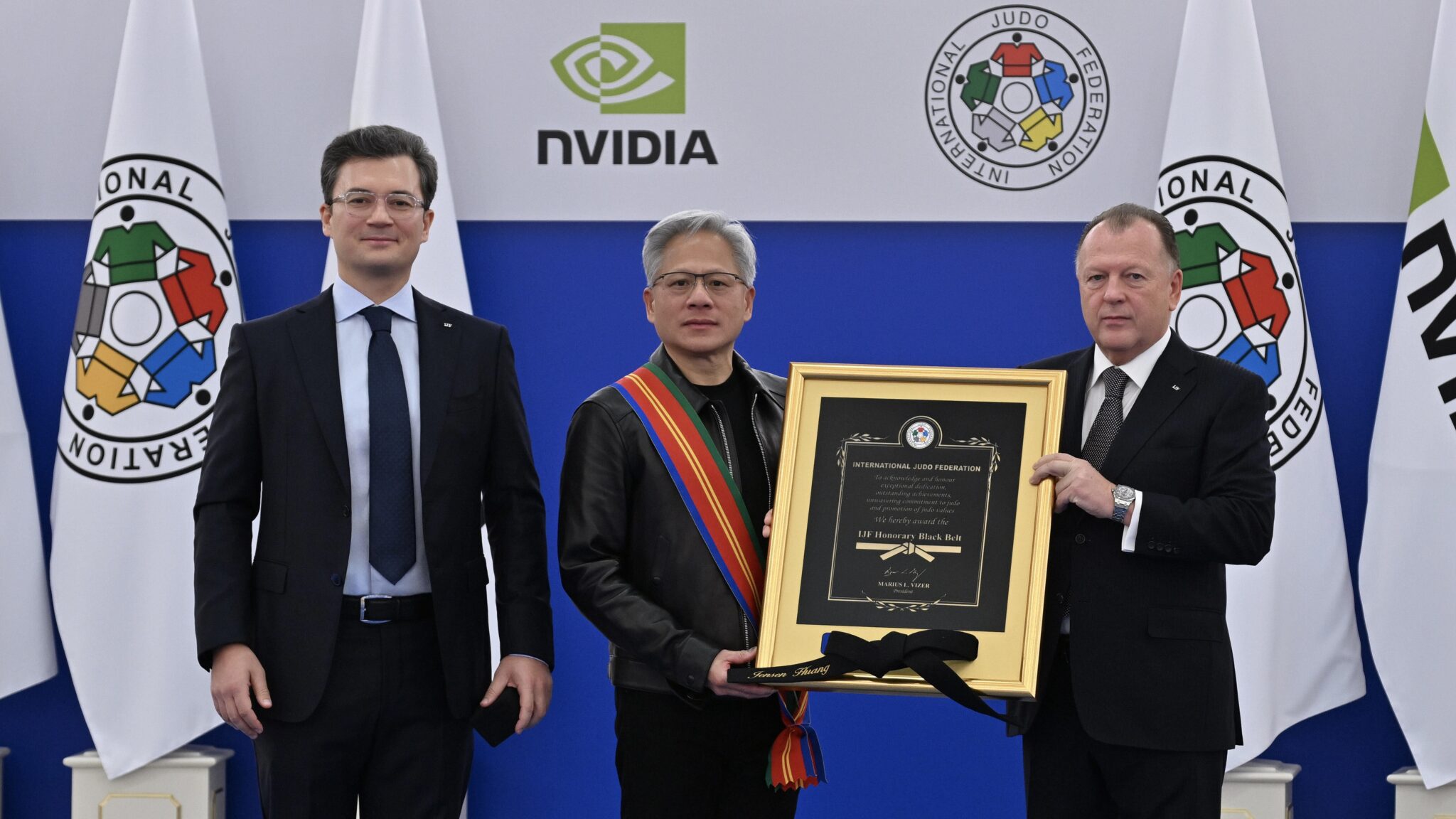
An Honorary Black Belt for Huang

At the end of their meeting, President Tokayev presented Huang with the Order of Dostyk, First Class, for his contribution to the development of artificial intelligence in Kazakhstan. Dostyk means friendship and the Order honors peace, friendship and cooperation.

Later that day, President of the International Judo Federation (IJF) Marius Vizer and Timur Kemell, IJF director of promotion and development and a member of the IJF Executive Committee, presented Huang with an honorary black belt in Judo. The belt, embroidered in gold stitching, was a special thanks for Huang’s support of Kazakhstan’s AI ambition and for leadership aligned with the spirit and rigor of the martial art.

AI-Native Companies Scale With Compute

And that development is accelerating. The nation’s AI-native companies are also building out their compute capacity — and the applications that run atop them.

Higgsfield is expanding its AI infrastructure with NVIDIA Vera Rubin running on cloud service providers, giving the company additional capacity as models, products and customer demand for its generative media applications grow.

inDrive and Pony.ai are also collaborating to explore robotaxi services in Kazakhstan, with Astana as the first deployment city. The companies will assess the feasibility of bringing Pony.ai’s seventh-generation robotaxis to the inDrive app, supported by NVIDIA AI infrastructure, built on the NVIDIA Hyperion sensor and compute platform with the NVIDIA Halos safety system.

More local capacity gives developers and companies room to train, fine-tune and serve increasingly capable models. Successful applications, in turn, create demand for more compute.

Kazakhstan’s AI opportunity isn’t defined by GPU counts alone. Connecting that infrastructure with developers, universities, startups and industries can turn accelerated computing into useful applications.

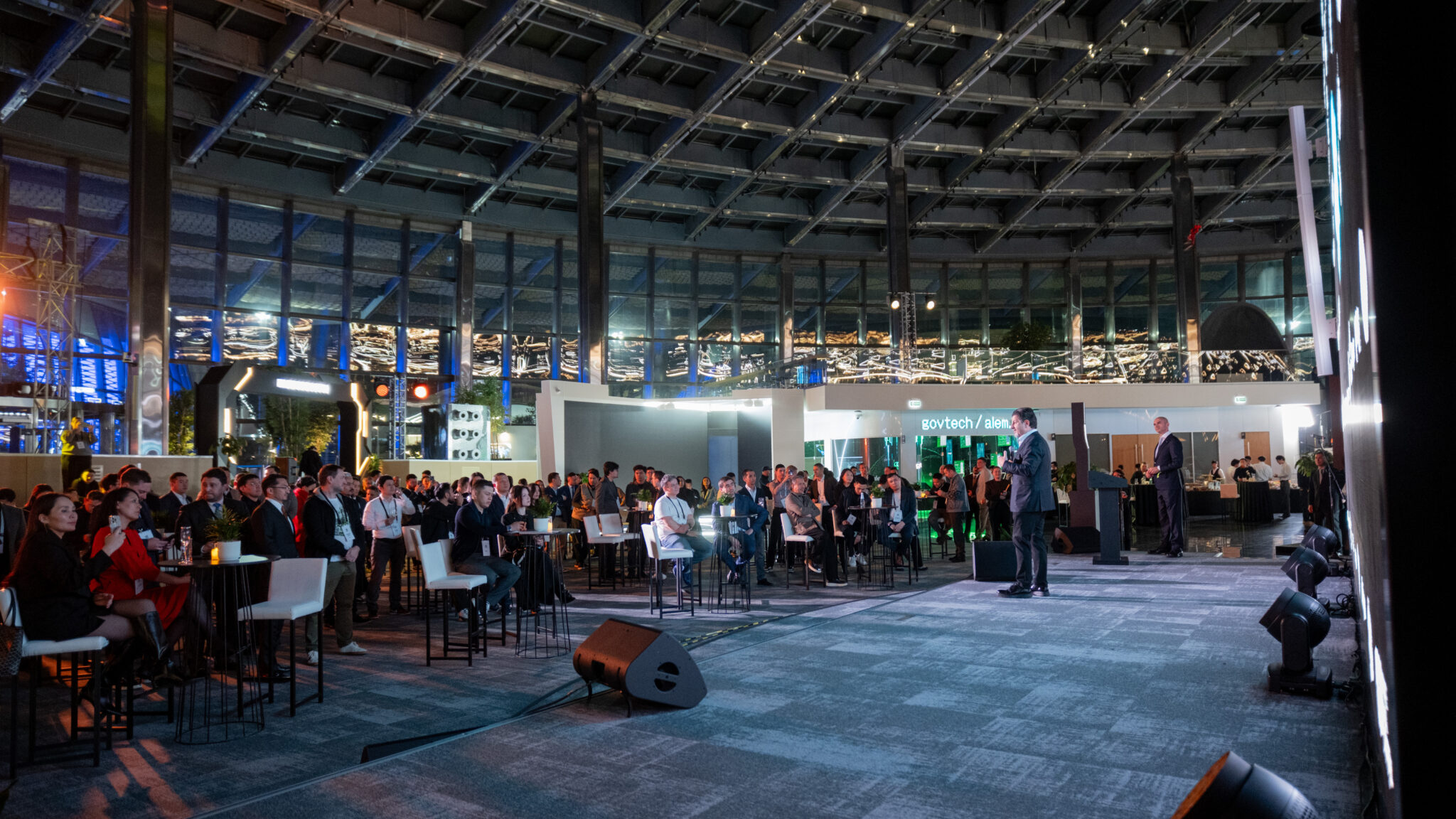
That was at the core of the discussion the NVIDIA team had with hundreds of developers from across Kazakhstan during a reception later in the evening. The gathering in this self-proclaimed AI nation was inspiring because of the ideas shared, the clear drive to build and a collective ambition to share it with the world. 

Today’s announcements represent different layers of the AI stack in Kazakhstan— infrastructure deployment, access to compute and AI-native product development — where the AI foundation is reaching new scale.

Watch the fireside chat between Jensen Huang and Deputy Prime Minister Zhaslan Madiyev, streamed live from Alem.AI in Astana.

Watch NVIDIA founder and CEO Jensen Huang’s GTC Berlin keynote in replay.