How FERC’s Large-Load Interconnection Actions Help Address Grid Stress, Improve Affordability
The U.S. Federal Energy Regulatory Commission’s new actions on energy — a foundational layer of AI — are poised to reduce costs for ratepayers, grow the industrial base and strengthen the nation’s electrical grid.
In a consequential grid infrastructure decision, the Federal Energy Regulatory Commission (FERC) today issued a major milestone on large-load interconnection impacting how those building AI factories, semiconductor fabrication support systems and advanced manufacturing facilities can connect to the grid.
In the era of AI, which NVIDIA founder and CEO Jensen Huang has described as a five-layer cake, energy is the critical foundation of technological innovation.
FERC’s actions do more than modernize the grid interconnection queue — the approval process power developers must complete to safely connect new energy generation to the electrical grid. Following U.S. Secretary of Energy Chris Wright’s order directing FERC to address large-load interconnection, the actions establish national policy for how America can simultaneously lower energy costs, grow its industrial base, scale AI and strengthen the electrical grid.
For policymakers, utilities and technology partners, the message is clear: This is a pro-growth, pro-affordability and pro-reliability policy.
Faster Connections, Stronger Grid
At its core, the new framework cuts through burdensome bureaucratic red tape and aligns industry incentives.
Large customers are no longer passive entrants into an overburdened interconnection queue. They’re active participants in building the infrastructure they require. That means:
Funding their own network upgrades, reducing cost pressure on existing ratepayers.
Bringing new energy generation online, increasing supply alongside demand.
Offering flexible load, allowing grid operators to manage peaks more efficiently.
Customers that can demonstrate flexibility — shifting or curtailing load in response to grid conditions — can move through the process on accelerated timelines, with study periods potentially as short as 60 days, per Secretary Wright’s directive.
This is not just faster interconnection. It’s smarter interconnection.
The Math Adds Up
Electric grids are capital-intensive systems with high fixed costs. When more demand is added efficiently, those costs are spread across a broader base — lowering prices per unit.
This dynamic is already playing out at the state level:
North Dakota, after adding 23 data centers, saw the nation’s largest decrease in electricity prices.
Mississippi, Louisiana and Virginia moved early to attract large loads and are now seeing tangible ratepayer, grid modernization and investment benefits.
PG&E has forecast that, under the right conditions, each new 1 gigawatt of data center load could reduce electric rates by 1-2% by spreading fixed grid costs over more usage.
Inversely, states that fail to attract new load risk concentrating system costs on a shrinking customer base — putting upward pressure on rates for households and small businesses.
FERC’s actions create a national pathway to avoid that outcome. They build on the successes of communities across North Dakota, Mississippi, Louisiana and Virginia to create a national on-ramp,enabling every region to compete for and benefit from the next wave of industrial and technological investment.
Infrastructure That Powers the Modern Economy
This is not abstract infrastructure. It underpins the technologies shaping the next generation of American competitiveness.
The facilities enabled by this framework will power:
AI-driven drug discovery that accelerates breakthroughs in medicine.
Semiconductor design and advanced manufacturing that secure domestic supply chains.
Weather modeling and climate analytics that improve resilience.
Next-generation energy systems that are more adaptive and reliable.
The benefits extend beyond any single facility or industry. They can reach every American who visits a doctor, buys a product or pays an electricity bill.
The Moment to Engage in a Decade-Defining Opportunity
The framework is in place — but how it’s implemented, refined and scaled will depend on the stakeholders who engage now. Across government and industry, those who engage today will define what this system looks like for the next decade — how fast it grows, how resilient it becomes and how broadly its benefits are shared.
NVIDIA is not waiting.
In parallel with FERC’s action, NVIDIA and Emerald AI are already working with partners across the ecosystem to build a new class of AI factories — designed from the ground up as flexible grid assets.
These facilities will:
Bring their own generation to the grid
Respond to grid conditions in real time
Act as stabilizing forces for surrounding communities
Commercial deployment begins later this year.
This is what the future of large-load interconnection looks like: not a burden on the grid, but a backbone of reliability and efficiency.
FERC has taken an important step forward, and NVIDIA welcomes this leadership.
NVIDIA and CrowdStrike Strengthen Agentic Cybersecurity Frontier
New CrowdStrike SafeMind agentic cybersecurity system built with NVIDIA Nemotron open models delivers greater protection and cost savings for cyber defense.
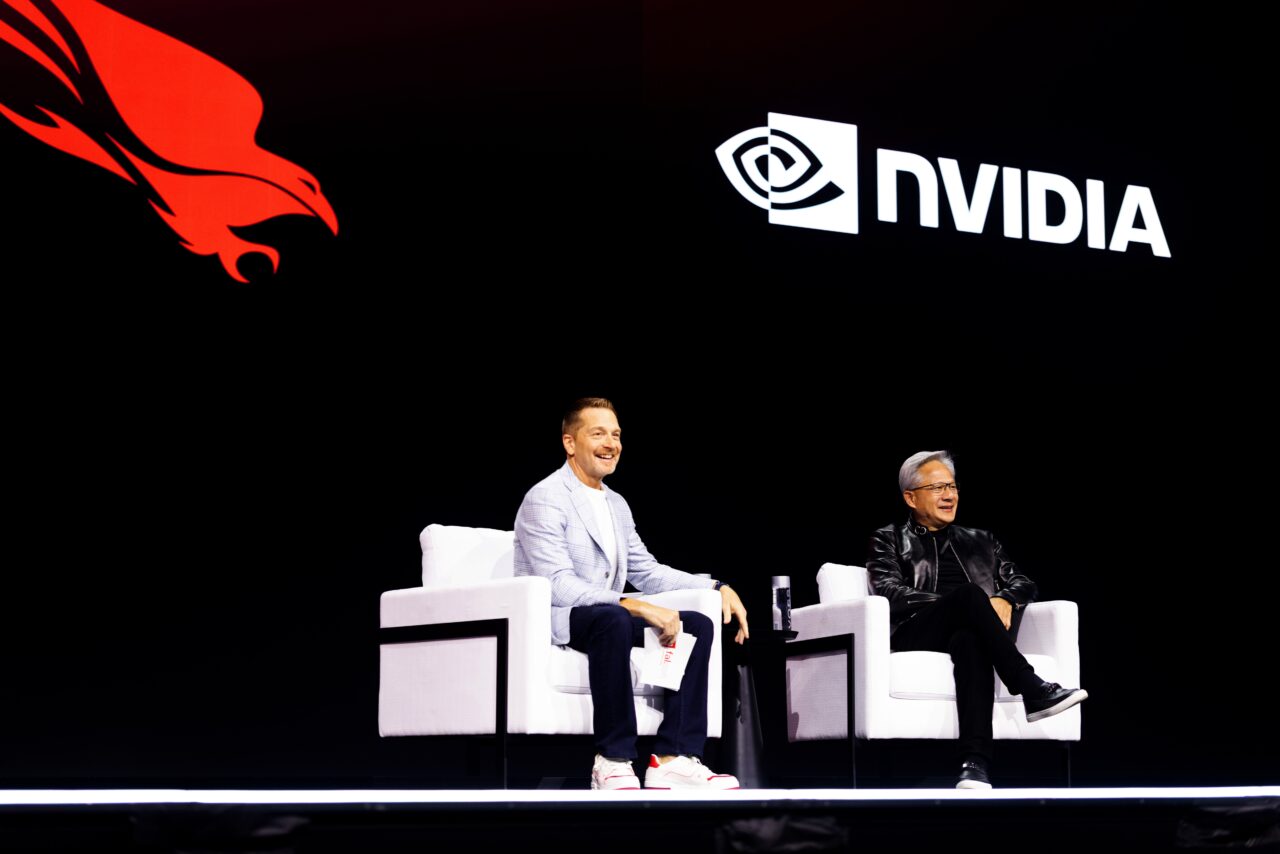
“We’re at an inflection point in cybersecurity,” Jensen Huang told a sold-out crowd at CrowdStrike’s Fal.Con 2026 in Las Vegas Tuesday. Attacks are now automated. Defense has to be, too.
The NVIDIA founder and CEO joined CrowdStrike CEO and founder George Kurtz to announce CrowdStrike SafeMind, its agentic cybersecurity system developed by the CrowdStrike Cyber Superintelligence Lab. “This is the beginning of a new age of cybersecurity,” Huang told the crowd of 10,000 security professionals. “On the one hand, the adversaries are going to be more armed than ever. On the other hand, all of you are going to be more armed than ever.”
SafeMind combines CrowdStrike’s purpose-built, beyond frontier-capable models and customized agentic harnesses, with defensive models built on NVIDIA Nemotron, in a continuous coevolution loop where offense and defense repeatedly challenge and improve each other.
CrowdStrike also announced CrowdStrike Falcon IQ to operationalize Project QuiltWorks through agentic workload automation and expanded its CrowdStrike Guardian AI safety solution. “We have asymmetric advantages because we have a large community of cybersecurity experts who want to work with each other and keep the world safe,” Huang told the crowd.
CrowdStrike’s annual conference drew security leaders from financial services, healthcare, the public sector and critical infrastructure.
“The real gap that I saw was that the attackers had frontier AI, and the defenders didn’t,” Kurtz told them. “And that changes now.”
SafeMind
CrowdStrike built SafeMind’s defensive model using NVIDIA Nemotron open models, post-trained with CrowdStrike’s cyber experience and threat data. The SafeMind models are paired with proprietary cybersecurity harnesses optimized to work as an agentic stack.
The result ships natively in the CrowdStrike Falcon platform as SafeMind, CrowdStrike’s agentic cybersecurity system. SafeMind brings offensive and defensive AI together in a continuous coevolution loop, where each side adapts to and strengthens the other. This process continuously hardens the security of the customer environment until attacks are unsuccessful.
“Your decade and a half of security data that we can train on — we can take a frontier model and make it essentially a super AGI that is incredibly good at cybersecurity,” Huang told Kurtz. “Together with NVIDIA, we built cybersecurity’s first complete agentic system for cybersecurity, including the first frontier models and harness purpose-built for defenders,” Kurtz said. “This isn’t a copilot baked into someone else’s intelligence. It’s not a chatbot with a security skin. It is a frontier-class model built and trained by CrowdStrike on our data in partnership with NVIDIA.”
NVIDIA Nemotron 3 Ultra orchestrates the defensive agent harness. A fine-tuned Nemotron 3 Super powers SafeMind’s rule-generation sub-agent.
By post-training Nemotron with CrowdStrike data, CrowdStrike internal evaluations showed that the Blue Solano model — based on Nemotron 3 Super — delivered higher accuracy rates than leading frontier models at 99% lower cost.
While SafeMind can operate as a complete system, the models can be used independently to empower defenders to stay ahead of the adversary. Security experts can also pair their own models with CrowdStrike’s custom harnesses, giving customers the flexibility to use the right models and capabilities for their environment.
“The harness is essentially the exoskeleton of the large language model,” Huang said. “The large language model is the brain. The exoskeleton turns it into an agent — and this exoskeleton doesn’t have to be the same shape and capability for every domain.”
When AI Is the Defense
AI-enabled attacks rose 89% in the past year, and the fastest eCrime breakout time has reached 27 seconds, according to CrowdStrike. Human-speed response isn’t defense. It’s documentation.
“There are many applications in the world where you must have the ability to fine-tune, to post-train — to create an AI that is super good at a particular domain,” Huang said. “Nemotron was created for precisely that. Completely free. Incredibly fast. You have the ability to have an asymmetric advantage against whatever comes your way.”
With open Nemotron as the base, CrowdStrike’s security teams post-trained on their own threat data without sending it to an outside provider, and customized the AI to their environment.
That’s not possible with a closed frontier model, and in security, the ability to inspect what’s defending matters.
The testing runs SafeMind in an offensive-defensive loop for adversarial coevolution. An offensive red-team agent finds the exploit, a blue-team defensive agent closes it and the findings become actionable detections to block attacks.
The red-agent harness runs Recon, Assault and Compromise sub-agents executing attack paths inside the cyber agent environment. The blue-agent harness monitors via Falcon sensors, generates detection candidates, validates them and promotes them.
CrowdStrike built the test environment with NVIDIA: a digital twin of NVIDIA’s own accelerated computing infrastructure, validated against NVIDIA’s real threat landscape.
“The basic framework of SafeMind — an adversarial model acting on a digital twin of the environment, with a defender model in a continuous cat-and-mouse loop, eventually learning how to secure itself — this basic framework applies to robotics, edge computing, enterprise computing and just about everything,” Huang said.
CrowdStrike also announced Falcon IQ. NVIDIA Nemotron models help to power the agentic engine at the heart of Charlotte AI AgentWorks, CrowdStrike’s no-code agent development platform where Falcon IQ runs.
Falcon IQ uses more than 50 agents working together as a unified agentic workforce to automate the most time-intensive workflows in assessment, prioritization and remediation.
Partners use Falcon IQ to deliver customized findings, recommendations and executive outputs to customers. Charlotte AI AgentWorks enables every Falcon user to build their own agentic security workforce.
The Full Stack
CrowdStrike has thousands of customer organizations generating trillions of daily security events.
With NVIDIA’s full-stack accelerated computing platform, the collaboration runs from the chips up through the models to the harnesses acting on what those models find. For Kurtz, that’s the point.
“The crowd in CrowdStrike,” Kurtz added, “is the asymmetry that puts the defenders in a unique position to defeat the adversary.”
Sparks Fly: NVIDIA Accelerates Local AI at IFA 2026
Local agents get easier to install, faster to run and able to tap multiple RTX PCs at home with NVIDIA PAIR — plus, new NVIDIA RTX Spark Windows PCs arriving in October.
Frontier intelligence is going local. At IFA 2026, NVIDIA, Microsoft and its partners are teaming up to provide faster inference and new tools that make agents easier to set up and run locally on NVIDIA hardware. New compact NVIDIA RTX Spark Windows PCs are also coming in October to give AI enthusiasts, developers and creators more ways to run capable agents locally and securely.
Today’s announcements include:
Simplified local AI support for NVIDIA GPUs is coming in Hermes Agent, OpenClaw and Perplexity Portable Computer.
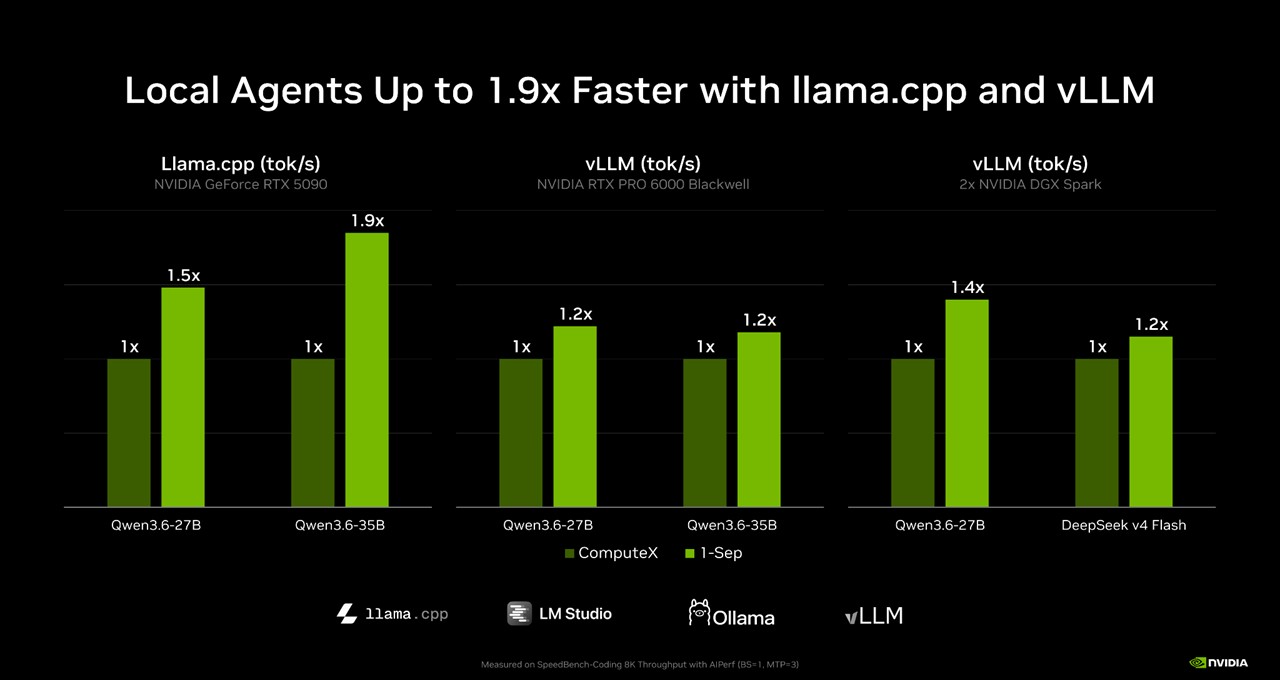
Up to 1.9x faster local inference — new llama.cpp and vLLM optimizations are available now directly and through LM Studio and Ollama.
NVIDIA PAIR — a Personal AI Router tool that intelligently distributes AI inference across the PCs on a user’s local network.
NVIDIA RTX Spark arrives in October — with new Windows PCs from Lenovo and Acer. Electronic Arts, Embark and Ubisoft are among the latest game publishers and developers bringing their blockbuster titles to NVIDIA RTX Spark.
Nemotron 3.5 Lightning — which can run on NVIDIA RTX PCs, RTX PRO Workstations, DGX Spark and Jetson — is a 30-billion parameter model that has been launched. Get started with Nemotron 3.5 Lightning today.
Z.ai’s GLM-5.3-Flash is a multimodal mixture-of-experts (MoE) model that’s bringing agentic AI to DGX Station.
Qwen has released Qwen3.8-Flash-Next, an open weight multimodal MoE model, which can run locally on DGX Spark and DGX Station, along with Qwen3.8-27B, a 27-billion-parameter open model optimized for local agentic and coding workloads on NVIDIA GPUs.
LTX’s LTX 2.5 is an open-world video generation model optimized for NVIDIA RTX GPUs, DGX Spark and DGX Station, with new NVFP4, FastVideo and ComfyUI enhancements for faster, more memory-efficient local generation.
MiniMax-H3is an open-weight video generation model with synchronized audio that can run locally on NVIDIA GPUs through ComfyUI. FastVideo teamed up with NVIDIA researchers to improve this further by releasing FastH3 — an open-weight, four-step distilled version that improves performance by 7x. Optimized FastVideo recipes for NVIDIA RTX GPUs and DGX Spark are coming soon.
Meta’s Muse Glimmer is a 30-billion-parameter open-weight model for coding and agentic workloads that can run locally on GeForce RTX PCs, DGX Spark, DGX Station and Jetson. NVIDIA has also released NVFP4 quantization with DGX Spark support for more memory-efficient local deployment.
DeepSeek v4 Flash is a 284-billion-parameter MoE model with 13 billion active parameters that can run locally on 2x DGX Spark cluster and DGX Station.
A Simpler Start for Local Agents
Getting a local agent up and running with local models required some effort — choosing a model, finding a compatible inference server, dialing in quantization settings and keeping everything updated. That friction is disappearing on RTX and DGX systems.
Three of the most widely used agent apps will offer simplified local model setup on Windows, each built on llama.cpp and incorporating NVIDIA’s latest inference optimizations. The new setup experiences are designed to reduce manual configuration and make it easier to get local agents up and running.
Last month, Perplexity introduced its Portable Computer agent, giving users a simple way to run Perplexity locally on Linux systems like NVIDIA DGX Spark with the models, orchestration and tools packaged into a single app experience.
Perplexity Portable Computer is available on NVIDIA RTX GPUs with at least 24GB VRAM running on Linux, with support on Windows coming soon, bringing that same streamlined setup to a broader group of PC users. Users can run complete workflows locally without consuming credits, while selectively escalating parts of a task to one of 15+ frontier models in the cloud when additional research or reasoning is needed. Portable Computer asks for permission before sending content to the cloud, helping users keep sensitive information on their device. Here’s some example use-cases:
Engineering: Review open PRs in a connected GitHub repo and sort them into ready, blocked, stale, and needs review, each tagged with the next step. Docs that fell out of sync with the latest merge get caught and fixed, with a PR opened for the changes.
Finance: Point the agent at two years of brokerage summaries, consolidated 1099s and tax returns and have it trace the recurring holdings creating the most avoidable fees and tax drag, with every figure cited to the exact file and page — all without a document ever reaching a chatbot.
Startups: Ask why activation went flat, and the agent analyzes the funnel export locally to find where new signups drop off between install and first completed task, then posts the top insights straight to the team’s Slack channel.
Hermes Agent — developed by Nous Research — is a general-purpose agent used by millions that excels at reliability and self-improvement. Model- and provider-agnostic, Hermes is built to run all day on local systems, making RTX PCs, RTX PRO workstations and DGX Spark a natural fit.
Configuring a local model in Hermes will provide users with one-click setup across RTX and DGX systems on Windows. The agent will automatically detect the NVIDIA GPU, select an appropriate model and configuration, and run it through integrated llama.cpp with NVIDIA inference optimizations already in place, eliminating manual model downloads and tuning. Support for Linux is coming soon.
Once it is running, Hermes works the way it does anywhere else. It uses tools, maintains context across tasks, remembers information between sessions and creates reusable skills over time, allowing the agent to become more capable with continued use. Running the model locally on a GPU keeps performance fast while keeping data on the system.
One-click local model setup is available now on Windows, with support coming soon to Linux. Learn more about Hermes Agent.
OpenClaw has become one of the defining projects of the open-agent movement — the largest AI project on GitHub, with more than 380K stars and a fast-growing community that’s building tools and skills across research, engineering, project management and everyday productivity.
NVIDIA, Microsoft and OpenClaw have been working together to make that experience easier to set up on Windows PCs. To reduce onboarding friction, the OpenClaw Windows App simplifies the process of setting up an optimized local model on any RTX GPU with at least 24GB of VRAM.
Inference performance is critical to keeping local agents responsive. NVIDIA is continuing to collaborate with the open-source llama.cpp and vLLM communities to accelerate agentic workloads across local NVIDIA platforms.
llama.cpp delivers up to 1.9x higher throughput through kernel optimizations on a GeForce RTX 5090, enhanced speculative decoding techniques and faster prefill.
vLLM delivers 1.2x on RTX PRO 6000 Blackwell Workstation Edition and up to 1.4x on two DGX Spark clusters. New XQA attention kernels in FlashInfer and backend optimizations help to accelerate inference across both platforms.
These gains are available on the llama.cpp and vLLM inferencing backends.
Users can also experience these via the LM Studio and Ollama applications.
Tap Idle PCs for More Local AI Compute With NVIDIA PAIR
More than half of U.S. households have two or more PCs, and much of that computing power sits idle throughout the day. NVIDIA Personal AI Router (PAIR) is a free, open source software tool that puts those systems to work together for local AI.
Agentic workflows often break complex tasks into smaller jobs that can run in parallel, but performance can slow when every request is competing for the same GPU. PAIR automatically discovers compatible PCs on a local network and routes independent inference requests to whichever system has capacity. It works with Ollama and LM Studio and can adapt as devices join or leave the network.
For example, a user could ask Hermes to create a “Sunday Reset” plan by sorting through a cluttered inbox and prioritizing what needs attention now, what can wait and what can be skipped. Hermes can split that work across multiple subagents, while PAIR distributes those jobs across available PCs instead of having them all wait on a single GPU.
The result is more compute for local agents, with more tasks running in parallel and the flexibility to move AI workloads to another PC while the main system is being used for gaming, creating or other work.
The NVIDIA PAIR beta is available for Windows, macOS and Linux through both graphical and terminal interfaces, supporting NVIDIA GeForce RTX 20 Series GPUs and newer, NVIDIA RTX PRO workstation GPUs (Turing architecture and newer), NVIDIA DGX Spark and Apple M4 or newer silicon.
Powerful On Device Photo Editing With Cyberlink PhotoDirector AI PC Mode on RTX Spark
Open image and video models enable artists to experiment with Creative AI models on PCs. This enables artists to iterate and explore concepts and ideas, without the dreaded token anxiety and keep more of their creative work private and on-device.
CyberLink’s new PhotoDirector AI PC Mode is one of the first applications to integrate these diffusion models directly into a creative software, and turn them into a creative tool at the finger tips of the artists. Coming to PhotoDirector 365 and optimized for NVIDIA RTX Spark when it launches, AI PC Mode users are getting AI-powered editing tools for generative editing, image enhancement, object and distraction removal, background removal and replacement, portrait refinement and the creation of entirely new visuals — with the flexibility to choose between local or cloud processing, depending on the task.
On NVIDIA GPUs, PhotoDirector uses TensorRT-RTX and FP8 to accelerate local AI.
NVIDIA RTX Spark is coming this October— and at IFA 2026, partners are showing off their hardware. At IFA, newly announced designs join the existing six OEMs shipping in October. Acer showed its compact desktop RTX Spark concept, and Lenovo announced its Yoga Pro 9n and Yoga 9n 2-in-1.
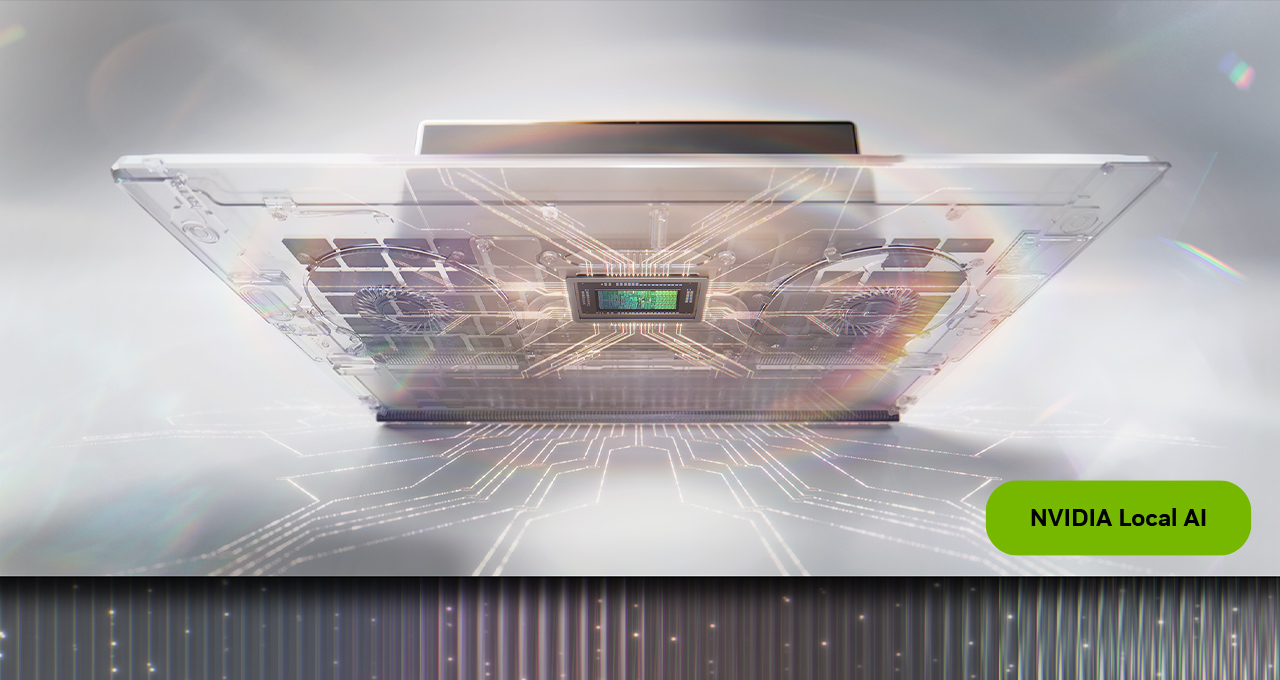
RTX Spark is a new beginning for Windows PCs. One PC built for creators, gamers and AI agents. With a powerful 1 Petaflop RTX Blackwell GPU, up to 128GB of unified memory and a highly efficient 20-core Grace CPU, RTX Spark delivers incredible performance and efficiency. This superchip enables high performance thin laptops with all day battery life and compact desktops to power always-on agents. Paired with the new Windows Agent framework, it enables agents that run safely in the background under OS level control.
Last week at Gamescom, Electronic Arts, Embark and Ubisoft were among the latest game publishers and developers bringing their blockbuster titles to NVIDIA RTX Spark Windows PCs. They join the publishers that announced RTX Spark support at COMPUTEX in May, including KRAFTON, NetEase, Riot Games and XBOX. Read more.
Sign up to be notified when RTX Spark laptops and desktops are available.
#ICYMI: More Updates From NVIDIA Local AI
🎮 NVIDIA Brings New RTX Tech and Games to Gamescom — NVIDIA released DLSS 4.5 Ray Reconstruction, featuring a new second-generation transformer model for improved image quality in ray-traced and path-traced games. Gamescom also brought new RTX announcements for titles including 007 First Light, CONTROL Resonant and Gears of War: E-Day, plus expanded game support for the upcoming NVIDIA RTX Spark.
🐋Introducing DeepSeek Harness — DeepSeek’s new open source harness pairs with DeepSeek-V4-Flash to power local agentic coding workflows on NVIDIA DGX Station and multi-DGX Spark setups.
📊MLPerf Client v2.0 Expands AI PC Benchmarking — MLCommons released MLPerf Client v2.0, developed in collaboration with NVIDIA and other industry leaders. The update adds new benchmarks for agentic AI and image generation, alongside expanded LLM testing for real-world local AI workloads.
NVIDIA and CrowdStrike Strengthen Agentic Cybersecurity Frontier
New CrowdStrike SafeMind agentic cybersecurity system built with NVIDIA Nemotron open models delivers greater protection and cost savings for cyber defense.
“We’re at an inflection point in cybersecurity,” Jensen Huang told a sold-out crowd at CrowdStrike’s Fal.Con 2026 in Las Vegas Tuesday. Attacks are now automated. Defense has to be, too.
The NVIDIA founder and CEO joined CrowdStrike CEO and founder George Kurtz to announce CrowdStrike SafeMind, its agentic cybersecurity system developed by the CrowdStrike Cyber Superintelligence Lab. “This is the beginning of a new age of cybersecurity,” Huang told the crowd of 10,000 security professionals. “On the one hand, the adversaries are going to be more armed than ever. On the other hand, all of you are going to be more armed than ever.”
SafeMind combines CrowdStrike’s purpose-built, beyond frontier-capable models and customized agentic harnesses, with defensive models built on NVIDIA Nemotron, in a continuous coevolution loop where offense and defense repeatedly challenge and improve each other.
CrowdStrike also announced CrowdStrike Falcon IQ to operationalize Project QuiltWorks through agentic workload automation and expanded its CrowdStrike Guardian AI safety solution. “We have asymmetric advantages because we have a large community of cybersecurity experts who want to work with each other and keep the world safe,” Huang told the crowd.
CrowdStrike’s annual conference drew security leaders from financial services, healthcare, the public sector and critical infrastructure.
“The real gap that I saw was that the attackers had frontier AI, and the defenders didn’t,” Kurtz told them. “And that changes now.”
SafeMind
CrowdStrike built SafeMind’s defensive model using NVIDIA Nemotron open models, post-trained with CrowdStrike’s cyber experience and threat data. The SafeMind models are paired with proprietary cybersecurity harnesses optimized to work as an agentic stack.
The result ships natively in the CrowdStrike Falcon platform as SafeMind, CrowdStrike’s agentic cybersecurity system. SafeMind brings offensive and defensive AI together in a continuous coevolution loop, where each side adapts to and strengthens the other. This process continuously hardens the security of the customer environment until attacks are unsuccessful.
“Your decade and a half of security data that we can train on — we can take a frontier model and make it essentially a super AGI that is incredibly good at cybersecurity,” Huang told Kurtz. “Together with NVIDIA, we built cybersecurity’s first complete agentic system for cybersecurity, including the first frontier models and harness purpose-built for defenders,” Kurtz said. “This isn’t a copilot baked into someone else’s intelligence. It’s not a chatbot with a security skin. It is a frontier-class model built and trained by CrowdStrike on our data in partnership with NVIDIA.”
NVIDIA Nemotron 3 Ultra orchestrates the defensive agent harness. A fine-tuned Nemotron 3 Super powers SafeMind’s rule-generation sub-agent.
By post-training Nemotron with CrowdStrike data, CrowdStrike internal evaluations showed that the Blue Solano model — based on Nemotron 3 Super — delivered higher accuracy rates than leading frontier models at 99% lower cost.
While SafeMind can operate as a complete system, the models can be used independently to empower defenders to stay ahead of the adversary. Security experts can also pair their own models with CrowdStrike’s custom harnesses, giving customers the flexibility to use the right models and capabilities for their environment.
“The harness is essentially the exoskeleton of the large language model,” Huang said. “The large language model is the brain. The exoskeleton turns it into an agent — and this exoskeleton doesn’t have to be the same shape and capability for every domain.”
When AI Is the Defense
AI-enabled attacks rose 89% in the past year, and the fastest eCrime breakout time has reached 27 seconds, according to CrowdStrike. Human-speed response isn’t defense. It’s documentation.
“There are many applications in the world where you must have the ability to fine-tune, to post-train — to create an AI that is super good at a particular domain,” Huang said. “Nemotron was created for precisely that. Completely free. Incredibly fast. You have the ability to have an asymmetric advantage against whatever comes your way.”
With open Nemotron as the base, CrowdStrike’s security teams post-trained on their own threat data without sending it to an outside provider, and customized the AI to their environment.
That’s not possible with a closed frontier model, and in security, the ability to inspect what’s defending matters.
The testing runs SafeMind in an offensive-defensive loop for adversarial coevolution. An offensive red-team agent finds the exploit, a blue-team defensive agent closes it and the findings become actionable detections to block attacks.
The red-agent harness runs Recon, Assault and Compromise sub-agents executing attack paths inside the cyber agent environment. The blue-agent harness monitors via Falcon sensors, generates detection candidates, validates them and promotes them.
CrowdStrike built the test environment with NVIDIA: a digital twin of NVIDIA’s own accelerated computing infrastructure, validated against NVIDIA’s real threat landscape.
“The basic framework of SafeMind — an adversarial model acting on a digital twin of the environment, with a defender model in a continuous cat-and-mouse loop, eventually learning how to secure itself — this basic framework applies to robotics, edge computing, enterprise computing and just about everything,” Huang said.
CrowdStrike also announced Falcon IQ. NVIDIA Nemotron models help to power the agentic engine at the heart of Charlotte AI AgentWorks, CrowdStrike’s no-code agent development platform where Falcon IQ runs.
Falcon IQ uses more than 50 agents working together as a unified agentic workforce to automate the most time-intensive workflows in assessment, prioritization and remediation.
Partners use Falcon IQ to deliver customized findings, recommendations and executive outputs to customers. Charlotte AI AgentWorks enables every Falcon user to build their own agentic security workforce.
The Full Stack
CrowdStrike has thousands of customer organizations generating trillions of daily security events.
With NVIDIA’s full-stack accelerated computing platform, the collaboration runs from the chips up through the models to the harnesses acting on what those models find. For Kurtz, that’s the point.
“The crowd in CrowdStrike,” Kurtz added, “is the asymmetry that puts the defenders in a unique position to defeat the adversary.”