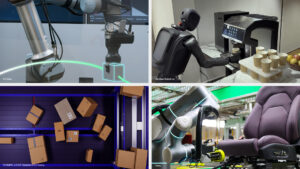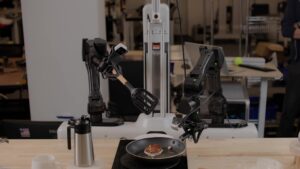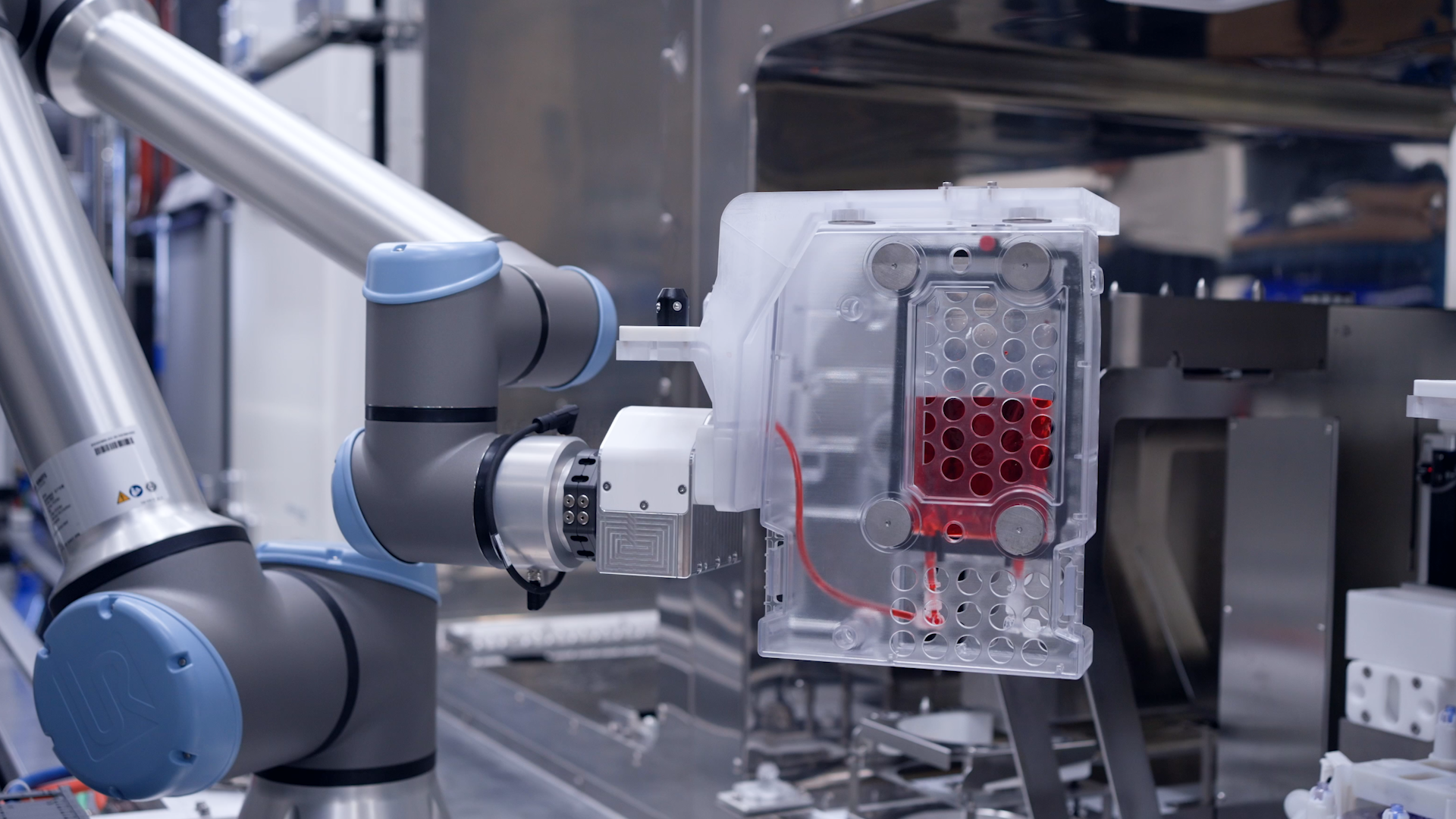
Multiply Labs is doing for cell therapy labs what has already happened in the chip industry: It’s introducing robots to do the tedious, precision and hygienic work better, faster and cheaper.
The startup concept was sparked when Fred Parietti was at MIT doing PhD research in robotics and he met with Alice Melocchi, who showed him how these laborious labs lacked automation while risking contamination.
“She showed me what she did in a lab and how difficult it was, and I couldn’t believe it — I thought drugs were made like chips, and this was insane but also real,” said Parietti, cofounder and CEO of Multiply Labs. “Next, I flew to Silicon Valley, and we started this at YCombinator.”
San Francisco-based Multiply Labs, founded in 2016, today is automating cell therapy manufacturing with robots for leading companies, including Kyverna Therapeutics and Legend Biotech.
Multiply Labs offers end-to-end robotic systems that produce gene modified cell therapies at scale.
Similar to how the semiconductor industry has evolved from clean rooms with technicians in bunny suits, Multiple Labs is ushering in this new era for biosciences. Like with chips today, it promises precision gains, reduced contamination and advanced manufacturing with physical AI.
Multiply Labs systems are bringing these therapeutics into the future using NVIDIA Omniverse libraries for developing digital twins of these lab environments and the NVIDIA Isaac Sim robotics simulation framework for training robots on the bespoke skills required to develop these treatments. It’s also developing humanoid robots using the NVIDIA Isaac GR00T humanoid foundation robot model for assisting in the labs with improved hygiene.
Cell therapies are new and involve taking cells from a patient or donor and modifying them for treating patients to fight diseases or a patient’s own immune response. They show promise for treating cancers, genetic disorders, autoimmune diseases and neurological conditions.
These artisanal treatments — one-offs for specific patients — are expensive to produce and can easily be destroyed in the process by contamination or improper handling. Robots within the controlled biomanufacturing clusters of Multiply Labs help ensure more hygienic and precision processes.
“It needs to be sterile, and you don’t want anyone breathing anywhere near the cells, so it was an obvious high value application of robotics,” said Parietti.
Simulating Cell Therapy Manufacturing Skills for Improved Precision in Labs
Cell therapy manufacturing is complex, costly, and prone to failure. Bioscience companies are turning to automation and simulation to reduce risk, scale output and preserve expert knowledge. A key development is imitation learning — training robots in Isaac Sim to replicate expert tasks by analyzing video demonstrations. This approach captures the tacit, often undocumented skills of top scientists and translates them into robotic control policies.
NVIDIA FoundationPose, an Isaac model for pose estimation, and NVIDIA FoundationStereo, an Isaac model for stereo matching, play a crucial role in extracting trajectories from video, enabling robots to learn directly from the best human examples. This is especially vital in pharma, where tech transfer of processes from labs to production environments is critical. Also, it’s important to mitigate knowledge loss due to staff turnover, which can cripple production.
“We’re literally training the robot on the exact video example of the best scientist, and we prove that they are statistically equivalent,” said Parietti. “If people leave or retire, yield can go down — we observe that there can be a lot of implicit knowledge in these operations, it’s almost like an art.”
Multiply Labs simulates robot arm processes using digital twins from NVIDIA Omniverse. This allows the company to run thousands of virtual iterations, identifying and resolving nearly all mechanical bugs before real-world deployment. The result: faster, safer and more precise lab operations.
Scaling Up Robotic Systems to Make Cell Therapies More Accessible
Cell and gene therapies hold extraordinary promise, but their complexity and cost have historically limited access. Automation is changing that.
Today, manufacturing a single dose of cell therapy can cost upwards of $100,000. Through advanced robotics, that cost can be reduced by more than 70%, bringing it down to $25,000 to $35,000 per dose. But cost is only part of the equation. Automation also increases throughput, enabling up to 100 times more therapies to be produced per square foot of facility space.
“We want to enable the shift of the industry from niche to scale — 100 times more therapies at 70% less cost — so life-saving treatments aren’t just for the few, but for the millions,” said Parietti.
These therapies involve thousands of precise, sterile steps — moving liquids between vessels, stirring bags and syringes without introducing bubbles, maintaining exact temperatures — all within tight time constraints. Human error, even in a single step, can compromise the entire process. Robots, on the other hand, don’t breathe, don’t stop and don’t deviate. They execute each task with precision, consistency and traceability around the clock.
Harnessing Humanoids to Improve Processes for Contamination
In the high-stakes world of cell therapy manufacturing, contamination isn’t just a nuisance — it’s a showstopper. While robotic arms inside the controlled cluster environment perform with surgical precision, the real wild west lies just outside the robotic cluster. Loading and unloading materials manually? That’s where the chaos creeps in. A sneeze, a slip, a syringe dropped where it shouldn’t be — suddenly, the pristine process is compromised.
Enter humanoids. Adaptable, two-armed workhorses designed to tackle the unstructured, unpredictable world outside the clean room. They just need to pick up cartridges, move them carefully and keep the process clean.

Multiply Labs is developing humanoids with NVIDIA Isaac GR00T N foundation models. Isaac GR00T N1.5 is an open robot foundational model for generalized humanoid robot reasoning and skills.
“GR00T gives our humanoids the muscle memory of a thousand lifetimes,” said Parietti. “It’s like teaching a robot to dance by showing it a few steps.”
With Isaac GR00T, training humanoids to handle loading and unloading becomes a scalable, repeatable process. It transforms messy human demonstrations into clean control policies, allowing robots to learn fast and deploy faster. As the industry scales from a handful of deployments to dozens, GR00T ensures that each humanoid knows exactly what to do — and how to do it without contaminating the goods.
The result? A fully automated manufacturing floor where humans watch from behind the glass, and humanoids — powered by Isaac GR00T — keep the process flowing, clean and contamination-free.
Categories:
Robotics
Related News