country_code

Fraunhofer Research Leads Way Into Future of Robotics

The Germany-based research group’s O3dyn platform uses NVIDIA simulation technologies to create autonomous mobile robots for manufacturing.
by Scott Martin

Joseph Fraunhofer was a 19th-century pioneer in optics who brought together scientific research with industrial applications. Fast forward to today and Germany’s Fraunhofer Society — Europe’s largest R&D organization — is setting its sights on the applied research of key technologies, from AI to cybersecurity to medicine.

Its Fraunhofer IML unit is aiming to push the boundaries of logistics and robotics. The German researchers are harnessing NVIDIA Isaac Sim to make advances in robot design through simulation.

Like many — including BMW, Amazon and Siemens — Fraunhofer IML relies on NVIDIA Omniverse. It’s using it to make gains in applied research in logistics for fulfillment and manufacturing.

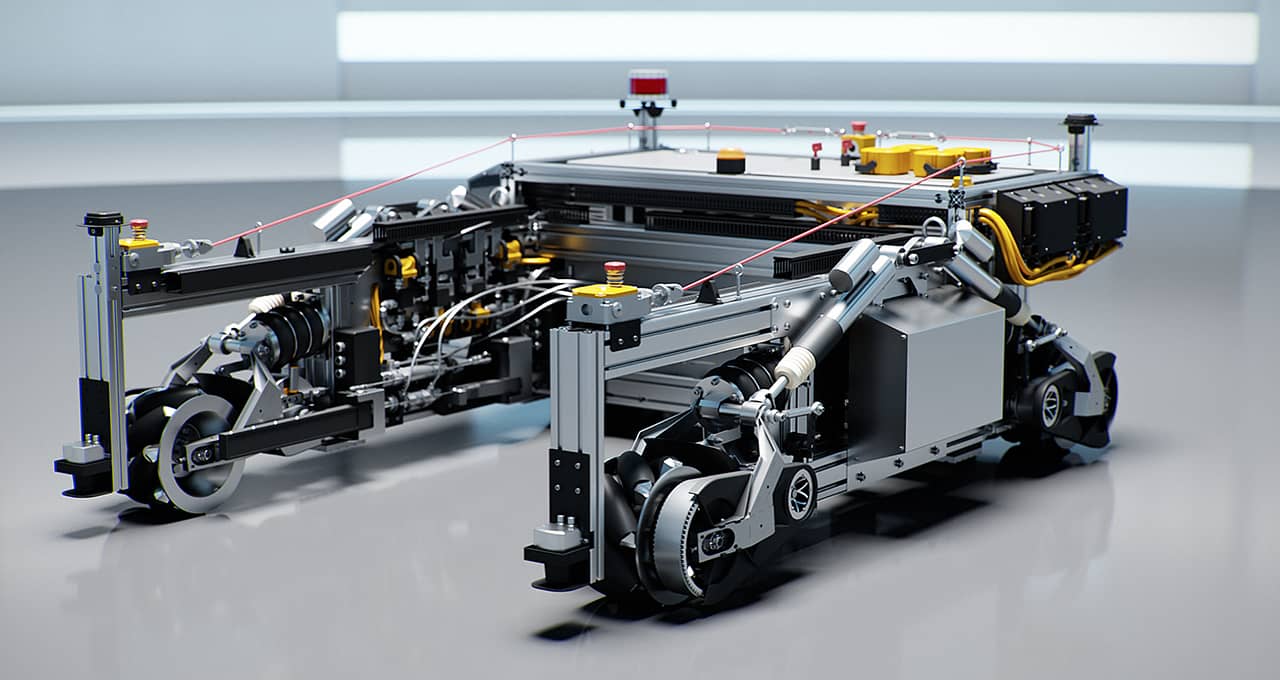
Fraunhofer’s newest innovation, dubbed O3dyn, uses NVIDIA simulation and robotics technologies to create an indoor-outdoor autonomous mobile robot (AMR).

Its goal is to enable the jump from automated guided vehicles to fast-moving AMRs that aren’t even yet available on the market.

This level of automation advancement promises a massive uptick in logistics acceleration.

“We’re looking at how we can go as fast and as safely as possible in logistics scenarios,” said Julian Esser, a robotics and AI researcher at Fraunhofer IML.

From MP3s to AMRs

Fraunhofer IML’s parent organization, based in Dortmund, near the country’s center, has more than 30,000 employees and is involved in hundreds of research projects. In the 1990s, it was responsible for the development of the MP3 file format, which led to the digital music revolution.

Seeking to send the automated guided vehicle along the same path as the compact disc, Fraunhofer in 2013 launched a breakthrough robot now widely used by BMW in its assembly plants and others.

This robot, known as the STR, is a workhorse for industrial manufacturing. It’s used for moving goods for the production lines. Fraunhofer IML’s AI work benefits the STR and other updates to this robotics platform, such as the O3dyn.

Fraunhofer IML is aiming to create AMRs that deliver a new state of the art. The O3dyn relies on the NVIDIA Jetson edge AI and robotics platform for a multitude of camera and sensor inputs to help navigate.

Advancing speed and agility, it’s capable of going up to 30 miles per hour and has wheels assisted by AI for any direction of movement to maneuver tight situations.

“The omnidirectional dynamics is very unique, and there’s nothing like this that we know of in the market,” said Sören Kerner, head of AI and autonomous systems at Fraunhofer IML.

Fraunhofer IML gave a sneak peek at its latest development on this pallet-moving robot at NVIDIA GTC.

Bridging Sim to Real

Using Isaac Sim, Fraunhofer IML’s latest research strives to develop and validate these AMRs in simulation by closing the sim-to-real gap. The researchers rely on Isaac Sim for virtual development of its highly dynamic autonomous mobile robot by exercising the robot in photorealistic, physically accurate 3D worlds.

This enables Fraunhofer to import into the virtual environment its robot’s more than 5,400 parts from computer-aided design software. It can then rig them with physically accurate specifications with Omniverse PhysX.

The result is that the virtual robot version can move as swiftly in simulation as the physical robot in the real world. Harnessing the virtual environment allows Fraunhofer to accelerate development, safely increase accuracy for real-world deployment and scale up faster.

Minimizing the sim-to-real gap makes simulation become a digital reality for robots. It’s a concept Fraunhofer refers to as simulation-based AI.

To make faster gains, Fraunhofer is releasing the AMR simulation model into open source so developers can make improvements.

“This is important for the future of logistics,” said Kerner. “We want to have as many people as possible work on the localization, navigation and AI of these kinds of dynamic robots in simulation.”

Learn more by watching Fraunhofer’s GTC session: “Towards a Digital Reality in Logistics Automation: Optimization of Sim-to-Real.”

Register for the upcoming GTC, running Sept. 19-22, and explore the robotics-related sessions.
 

New NVIDIA Nemotron 3 Super Delivers 5x Higher Throughput for Agentic AI

A new, open, 120-billion-parameter hybrid mixture-of-experts model optimized for NVIDIA Blackwell addresses the costs of long thinking and context explosion that slow autonomous agent workflows.
by Kari Briski

Launched today, NVIDIA Nemotron 3 Super is a 120‑billion‑parameter open model with 12 billion active parameters designed to run complex agentic AI systems at scale. 

Available now, the model combines advanced reasoning capabilities to efficiently complete tasks with high accuracy for autonomous agents.

AI-Native Companies: Perplexity offers its users access to Nemotron 3 Super for search and as one of 20 orchestrated models in Computer. Companies offering software development agents like CodeRabbit, Factory and Greptile are integrating the model into their AI agents along with proprietary models to achieve higher accuracy at lower cost. And life sciences and frontier AI organizations like Edison Scientific and Lila Sciences will power their agents for deep literature search, data science and molecular understanding.

Enterprise Software Platforms: Industry leaders such as Amdocs, Palantir, Cadence, Dassault Systèmes and Siemens are deploying and customizing the model to automate workflows in telecom, cybersecurity, semiconductor design and manufacturing. 

As companies move beyond chatbots and into multi‑agent applications, they encounter two constraints.

The first is context explosion. Multi‑agent workflows generate up to 15x more tokens than standard chat because each interaction requires resending full histories, including tool outputs and intermediate reasoning. 

Over long tasks, this volume of context increases costs and can lead to goal drift, where agents lose alignment with the original objective.

The second is the thinking tax. Complex agents must reason at every step, but using large models for every subtask makes multi-agent applications too expensive and sluggish for practical applications.

Nemotron 3 Super has a 1‑million‑token context window, allowing agents to retain full workflow state in memory and preventing goal drift.

Nemotron 3 Super has set new standards, claiming the top spot on Artificial Analysis for efficiency and openness with leading accuracy among models of the same size. 

The model also powers the NVIDIA AI-Q research agent to the No. 1 position on DeepResearch Bench and DeepResearch Bench II leaderboards, benchmarks that measure an AI system’s ability to conduct thorough, multistep research across large document sets while maintaining reasoning coherence. 

Hybrid Architecture

Nemotron 3 Super uses a hybrid mixture‑of‑experts (MoE) architecture that combines three major innovations to deliver up to 5x higher throughput and up to 2x higher accuracy than the previous Nemotron Super model. 

  • Hybrid Architecture: Mamba layers deliver 4x higher memory and compute efficiency, while transformer layers drive advanced reasoning.
  • MoE: Only 12 billion of its 120 billion parameters are active at inference. 
  • Latent MoE: A new technique that improves accuracy by activating four expert specialists for the cost of one to generate the next token at inference.
  • Multi-Token Prediction: Predicts multiple future words simultaneously, resulting in 3x faster inference.

On the NVIDIA Blackwell platform, the model runs in NVFP4 precision. That cuts memory requirements and pushes inference up to 4x faster than FP8 on NVIDIA Hopper, with no loss in accuracy. 

Open Weights, Data and Recipes

NVIDIA is releasing Nemotron 3 Super with open weights under a permissive license. Developers can deploy and customize it on workstations, in data centers or in the cloud.

The model was trained on synthetic data generated using frontier reasoning models. NVIDIA is publishing the complete methodology, including over 10 trillion tokens of pre- and post-training datasets, 15 training environments for reinforcement learning and evaluation recipes. Researchers can further use the NVIDIA NeMo platform to fine-tune the model or build their own. 

Use in Agentic Systems

Nemotron 3 Super is designed to handle complex subtasks inside a multi-agent system. 

A software development agent can load an entire codebase into context at once, enabling end-to-end code generation and debugging without document segmentation. 

In financial analysis it can load thousands of pages of reports into memory,  eliminating the need to re-reason across long conversations, which improves efficiency. 

Nemotron 3 Super has high-accuracy tool calling that ensures autonomous agents reliably navigate massive function libraries to prevent execution errors in high-stakes environments, like autonomous security orchestration in cybersecurity.

Availability

NVIDIA Nemotron 3 Super, part of the Nemotron 3 family, can be accessed at build.nvidia.com, Perplexity, OpenRouter and Hugging Face. Dell Technologies is bringing the model to the Dell Enterprise Hub on Hugging Face, optimized for on-premise deployment on the Dell AI Factory, advancing multi-agent AI workflows. HPE is also bringing NVIDIA Nemotron to its agents hub to help ensure scalable enterprise adoption of agentic AI. 

Enterprises and developers can deploy the model through several partners:

The model is packaged as an NVIDIA NIM microservice, allowing deployment from on-premises systems to the cloud.

Stay up to date on agentic AI, NVIDIA Nemotron and more by subscribing to NVIDIA AI news, joining the community, and following NVIDIA AI on LinkedIn, Instagram, X and Facebook.

Explore self-paced video tutorials and livestreams.

NVIDIA and ComfyUI Streamline Local AI Video Generation for Game Developers and Creators at GDC

AI-powered video generation becomes more accessible with ComfyUI’s App Mode view, NVIDIA RTX Video Super Resolution and new NVFP4 models.
by Michael Fukuyama

Game developers and artists are building cinematic worlds and iconic characters — raising the bar for immersive experiences on NVIDIA RTX AI PCs

At the Game Developers Conference (GDC) in San Francisco this week, NVIDIA announced a suite of updates that streamline AI video generation for concept development and storyboarding on RTX GPUs and the NVIDIA DGX Spark desktop supercomputer.

These announcements include:

  • ComfyUI’s new App View with a simplified interface, lowering the barrier for entry for the popular generative AI tool.
  • RTX Video Super Resolution available for ComfyUI, a real-time 4K upscaler ideal for video generation — also available for developers as a Python Wheel.
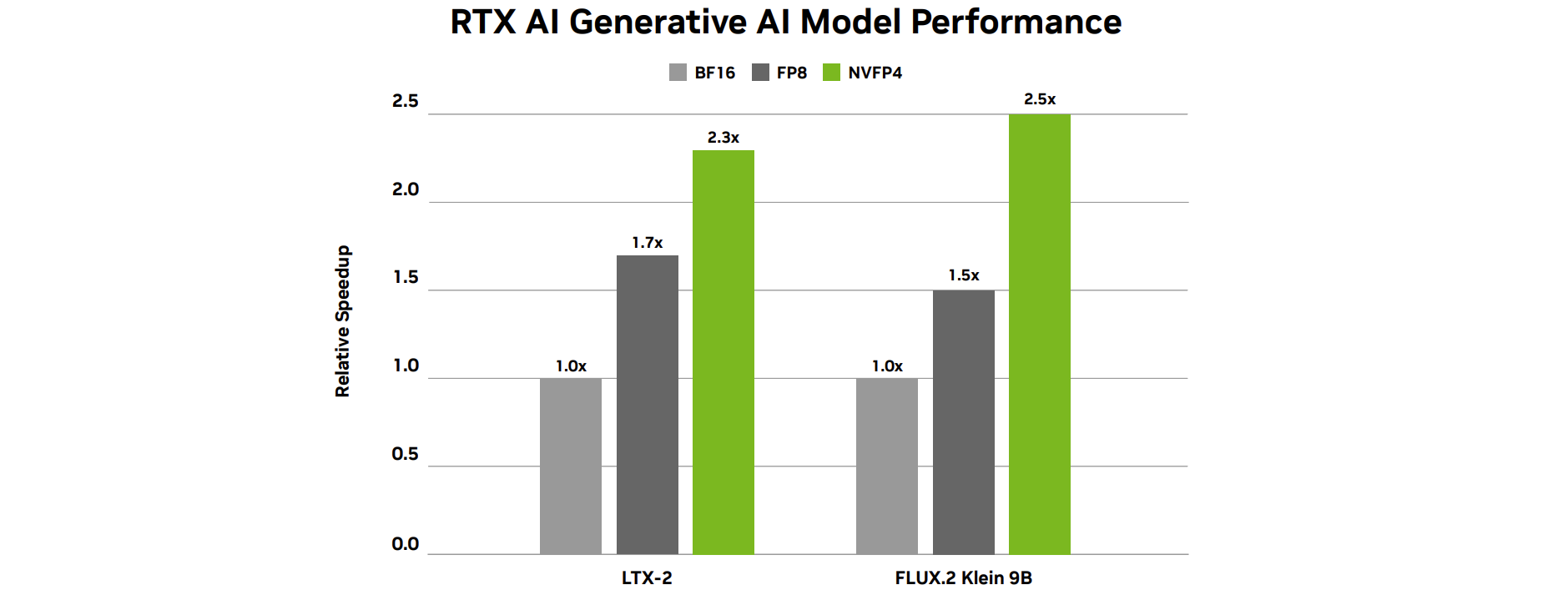
  • NVFP4 and FP8 model variants are available today for FLUX.2 Klein, with NVFP4 support for LTX-2.3 coming soon, delivering up to 2.5x performance gains and 60% lower memory usage for both models.

Frictionless Local AI: Collaborate, Optimize, Customize

Many of today’s popular AI applications are making it easier for beginners to try state-of-the-art models directly on their laptop or desktop.

For artists unfamiliar with node graphs, ComfyUI’s new App View presents workflows in a simplified interface. Users only need to enter a prompt, adjust simple parameters and hit generate. The full node-based experience remains available as Node View, and users can seamlessly switch between the two modes.

App View is compatible with the RTX optimizations in ComfyUI. Performance for RTX GPUs is 40% faster since September, and ComfyUI now supports NVFP4 and FP8 data formats natively. All combined, performance is 2.5x faster and VRAM is reduced by 60% with NVIDIA GeForce RTX 50 Series GPUs’ NVFP4 format, and performance is 1.7x faster and VRAM is reduced by 40% with FP8.

At CES in January, NVIDIA announced several models released with NVFP4 and FP8 support. And now more NVFP4 and FP8 models are available — LTX-2.3, with NVFP4 support coming soon, FLUX.2 Klein 4B, and FLUX.2 Klein 9B directly in ComfyUI. To get started, download the NVFP4 and FP8 checkpoints directly from Hugging Face, load the default workflows in ComfyUI via the Template Browser and replace the default model checkpoint with the newly downloaded checkpoint. 

App View mode is available today. Learn more on ComfyUI

Faster 4K Video Generation 

Getting high-quality video outputs often means juggling three constraints: speed, VRAM and control. While many artists ultimately want 4K quality, most prefer to generate smaller, faster previews first, and then upscale them. Today’s upscalers take minutes to upscale a 10‑second clip into 4K resolution.

Now, users can quickly upscale generated video to 4K with NVIDIA RTX Video Super Resolution, available as a node for ComfyUI. RTX Video can be accessed as a standalone node for building video workflows from scratch.

For AI developers, NVIDIA released a free Python package available via the PyPI repository, along  with sample code on GitHub and a VFX Python bindings guide, to get started quickly. The package provides programmatic access to the same AI upscaling technology that powers RTX Video, running directly on RTX GPU Tensor Cores to deliver 4K upscaling 30x faster than alternative popular local upscalers, and at a fraction of the VRAM cost. The package is powered by the NVIDIA Video Effects software development kit.

Generative AI model performance for LTX-2 and FLUX.2 Klein 9B on an NVIDIA RTX 5090 GPU. Performance testing done on RTX 5090. LTX-2: 512×768 resolution, 100 frames, 20 steps. FLUX.2 Klein 9B (base): 1024×1024 resolution, 20 steps.

Ready to get started with ComfyUI? Check out the latest NVIDIA Studio Sessions tutorial hosted by  visual effects artist Max Novak for a guided walkthrough:

#ICYMI: The Latest Updates for RTX AI PCs at GDC

🎉Join NVIDIA at GTC, March 16-19 in San Jose! Check out “Create Generative AI Workflow for Design and Visualization in ComfyUI” on March 17, for a training session led by NVIDIA 3D workflow specialists focused on building RTX-accelerated generative workflows for images, video, 3D, and PBR materials. Register today and explore the session catalog.

💡LTX Desktop is a fully local, open-source video editor running directly on the LTX engine, optimized for NVIDIA GPUs and compatible hardware.

🦥 LM Link connects separate devices running LM Studio, allowing models to run on remote machines as if they were local. It’s ideal for users wanting to run an agent on their laptop while still accessing free and private AI, powered by their DGX Spark or RTX desktop. Learn how to run LM Studio on DGX Spark.

🎮On Tuesday, March 31, as part of the next opt-in NVIDIA App beta, overrides for NVIDIA DLSS 4.5 Dynamic Multi Frame Generation and DLSS 4.5 Multi Frame Generation 6x Mode will be released for GeForce RTX 50 Series owners. Learn about NVIDIA news at GDC.

🤖Next month, a new NVIDIA RTX Remix update will introduce Advanced Particle VFX, enabling modders to create a wide array of particle effects that further improve image quality, detail and immersion.

🦄Topaz Labs has collaborated with NVIDIA to optimize NeuroStream for NVIDIA GPUs — a proprietary VRAM optimization that allows complex AI models to run on consumer hardware.

📃Microsoft has introduced support for VoiceMod, one of the first apps to enable Windows ML for GPU inference, significantly improving performance voice quality compared with CPUs. 

Plug in to NVIDIA AI PC on Facebook, Instagram, TikTok and X — and stay informed by subscribing to the RTX AI PC newsletter. Follow NVIDIA Workstation on LinkedIn and X

See notice regarding software product information.

AI Is a 5-Layer Cake

by Jensen Huang