Expanding the open model universe, NVIDIA today released new open models, data and tools to advance AI across every industry.
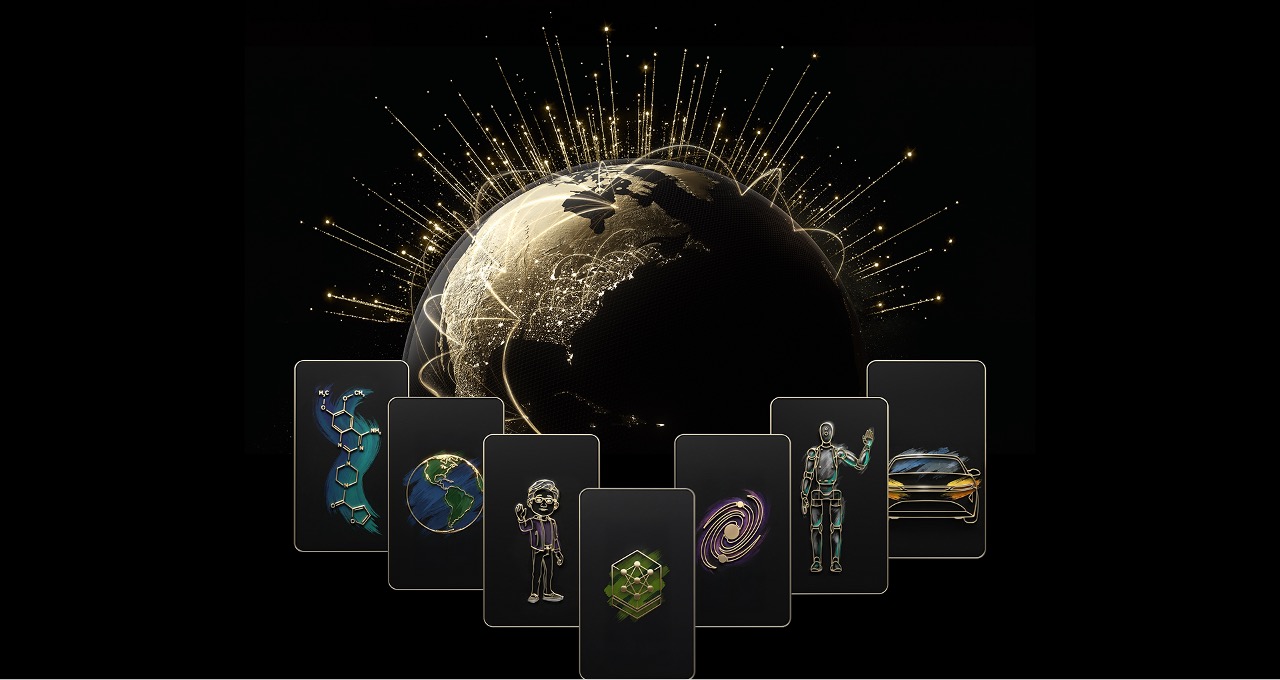
These models — spanning the NVIDIA Nemotron family for agentic AI, the NVIDIA Cosmos platform for physical AI, the new NVIDIA Alpamayo family for autonomous vehicle development, NVIDIA Isaac GR00T for robotics and NVIDIA Clara for biomedical — will empower companies with the tools to develop real-world AI systems.
NVIDIA contributes open-source training frameworks and one of the world’s largest collections of open multimodal data, including 10 trillion language training tokens, 500,000 robotics trajectories, 455,000 protein structures and 100 terabytes of vehicle sensor data. This is an unprecedented scale of diverse open resources to accelerate innovation in language, robots, scientific research and autonomous vehicles.
Leading technology companies — including Bosch, CodeRabbit, CrowdStrike, Cohesity, Fortinet, Franka Robotics, Humanoid, Palantir, Salesforce, ServiceNow, Hitachi and Uber — are adopting and building on NVIDIA’s open model technologies.
NVIDIA Nemotron Brings Speech, Multimodal Intelligence and Safety to AI Agents
Building on the recently released NVIDIA Nemotron 3 family of open models and data, NVIDIA is releasing Nemotron models for speech, multimodal retrieval-augmented generation (RAG) and safety.
- Nemotron Speech comprises leaderboard-topping open models, including a new ASR model, that deliver real-time, low-latency speech recognition for live captions and speech AI applications. Daily and Modal benchmarks show that the model delivers 10x faster performance than other models in its class.
- Nemotron RAG comprises new embed and rerank vision language models (VLMs) that provide highly accurate multilingual and multimodal data insights to enhance document search and information retrieval.
- Nemotron Safety models, which strengthen the safety and trustworthiness of AI applications, now include the Llama Nemotron Content Safety model, featuring expanded language support, and Nemotron PII, which detects sensitive data with high accuracy.
Bosch is adopting Nemotron Speech to enable drivers to interact with their vehicles. ServiceNow trains its Apriel model family on open datasets, including Nemotron for cost-efficient multimodal performance.
Cadence and IBM are piloting NVIDIA Nemotron RAG models to improve search and reasoning across complex technical documents.
CrowdStrike, Cohesity and Fortinet are adopting NVIDIA Nemotron Safety models to strengthen the trustworthiness of their AI applications.
Palantir is integrating Nemotron models into its Ontology framework to build a first-of-its-kind, integrated technology stack for specialized AI agents. CodeRabbit is using Nemotron models to power and scale its AI code reviews, improving speed and cost efficiency while maintaining high review accuracy.
NVIDIA is also releasing open-source datasets, training resources and blueprints to developers, including the dataset and training code for the Llama Embed Nemotron 8B model, featured on the MMTEB leaderboard. This is in addition to the updated LLM Router that shows developers how to automatically direct AI requests to the best model for the job, and the dataset used to build the new Nemotron Speech ASR model.
New Models for Every Type of Physical AI and Robot
Developing physical AI for robots and autonomous systems requires large, diverse datasets and models that can perceive, reason and act in complex, real-world environments. On Hugging Face, robotics is the fastest-growing segment, with NVIDIA’s open robotics models and datasets leading the platform’s downloads.
NVIDIA is releasing NVIDIA Cosmos open world foundation models that bring humanlike reasoning and world generation to accelerate physical AI development and validation.
- Cosmos Reason 2 is a new, leaderboard-topping reasoning VLM that helps robots and AI agents see, understand and interact with higher accuracy in the physical world.
- Cosmos Transfer 2.5 and Cosmos Predict 2.5 are leading models that generate large-scale synthetic videos across diverse environments and conditions.
NVIDIA has also released open models and blueprints for each physical AI embodiment, built on Cosmos:
- Isaac GR00T N1.6 is an open reasoning vision language action (VLA) model, purpose-built for humanoid robots, that unlocks full body control and uses NVIDIA Cosmos Reason for better reasoning and contextual understanding.
- The NVIDIA Blueprint for video search and summarization, part of the NVIDIA Metropolis platform, is a reference workflow for building vision AI agents that can analyze large volumes of recorded and live video to improve operational efficiency and public safety.
Salesforce, Milestone, Hitachi, Uber, VAST Data and Encord are using Cosmos Reason for traffic and workplace productivity AI agents. Franka Robotics, Humanoid and NEURA Robotics are using Isaac GR00T to simulate, train and validate new behaviors for robots before scaling to production.
NVIDIA Alpamayo for Reasoning-Based Autonomous Vehicles
Developing safe, scalable autonomous driving depends on AI that can perceive, reason and act in complex real-world environments and scenarios, with development workflows that support rapid training, testing and improvement at scale.
NVIDIA is releasing NVIDIA Alpamayo, a new family of open models, simulation tools and large datasets to advance reasoning-based autonomous vehicle development. It includes:
- Alpamayo 1, the first open, large-scale reasoning VLA model for autonomous vehicles (AVs) that enables vehicles to understand their surroundings, as well as explain their actions.
- AlpaSim, an open-source simulation framework that enables closed-loop training and evaluation of reasoning-based AV models across diverse environments and edge cases.
NVIDIA is also releasing Physical AI Open Datasets, including over 1,700 hours of driving data collected across the widest range of geographies and conditions, covering rare and complex real-world edge cases essential for advancing reasoning architectures.
NVIDIA Clara for Healthcare and Life Sciences
To lower costs and deliver treatments faster, NVIDIA is launching new Clara AI models that bridge the gap between digital discovery and real-world medicine.
Helping researchers design treatments that are safer, more effective and easier to produce, these models include:
- La-Proteina enables the design of large, atom-level-precise proteins for research and drug candidate development, giving scientists new tools to study diseases previously considered untreatable.
- ReaSyn v2 ensures AI-designed drugs are practical to synthesize by incorporating a manufacturing blueprint into the discovery process.
- KERMT provides high-accuracy, computational safety testing early in development by predicting how a potential drug will interact with the human body.
- RNAPro unlocks the potential of personalized medicine by predicting the complex 3D shapes of RNA molecules.
In addition, an NVIDIA dataset of 455,000 synthetic protein structures helps AI researchers build more accurate AI models.
Get Started With NVIDIA Open Models and Technologies
NVIDIA open models, data and frameworks are now available on GitHub and Hugging Face and from a range of cloud, inference and AI infrastructure platforms, as well as build.nvidia.com, giving developers flexible access to supporting resources.
Many of these models are also available as NVIDIA NIM microservices for secure, scalable deployment on any NVIDIA-accelerated infrastructure, from the edge to the cloud.
Learn more by watching NVIDIA Live at CES.