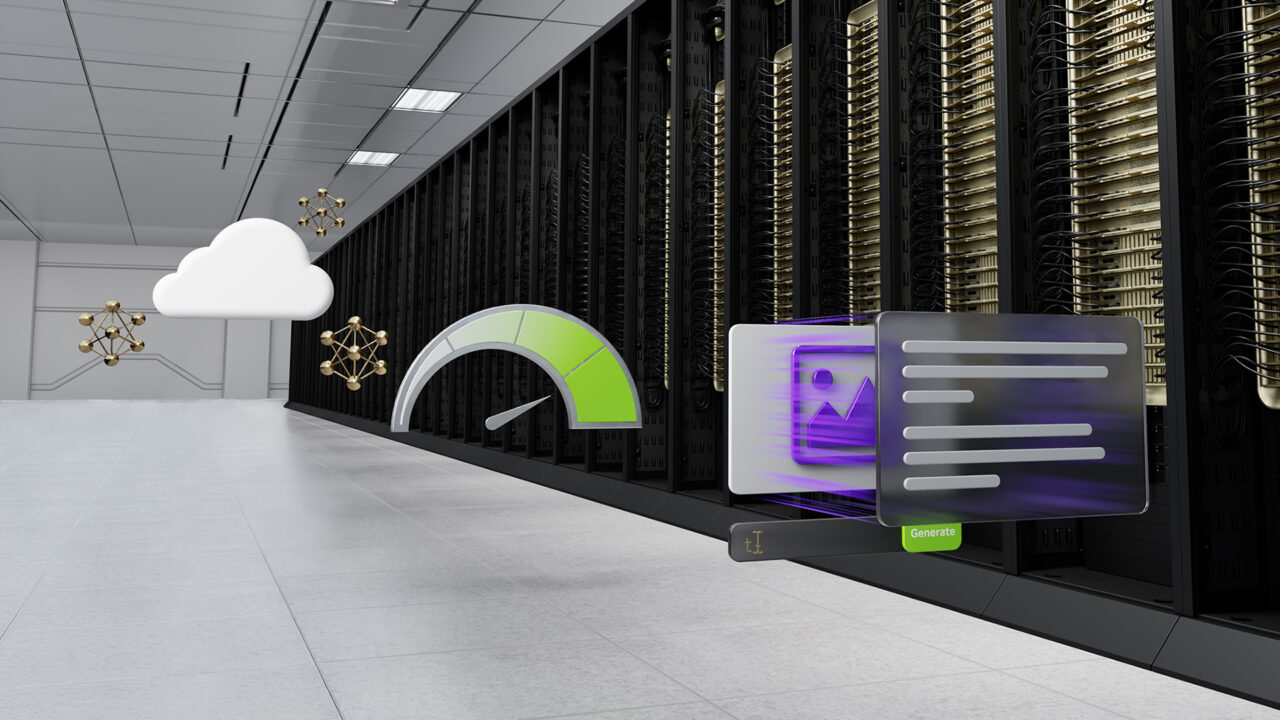
From AI assistants doing deep research to autonomous vehicles making split-second navigation decisions, AI adoption is exploding across industries.
Behind every one of those interactions is inference — the stage after training where an AI model processes inputs and produces outputs in real time.
Today’s most advanced AI reasoning models — capable of multistep logic and complex decision-making — generate far more tokens per interaction than older models, driving a surge in token usage and the need for infrastructure that can manufacture intelligence at scale.
AI factories are one way of meeting these growing needs.
But running inference at such a large scale isn’t just about throwing more compute at the problem.
To deploy AI with maximum efficiency, inference must be evaluated based on the Think SMART framework:
- Scale and efficiency
- Multidimensional performance
- Architecture and codesign
- Return on investment driven by performance
- Technology ecosystem and install base
Scale and Efficiency
As models evolve from compact applications to massive, multi-expert systems, inference must keep pace with increasingly diverse workloads — from answering quick, single-shot queries to multistep reasoning involving millions of tokens.
The expanding size and intricacy of AI models — as well as scale of AI adoption — is introducing major implications for inference, such as resource intensity, latency and throughput, energy and costs, and diversity of use cases.
To meet this growing demand, AI service providers and enterprises are scaling up their infrastructure, with new AI factories coming online from partners like CoreWeave, Dell Technologies, Google Cloud and Nebius.
Multidimensional Performance
Scaling complex AI deployments means AI factories need the flexibility to serve tokens across a wide spectrum of use cases while balancing accuracy, latency and costs.
Some workloads, such as real-time speech-to-text translation, demand ultralow latency and a large number of tokens per user, straining computational resources for maximum responsiveness. Others are latency-insensitive and geared for sheer throughput, such as generating answers to dozens of complex questions simultaneously.
But most popular real-time scenarios operate somewhere in the middle: requiring quick responses to keep users happy and high throughput to simultaneously serve up to millions of users — all while minimizing cost per token.
For example, the NVIDIA inference platform is built to balance both latency and throughput, powering inference benchmarks on models like gpt-oss, DeepSeek-R1 and Llama 3.1.
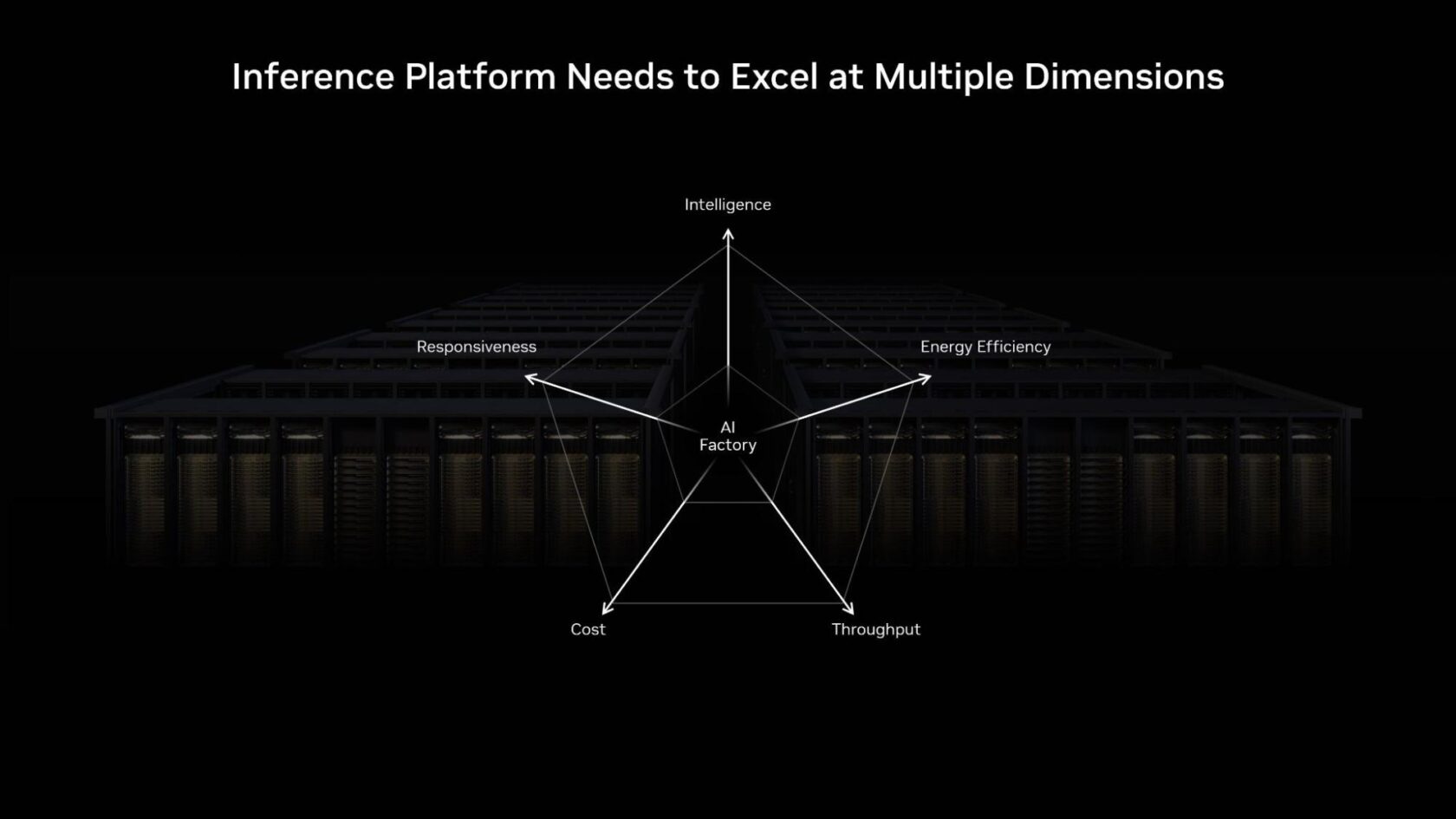
What to Assess in an AI Factory to Achieve Optimal Multidimensional Inference Performance
- Intelligence: Evaluate how model size and complexity impact both performance and cost. Larger models may deliver deeper intelligence, but they require significantly more compute, affecting overall efficiency.
- Responsiveness: Balance user experience with system scalability. Allocating more compute per query improves responsiveness, while sharing resources across users maximizes total throughput and revenue.
- Energy Efficiency: Measure performance in tokens per second per watt to understand true productivity within power limits. Achieving higher energy efficiency directly translates to better economics and sustainability at scale.
- Cost: Assess performance per dollar to ensure scalable, cost-effective AI deployment. Sustainable economics comes from balancing low-latency responsiveness with high-throughput efficiency across diverse inference workloads.
- Throughput: Track how many tokens your system processes per second and how flexibly it adapts to varying demand. Optimizing token throughput is essential to scaling workloads and maximizing output.
Architecture and Software Codesign
AI inference performance isn’t a single-component challenge; it requires a full-stack solution that is engineered from the ground up. It comes from hardware and software working in sync — GPUs, networking and code tuned to avoid bottlenecks and make the most of every cycle.
Powerful architecture without smart orchestration wastes potential; great software without fast, low-latency hardware means sluggish performance. The key is architecting a system so that it can quickly, efficiently and flexibly turn prompts into useful answers.
The NVIDIA inference platform delivers a full-stack solution through extreme codesign of powerful hardware and a comprehensive software stack.
Architecture Optimized for Inference at AI Factory Scale
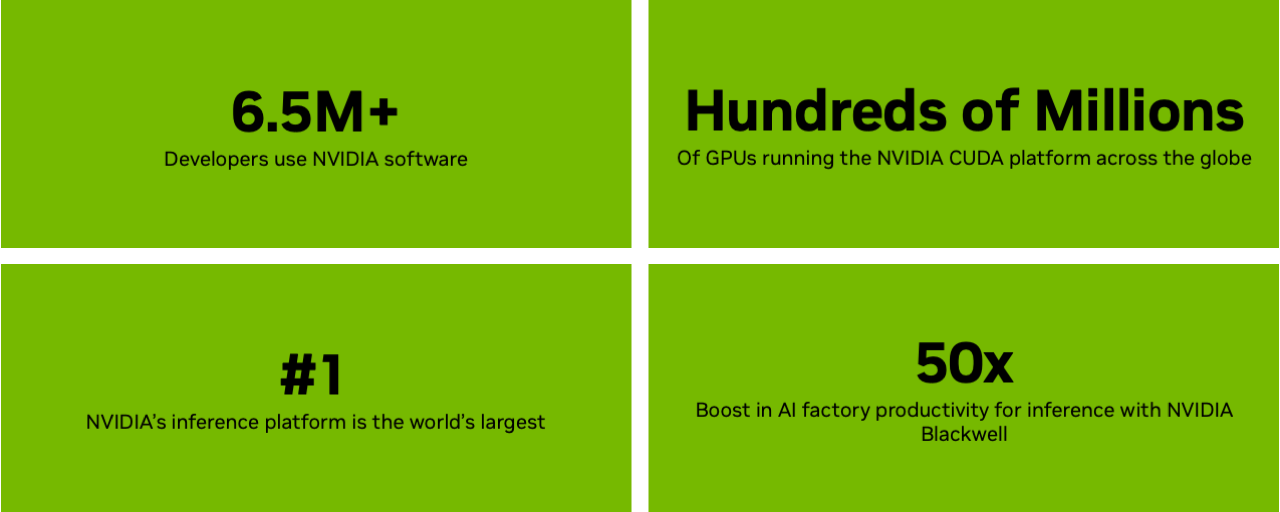
The NVIDIA Blackwell platform unlocks a 50x boost in AI factory productivity for inference — meaning enterprises can optimize throughput and interactive responsiveness, even when running the most complex models.
The NVIDIA GB200 NVL72 rack-scale system connects 36 NVIDIA Grace CPUs and 72 Blackwell GPUs with NVIDIA NVLink interconnect, delivering 40x higher revenue potential, 30x higher throughput, 25x more energy efficiency and 300x more water efficiency for demanding AI reasoning workloads.
Further, NVFP4 is a low-precision format that delivers peak performance on NVIDIA Blackwell and slashes energy, memory and bandwidth demands without skipping a beat on accuracy, so users can deliver more queries per watt and lower costs per token.
Full-Stack Inference Platform Accelerated on Blackwell
Enabling inference at AI factory scale requires more than accelerated architecture. It requires a full-stack platform with multiple layers of solutions and tools that can work in concert together.
Modern AI deployments require dynamic autoscaling from one to thousands of GPUs. The NVIDIA Dynamo platform steers distributed inference to dynamically assign GPUs and optimize data flows, delivering up to 4x more performance without cost increases. Plus, new cloud integrations with NVIDIA Dynamo further simplify AI inference at data center scale.
For inference workloads focused on getting optimal performance per GPU, such as speeding up large mixture of expert models, frameworks like NVIDIA TensorRT-LLM are helping developers achieve breakthrough performance.
With its new PyTorch-centric workflow, TensorRT-LLM streamlines AI deployment by removing the need for manual engine management. These solutions aren’t just powerful on their own — they’re built to work in tandem. For example, using Dynamo and TensorRT-LLM, mission-critical inference providers like Baseten can immediately deliver state-of-the-art model performance even on new frontier models like gpt-oss.
On the model side, families like NVIDIA Nemotron are built with open training data for transparency, while still generating tokens quickly enough to handle advanced reasoning tasks with high accuracy — without increasing compute costs. And with NVIDIA NIM, those models can be packaged into ready-to-run microservices, making it easier for teams to roll them out and scale across environments while achieving the lowest total cost of ownership.
Together, these layers — dynamic orchestration, optimized execution, well-designed models and simplified deployment — form the backbone of inference enablement for cloud providers and enterprises alike.
Return on Investment Driven by Performance
As AI adoption grows, organizations are increasingly looking to maximize the return on investment from each user query.
Performance is the biggest driver of return on investment. A 4x increase in performance from the NVIDIA Hopper architecture to Blackwell yields up to 10x profit growth within a similar power budget.
In power-limited data centers and AI factories, generating more tokens per watt translates directly to higher revenue per rack. Managing token throughput efficiently — balancing latency, accuracy and user load — is crucial for keeping costs down.
The industry is seeing rapid cost improvements, going as far as reducing costs-per-million-tokens by 80% through stack-wide optimizations. The same gains are achievable running gpt-oss and other open-source models from NVIDIA’s inference ecosystem, whether in hyperscale data centers or on local AI PCs.
Technology Ecosystem and Install Base
As models advance — featuring longer context windows, more tokens and more sophisticated runtime behaviors — their inference performance scales.
Open models are a driving force in this momentum, accelerating over 70% of AI inference workloads today. They enable startups and enterprises alike to build custom agents, copilots and applications across every sector.
Open-source communities play a critical role in the generative AI ecosystem — fostering collaboration, accelerating innovation and democratizing access. NVIDIA has over 1,000 open-source projects on GitHub in addition to 450 models and more than 80 datasets on Hugging Face. These help integrate popular frameworks like JAX, PyTorch, vLLM and TensorRT-LLM into NVIDIA’s inference platform — ensuring maximum inference performance and flexibility across configurations.
That’s why NVIDIA continues to contribute to open-source projects like llm-d and collaborate with industry leaders on open models, including Llama, Google Gemma, NVIDIA Nemotron, DeepSeek and gpt-oss — helping bring AI applications from idea to production at unprecedented speed.
The Bottom Line for Optimized Inference
The NVIDIA inference platform, coupled with the Think SMART framework for deploying modern AI workloads, helps enterprises ensure their infrastructure can keep pace with the demands of rapidly advancing models — and that each token generated delivers maximum value.
Learn more about how inference drives the revenue generating potential of AI factories.
For monthly updates, sign up for the NVIDIA Think SMART newsletter.