country_code

What Is Path Tracing?

by

Turn on your TV. Fire up your favorite streaming service. Grab a Coke. A demo of the most important visual technology of our time is as close as your living room couch.

Propelled by an explosion in computing power over the past decade and a half, path tracing has swept through visual media.

It brings big effects to the biggest blockbusters, casts subtle light and shadow on the most immersive melodramas and has propelled the art of animation to new levels.

More’s coming.

Path tracing is going real time, unleashing interactive, photorealistic 3D environments filled with dynamic light and shadow, reflections and refractions.

So what is path tracing? The big idea behind it is seductively simple, connecting innovators in the arts and sciences over the span half a millennium.

What’s the Difference Between Rasterization and Ray Tracing?
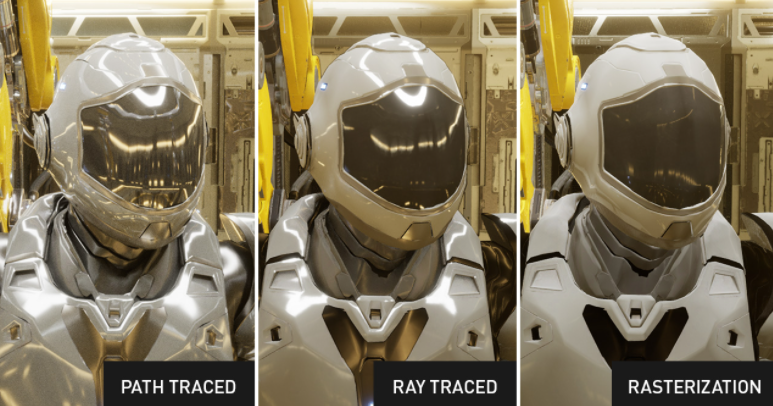
First, let’s define some terms, and how they’re used today to create interactive graphics — graphics that can react in real time to input from a user, such as in video games.

The first, rasterization, is a technique that produces an image as seen from a single viewpoint. It’s been at the heart of GPUs from the start. Modern NVIDIA GPUs can generate over 100 billion rasterized pixels per second. That’s made rasterization ideal for real-time graphics, like gaming.

Ray tracing is a more powerful technique than rasterization. Rather than being constrained to finding out what is visible from a single point, it can determine what is visible from many different points, in many different directions. Starting with the NVIDIA Turing architecture, NVIDIA GPUs have provided specialized RTX hardware to accelerate this difficult computation. Today, a single GPU can trace billions of rays per second.

Being able to trace all of those rays makes it possible to simulate how light scatters in the real world much more accurately than is possible with rasterization. However, we still must answer the questions, how will we simulate light and how will we bring that simulation to the GPU?

What’s Ray Tracing? Just Follow the String

To better answer that question, it helps to understand how we got here.

David Luebke, NVIDIA vice president of graphics research, likes to begin the story in the 16th century with Albrecht Dürer — one of the most important figures of the Northern European Renaissance — who used string and weights to replicate a 3D image on a 2D surface.

Dürer made it his life’s work to bring classical and contemporary mathematics together with the arts, achieving breakthroughs in expressiveness and realism.
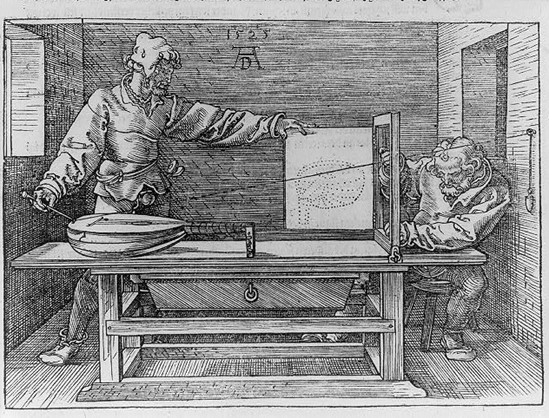
The string’s the thing: Albrecht Dürer was the first to describe what’s now known as “ray tracing,” a technique for creating accurate representations of 3D objects on a 2D surfaces in Underweysung der Messung (Nuremberg, 1525),f15

In 1525 with Treatise on Measurement, Dürer was the first to describe the idea of ray tracing. Seeing how Dürer described the idea is the easiest way to get your head around the concept.

Just think about how light illuminates the world we see around us.

Now imagine tracing those rays of light backward from the eye with a piece of string like the one Dürer used, to the objects that light interacts with. That’s ray tracing.

Ray Tracing for Computer Graphics
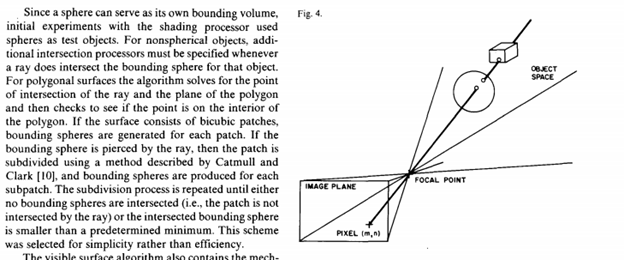
Turner Whitted’s 1979 paper, “An improved illumination model for shaded display,” jump-started a ray-tracing renaissance.

In 1969, more than 400 years after Dürer’s death, IBM’s Arthur Appel showed how the idea of ray tracing could be brought to computer graphics, applying it to computing visibility and shadows.

A decade later, Turner Whitted was the first to show how this idea could capture reflection, shadows and refraction, explaining how the seemingly simple concept could make much more sophisticated computer graphics possible. Progress was rapid in the following few years.

In 1984, Lucasfilm’s Robert Cook, Thomas Porter and Loren Carpenter detailed how ray tracing could incorporate many common filmmaking techniques — including motion blur, depth of field, penumbras, translucency and fuzzy reflections — that were, until then, unattainable in computer graphics.
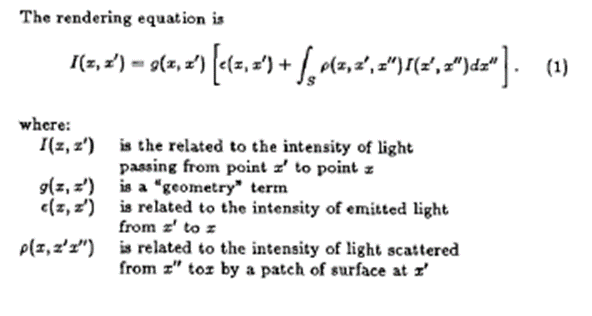
Jim Kajiya’s 1986 paper, “The Rendering Equation,” not only outlined an elegant, physics-based equation for describing how light moves around in a scene, it outlined an efficient way to put it to work.

Two years later, CalTech professor Jim Kajiya’s crisp, seven-page paper, “The Rendering Equation,” connected computer graphics with physics by way of ray tracing and introduced the path-tracing algorithm, which makes it possible to accurately represent the way light scatters throughout a scene.

What’s Path Tracing?

In developing path tracing, Kajiya turned to an unlikely inspiration: the study of radiative heat transfer, or how heat spreads throughout an environment. Ideas from that field led him to introduce the rendering equation, which describes how light passes through the air and scatters from surfaces.

The rendering equation is concise, but not easy to solve. Computer graphics scenes are complex, with billions of triangles not being unusual today. There’s no way to solve the rendering equation directly, which led to Kajiya’s second crucial innovation.

Kajiya showed that statistical techniques could be used to solve the rendering equation: even if it isn’t solved directly, it’s possible to solve it along the paths of individual rays. If it is solved along the path of enough rays to approximate the lighting in the scene accurately, photorealistic images are possible.

And how is the rendering equation solved along the path of a ray? Ray tracing.

The statistical techniques Kajiya applied are known as Monte Carlo integration and date to the earliest days of computers in the 1940s. Developing improved Monte Carlo algorithms for path tracing remains an open research problem to this day; NVIDIA researchers are at the forefront of this area, regularly publishing new techniques that improve the efficiency of path tracing.

By putting these two ideas together — a physics-based equation for describing the way light moves around a scene — and the use of Monte Carlo simulation to help choose a manageable number of paths back to a light source, Kajiya outlined the fundamental techniques that would become the standard for generating photorealistic computer-generated images.

His approach transformed a field dominated by a variety of disparate rendering techniques into one that — because it mirrored the physics of the way light moved through the real world — could put simple, powerful algorithms to work that could be applied to reproduce a large number of visual effects with stunning levels of realism.

Path Tracing Comes to the Movies

In the years after its introduction in 1987, path tracing was seen as an elegant technique — the most accurate approach known — but it was completely impractical. The images in Kajiya’s original paper were just 256 by 256 pixels, yet they took over 7 hours to render on an expensive mini-computer that was far more powerful than the computers available to most other people.

But with the increase in computing power driven by Moore’s law — which described the exponential increase in computing power driven by advances that allowed chipmakers to double the number of transistors on microprocessors every 18 months — the technique became more and more practical.

Beginning with movies such as 1998’s A Bug’s Life, ray tracing was used to enhance the computer-generated imagery in more and more motion pictures. And in 2006, the first entirely path-traced movie, Monster House, stunned audiences. It was rendered using the Arnold software that was co-developed at Solid Angle SL (since acquired by Autodesk) and Sony Pictures Imageworks.

The film was a hit — grossing more than $140 million worldwide. And it opened eyes about what a new generation of computer animation could do. As more computing power became available, more movies came to rely on the technique, producing images that are often indistinguishable from those captured by a camera.

The problem: it still takes hours to render a single image and sprawling collections of servers — known as “render farms” — are running continuously to render images for months in order to make a complete movie. Bringing that to real-time graphics would take an extraordinary leap.

What Does This Look Like in Gaming?

For many years, the idea of path tracing in games was impossible to imagine. While many game developers would have agreed that they would want to use path tracing if it had the performance necessary for real-time graphics, the performance was so far off of real time that path tracing seemed unattainable.

Yet as GPUs have continued to become faster and faster, and now with the widespread availability of RTX hardware, real-time path tracing is in sight. Just as movies began incorporating some ray-tracing techniques before shifting to path tracing — games have started by putting ray tracing to work in a limited way.

Right now a growing number of games are partially ray traced. They combine traditional rasterization-based rendering techniques with some ray-tracing effects.

So what does path traced mean in this context? It could mean a mix of techniques. Game developers could rasterize the primary ray, and then path trace the lighting for the scene.

Rasterization is equivalent to casting one set of rays from a single point that stops at the first thing they hit. Ray tracing takes this further, casting rays from many points in any direction. Path tracing simulates the true physics of light, which uses ray tracing as one component of a larger light simulation system.

This would mean all lights in a scene are sampled stochastically — using Monte Carlo or other techniques — both for direct illumination, to light objects or characters, and for global illumination, to light rooms or environments with indirect lighting.

To do that, rather than tracing a ray back through one bounce, rays would be traced over multiple bounces, presumably back to their light source, just as Kajiya outlined.

A few games are doing this already, and the results are stunning.

Microsoft has released a plugin that puts path tracing to work in Minecraft.

Quake II, the classic shooter — often a sandbox for advanced graphics techniques — can also be fully path traced, thanks to a new plugin.

There’s clearly more to be done. And game developers will need to know customers have the computing power they need to experience path-traced gaming.

Gaming is the most challenging visual computing project of all: requiring high visual quality and the speed to interact with fast-twitch gamers.

Expect techniques pioneered here to spill out to every aspect of our digital lives.

What’s Next?

As GPUs continue to grow more powerful, putting path tracing to work is the next logical step.

For example, armed with tools such as Arnold from Autodesk, V-Ray from Chaos Group or Pixar’s Renderman — and powerful GPUs — product designers and architects use ray tracing to generate photorealistic mockups of their products in seconds, letting them collaborate better and skip expensive prototyping.

As GPUs offer ever more computing power, video games are the next frontier for ray tracing and path tracing.

In 2018, NVIDIA announced NVIDIA RTX, a ray-tracing technology that brings real-time, movie-quality rendering to game developers.

NVIDIA RTX, which includes a ray-tracing engine running on NVIDIA Ampere and Turing architecture GPUs, supports ray-tracing through a variety of interfaces.

And NVIDIA has partnered with Microsoft to enable full RTX support via Microsoft’s new DirectX Raytracing (DXR) API.

Since then, NVIDIA has continued to develop NVIDIA RTX technology, as more and more developers create games that support real-time ray tracing.

Minecraft even includes support for real-time path tracing, turning the blocky, immersive world into immersive landscapes swathed with light and shadow.

Thanks to increasingly powerful hardware, and a proliferation of software tools and related technologies, more is coming.

As a result, digital experiences — games, virtual worlds and even online collaboration tools — will take on the cinematic qualities of a Hollywood blockbuster.

So don’t get too comfy. What you’re seeing from your living room couch is just a demo of what’s to come in the world all around us.


This article has been updated to reflect the correct date for the publication of Albrecht Dürer’s Treatise on Measurement. 

Heart of the Matter: How a Major Children’s Hospital Uses Open Source NVIDIA AI for Cardiac Care

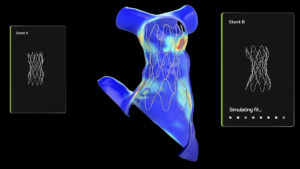
Children’s Hospital of Philadelphia is using open source AI tools to model children’s hearts in seconds — with the goal of enabling safer, more precise care for kids with congenital heart disease.
by

Perplexity Portable Computer Is Now Available on Windows, Powered by NVIDIA RTX

Perplexity’s local agent platform now supports Windows RTX PCs, giving more users a way to run private AI workflows without cloud credits.
by

As local models become more capable, AI agents can handle more work directly on a PC while keeping sensitive information on the device.

Portable Computer is a local version of the agent Perplexity Computer that plans and carries out multistep tasks. Accelerated by NVIDIA GPUs, it uses local models to analyze data, bring together information across files and handle recurring work. Sensitive information stays on device, and locally completed work doesn’t consume Perplexity Computer credits. Users can also orchestrate work up to cloud models for more advanced research and reasoning.

Today, Perplexity is adding Portable Computer in the Perplexity app for Windows on compatible NVIDIA GeForce RTX PCs and NVIDIA RTX PRO Workstations, bringing powerful agentic AI to more Windows PC users. The release builds on existing support for NVIDIA DGX Spark systems and RTX PCs running Linux.

Local Agents Powered by NVIDIA RTX

Perplexity brings local and cloud AI together in one app, letting users work with sensitive files on their PCs and take advantage of Computer’s built-in tools such as the built-in browser and proprietary SPACE sandbox.

For tasks that call for more advanced reasoning, Portable Computer can also identify when a task needs cloud support, asking the user for permission before sending information off-device.

The app simplifies setup with a local model, such as Qwen 3.8 27B, that is post-trained to work with Perplexity Computer and optimized for NVIDIA RTX GPUs. Users can put the agent to work without having to research models or configure the complex software stack typically required to run local AI.

Connectors for Microsoft Outlook, OneDrive, Word, Google Drive, Gmail, Slack and GitHub extend that experience across the files and apps already part of users’ daily workflows.

For example, the agent can help with:

  • Engineering: Review open pull requests in a connected GitHub project, organize them by status and identify next steps. Computer can also flag outdated documentation and submit proposed updates for review.
  • Finance: Point Computer at two years of brokerage summaries, consolidated 1099s and tax returns, and have it trace the recurring holdings creating the most avoidable fees and tax drag, with every figure cited to the exact file and page — all without a document ever reaching a chatbot.
  • Startups: Ask Computer why activation went flat, and the agent analyzes the funnel export locally to find where new signups drop off between install and first completed task, then posts the top insights straight to the team’s Slack channel.

Try Portable Computer on Windows PCs Today

Portable Computer is available for NVIDIA GeForce RTX and RTX PRO GPUs with 24GB or more of VRAM. NVIDIA DGX Station support is expected to come soon. 

Try Perplexity Portable Computer today.

#ICYMI: The Latest Updates From NVIDIA Local AI

🧠Z.ai’s GLM 5.3 Flash provides impressive performance and visual intelligence at low cost, optimized for DGX Station and dual DGX Spark systems.

🐋DeepSeek-v4.1 Flash significantly reduces key-value cache memory demands and operating costs for complex AI agent workloads, delivering remarkable intelligence per dollar.

⚡Qwen has released Qwen3.8-Flash-Next, an open-weight multimodal mixture-of-experts model, and an early preview of Qwen4, which can run locally on a single DGX Spark with NVFP4 and punches well above its weight.

👾GLM 5.3 is Z.ai’s 744-billion-parameter flagship model, tuned for agent sessions that run for hours on DGX Station and a cluster of four DGX Spark systems. 

Follow NVIDIA RTX Spark on X, Instagram, TikTok and Facebook — and stay informed by subscribing to the NVIDIA Local AI newsletter. Follow NVIDIA Workstation on LinkedIn and X

See notice regarding software product information.

  • Categories:
  • AI

NVIDIA Brings Real-Time AI to Broadcast, Sports and Global Streaming at IBC

by

At the IBC conference, running Sept. 11-14 in Amsterdam, the creative, technology and business communities are coming together to turn ideas into action and discuss innovations across the media and entertainment industries. More than 44,000 attendees from 170+ countries are gathering to explore 1,300+ exhibitions in 14+ halls and outdoor spaces, with over 600 speakers delivering insights.

Read on to learn more about what NVIDIA’s highlighting at the show.


NVIDIA AI for Media Brings Real-Time Intelligence to Broadcast, Sports and Production Workflows 🔗

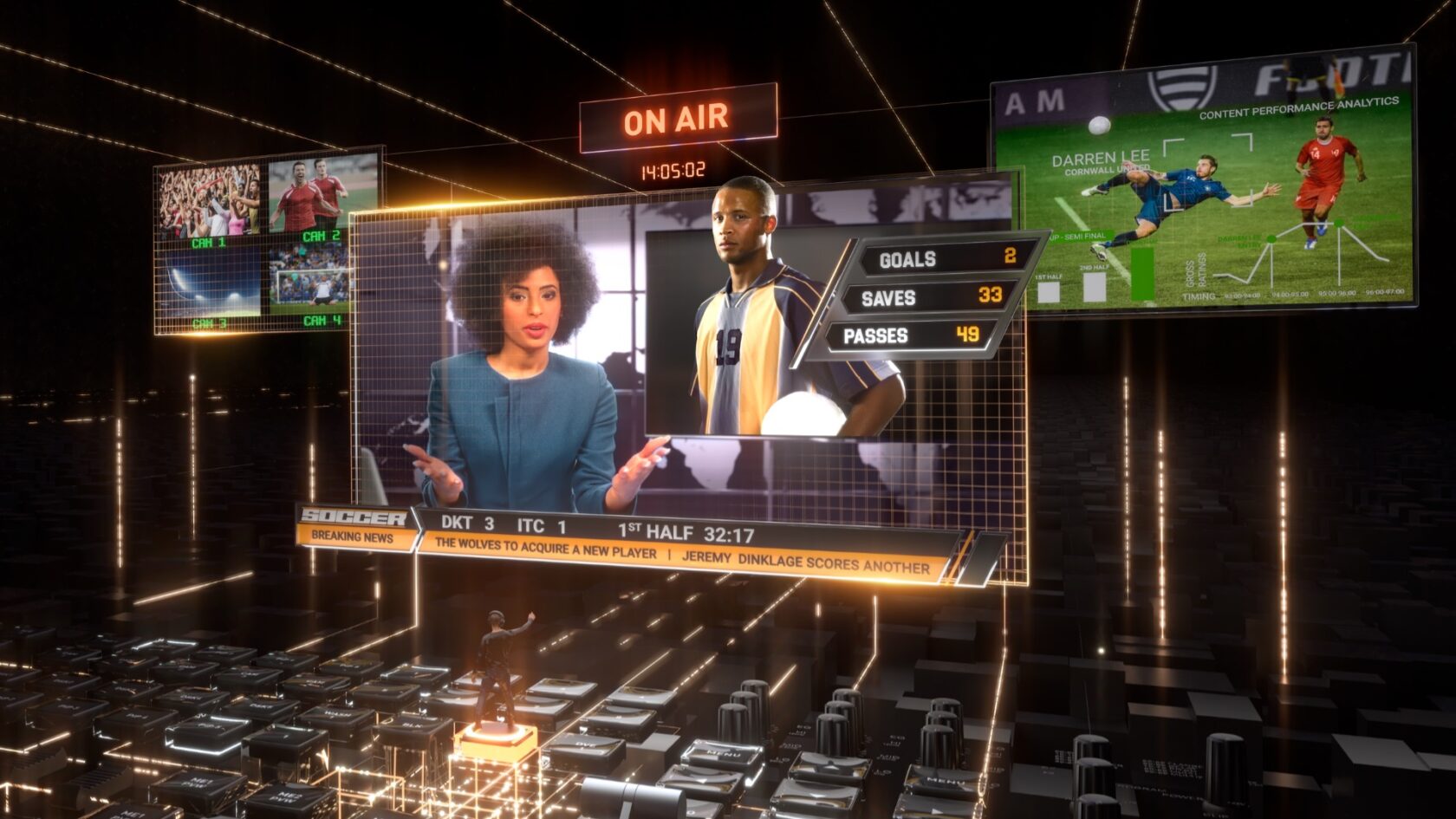
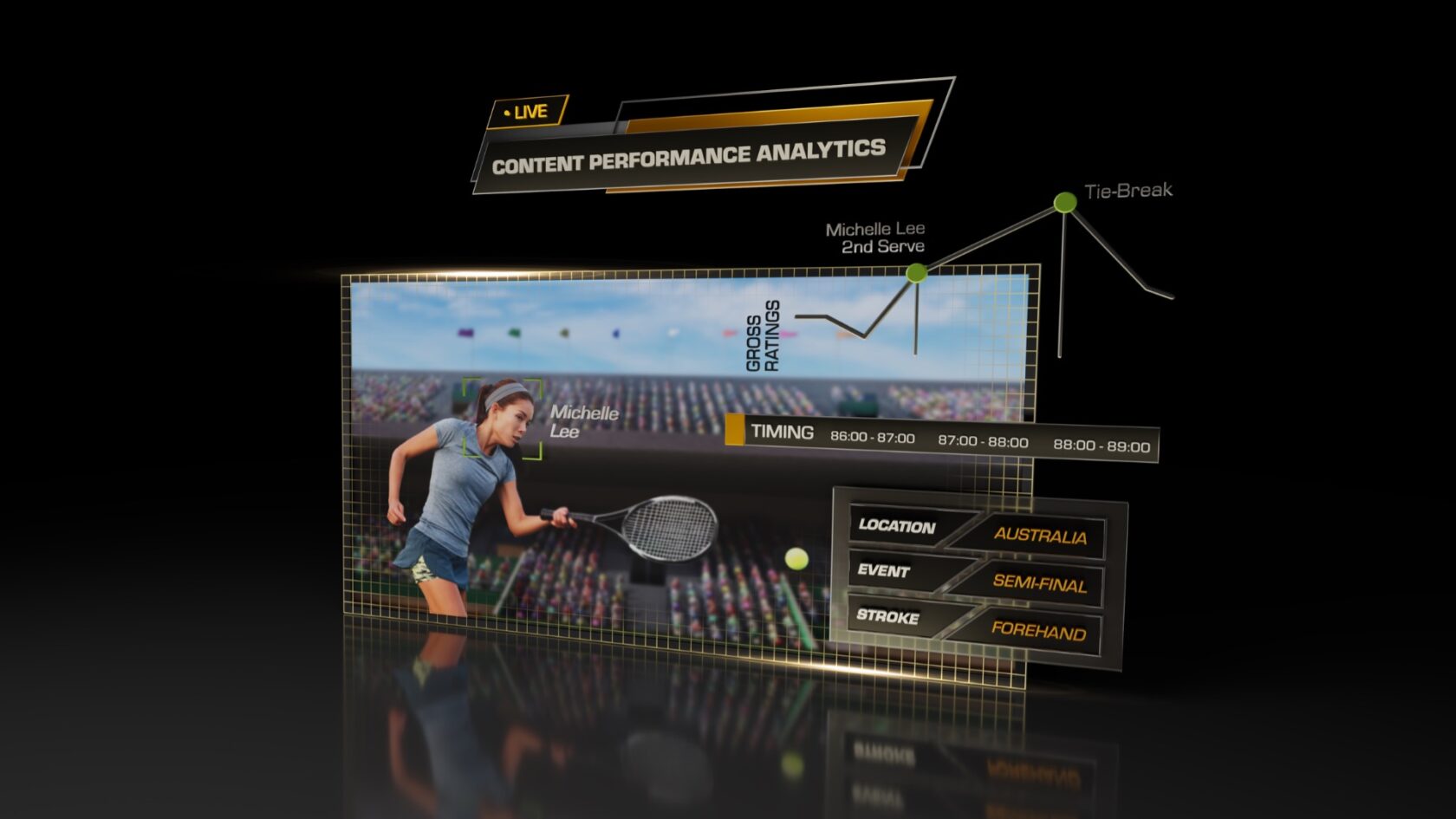
Media companies are increasingly integrating AI into live production, sports, news and streaming workflows to unlock richer performance insights, verify video authenticity, and enhance and localize content — all without disrupting trusted broadcast environments.

At IBC 2026 in Amsterdam, NVIDIA announced a major expansion to NVIDIA AI for Media — a collection of GPU-accelerated software development kits (SDKs), NVIDIA NIM microservices, playbooks, and blueprints that enhance audio, video and augmented-reality effects for media and entertainment workflows — to unlock new ways to understand motion, verify and enhance video, localize programming and build AI-powered media applications. 

The NVIDIA Synthetic Video Detector (SVD) NIM microservice, announced earlier this year at SIGGRAPH, helps organizations assess the probability of whether footage is authentic or AI-generated, giving editorial, content-authentication, digital-forensics and media-integrity teams another point of analysis in their review process.

Since its initial release, SVD’s accuracy has reached 99.3% for text-to-video content and 97.7% for image-to-video content, with especially large gains on difficult image-to-video cases. 

Dalet is integrating SVD into a secure, cloud-hosted verification workflow for news organizations. This allows editorial teams to submit footage through SVD, inspect and review the resulting scores and metadata within a Dalet interface. 

TwelveLabs announced the general availability of Compliance by TwelveLabs, its first application built on the company’s video intelligence platform, helping media and broadcast teams rapidly screen content against regional and custom compliance standards. The solution integrates SVD to add frame-level authenticity signals and confidence scores, enabling media teams to identify potentially synthetic media within the same compliance workflow.

Wowza, whose Wowza Streaming Engine media server technology powers more than 35,000 video deployments across over 170 countries, will distribute SVD through the Wowza Video Intelligence Framework. The solution, powered by NVIDIA-accelerated infrastructure, will enable broadcasters, streaming providers and other organizations to analyze live video feeds and extract data around detected objects, scenes and signs of AI generation in real time. It can be deployed and run on premises, at the edge, in the cloud, across hybrid deployments or fully air-gapped, giving organizations greater control over critical media workflows.

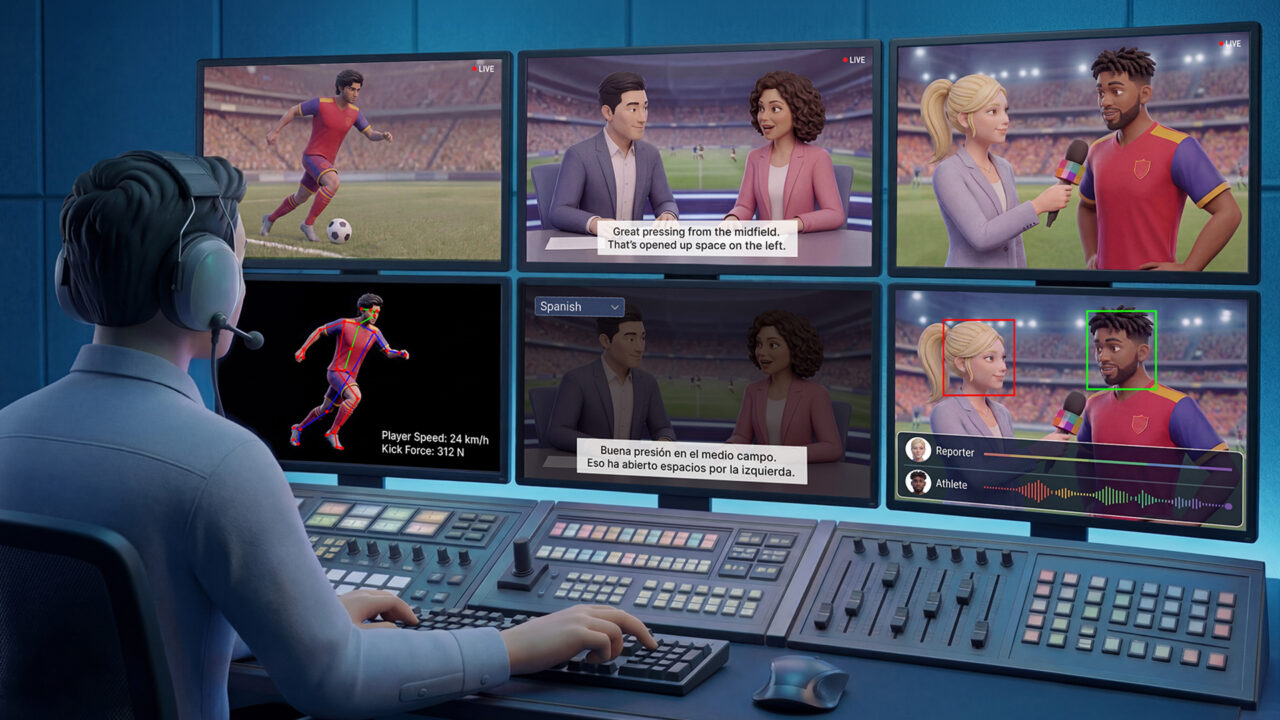
NVIDIA 3D Body Pose estimates 2D and 3D human joint locations and angles from video captured by a single camera, helping turn motion into structured data without marker-based capture systems.

For sports organizations, that data can support player and athlete movement tracking, biomechanics and performance analysis, replay enhancement, officiating and adjudication workflows, player-safety applications, and virtual interaction and immersive experiences. 

The technology can also provide structured human-motion data for content-creation workflows. When mapped to a compatible character rig, joint and motion data can serve as input for animation blocking, digital doubles, character retargeting and virtual-production experiences.

Vizrt is using Body Pose technology in live virtual-studio environments, with tracked body movement driving real-time 3D lighting effects such as reflections, shadows and environmental rendering.

Video Frame Generation (VFG) makes video motion appear smoother by using generative AI to create new frames between the original frames of a video. It can increase frame rates by 2x or 4x while preserving visual quality and temporal consistency, enabling more fluid sports, slow-motion replays, live media and other high-motion video experiences. VFG also supports frame-rate conversion and frame boosting for generative AI video workflows.

Ross Video is integrating VFG into its Rio Replay platform to create AI-assisted slow-motion video for sports production.

The work supports 6x slow-motion generation for sports replay. Development is underway toward 8x interpolation, meaning generated intermediate frames can give replay teams smoother motion without requiring every frame to be captured by an ultrahigh-frame-rate source camera. 

NVIDIA Video Super Resolution (VSR) uses AI to upscale video while reducing noise, blur and compression artifacts. New streaming modes let developers choose between real-time performance and higher image quality, while adjustable controls help achieve the desired level of enhancement. VSR also adds 10-bit video support and improves overall performance and quality. VSR is available through the NVIDIA Video Effects SDK and a NIM microservice for use in streaming, broadcast, conferencing, video playback and content-creation applications. 

The technology can support video players, conferencing applications, creator tools, streaming services, transcoders and broadcast systems through a common interface.

NVIDIA TrueHDR converts standard-dynamic-range video into high-dynamic-range output in real time, reaching up to approximately 2,000 nits while preserving local contrast and adapting brightness to the content.

VSR, VFG and TrueHDR can be combined within a single video-effects pipeline — helping media companies enhance existing content libraries for streaming, transcoding, gaming and creator workflows.  

The NVIDIA LipSync and Active Speaker Detection NIM microservices help developers build localization systems for interviews, news, sports, entertainment and other programming where multiple people may appear on screen.

LipSync transforms mouth movement in an input video to match a target audio track while preserving natural head pose, blinking and body movement. The new release improves facial occlusion handling and better preserves teeth, lip and facial textures.

The new Active Speaker Detection NIM microservice no longer requires speaker diarization for multiple audio tracks, adds voice activity detection and expands NIM microservice deployment support through a gRPC interface and broader GPU compatibility.

NDI is using NVIDIA AI for Media, including the NVIDIA LipSync NIM microservice, to enable real-time translation, lip-synced dubbing and regional language adaptation within existing broadcast workflows. By generating multiple language experiences from a common media stream, the approach can help broadcasters reach global audiences while reducing the bandwidth, infrastructure and production complexity traditionally required for multilingual distribution.

Studio Voice includes new Microphone Profiles built on NVIDIA Studio Voice NIM microservices, giving users more control over the tonal character of enhanced speech.

The capability is designed to suppress background noise, reduce room reverberation and improve speech clarity, then shape the enhanced output into a selected microphone profile for more polished live communications, streaming, podcasting and content creation.

Try NVIDIA AI for Media NIM microservices. See the latest NVIDIA and partner workflows at IBC 2026.


NVIDIA Holoscan for Media Provides Open Media Exchange Layer to Build and Connect Live Media Applications 🔗

As broadcasters, streaming services and sports organizations adopt software and AI, the infrastructure behind live content is becoming more flexible, more connected and increasingly built on shared accelerated computing.

The integration of Media Exchange Layer (MXL) with NVIDIA Holoscan for Media accelerates that transition — providing the common exchange layer that helps media applications connect and operate together. 

Holoscan for Media is an open reference architecture and developer toolkit for building AI-powered media functions and applications for software-defined live production. MXL adds an open way for those software-based media functions to exchange live video, audio and data across a distributed environment. 

As production functions move into software, developers can build applications that share accelerated infrastructure, connect dynamically and evolve independently. That can help media companies use infrastructure more efficiently, introduce new capabilities faster and reduce the amount of custom integration required between applications.

The integration also creates a stronger foundation for AI in live media. AI processing, video applications and traditional media functions can increasingly operate on the same accelerated infrastructure and in the same software-defined environment.

For technology vendors, this expands the opportunity to build applications that can work across broader, multi-vendor ecosystems. For media companies, it creates a path toward infrastructure that can adapt as formats, applications and AI capabilities change.

See the demo at IBC in EBU Stand 10.D21. ​Learn more about Holoscan for Media.


NVIDIA Sports Intelligence Playbooks Chart a Path to Multimodal AI for Sports 🔗

Sports is becoming a proving ground for a broader shift in AI: from general-purpose models toward fine-tuned open models built on proprietary data.

NVIDIA Sports Intelligence Playbooks are designed to accelerate that transition. They give leagues, media companies and technology providers structured frameworks to fine-tune NVIDIA open models on their own sports footage and annotations, creating multimodal AI that can understand the rules, players, scoring, strategy and context unique to a sport.

Sports organizations hold large volumes of proprietary video, metadata and performance information that are difficult for competitors to replicate. The playbooks provide a practical blueprint for converting those assets into AI capabilities that can underpin new analytics products, media experiences, automation tools and revenue streams.

The playbooks span the AI lifecycle, including data preparation, fine-tuning, inference, evaluation, optimization and deployment, and bring together NVIDIA technologies including Nemotron, NeMo AutoModel, Megatron Bridge, NIM microservices and NVIDIA accelerated computing

By providing an integrated path from model customization to production, Sports Intelligence Playbooks can reduce the cost and complexity of building specialized sports AI while increasing demand across its compute, software and inference stack.

Early testing demonstrates the potential of domain specialization. When evaluated on previously unseen footage using question formats similar to those used in training,  multiple-choice accuracy increased from approximately 53% to 94% and open-ended evaluation from approximately 5.7% to 66%.

Machina Sports is integrating Sports Intelligence Playbooks with its sports-native data, evaluation and agent infrastructure, enabling rights holders to turn proprietary media and expertise into private, deployable intelligence for live production, content and fan experiences.

The opportunity also expands as agentic AI becomes increasingly adopted. With the NVIDIA AI-Q Blueprint, organizations can use their domain-specific sports models as expert intelligence within agents that reason across video, enterprise data and software systems, extending the playbook from sports understanding into decision-making and automation.

Wowza is integrating vision language models, including NVIDIA Cosmos 3 and Nemotron, into the Wowza Video Intelligence Framework, fine-tuned through NVIDIA Sports Intelligence Playbooks to detect sports-specific moments in live streams and reduce time to action. 

Explore NVIDIA Sports Intelligence Playbooks.


NVIDIA Brings Multilingual Content Localization to Live Broadcast 🔗

Reaching global audiences with live programming requires more than translating words. Language nuances, voice, timing, facial movement, captions and onscreen graphics must work together in real time, while preserving the editorial intent and production quality of the original program.

To help broadcasters, sports leagues, rights holders and streaming services bring these elements into a unified, software-defined, real-time localization workflow, NVIDIA is bringing its Content Localization technologies to the NVIDIA Holoscan for Media developer toolkit. Designed for broadcast and streaming developers, the reference workflow enables captions, translated audio, dubbing, synchronized video and localized graphics.

Content Localization with Holoscan for Media provides a reference for how localization technologies can work together in software-defined broadcast applications. Developers can select the capabilities needed for each program, market or distribution channel rather than deploying separate infrastructure for every localized version.

Content Localization with Holoscan for Media incorporates the latest advancements from NVIDIA AI for Media, including improved LipSync when faces are partially obscured and enhanced Active Speaker Detection to help applications identify who’s speaking in multi-person scenes.

Expanding the Reach of Live Programming

Localization can transform the reach and economics of live programming. A shared, composable workflow can help media companies introduce regional coverage faster, serve more audiences and tailor experiences for individual markets — while preserving the timing, visual context and editorial control required for live production.

Technologies from AI-Media, CAMB.AI, Chyron and Panjaya each address a specific part of content localization with Holoscan for Media, from adapting voice and onscreen delivery to creating multilingual captions and translated audio, localizing graphics, and preserving expression and identity across live and on-demand content.

The Content Localization technologies also support file-based, streaming and post-production applications. Developers can use application programming interfaces for on-demand workflows and the Holoscan for Media reference workflow when localization must run as part of a live media environment. Together, they provide a consistent foundation for building multilingual media services across production and distribution.

Learn more about NVIDIA Holoscan for Media and AI for Media.