Teaching the AI brains of autonomous vehicles to understand the world as humans do requires billions of miles of driving experience. The road to achieving this astronomical level of driving leads to the virtual world.
On the latest episode of the AI Podcast, Waabi CEO and founder Raquel Urtasun joins NVIDIA’s Katie Burke Washabaugh to talk about the role simulation technology plays in developing production-level autonomous vehicles.
Waabi is an autonomous-vehicle system startup that uses powerful, high-fidelity simulation to run multiple scenarios simultaneously and tailor training to rare and dangerous situations that are difficult to encounter in the real world.
Urtasun is also a professor of Computer Science at the University of Toronto. Before starting Waabi, she led the Uber Advanced Technologies Group as chief scientist and head of research and development.
Driving enjoyment and autonomous driving capabilities can complement one another in intelligent, sustainable vehicles. Learn about the automaker’s plans to unveil its third vehicle, the Polestar 3, the tech inside it, and what the company’s racing heritage brings to the intersection of smarts and sustainability.
Humans playing games against machines is nothing new, but now computers can develop their own games for people to play. Programming enthusiast and social media influencer Harrison Kinsley created GANTheftAuto, an AI-based neural network that generates a playable chunk of the classic video game Grand Theft Auto V.
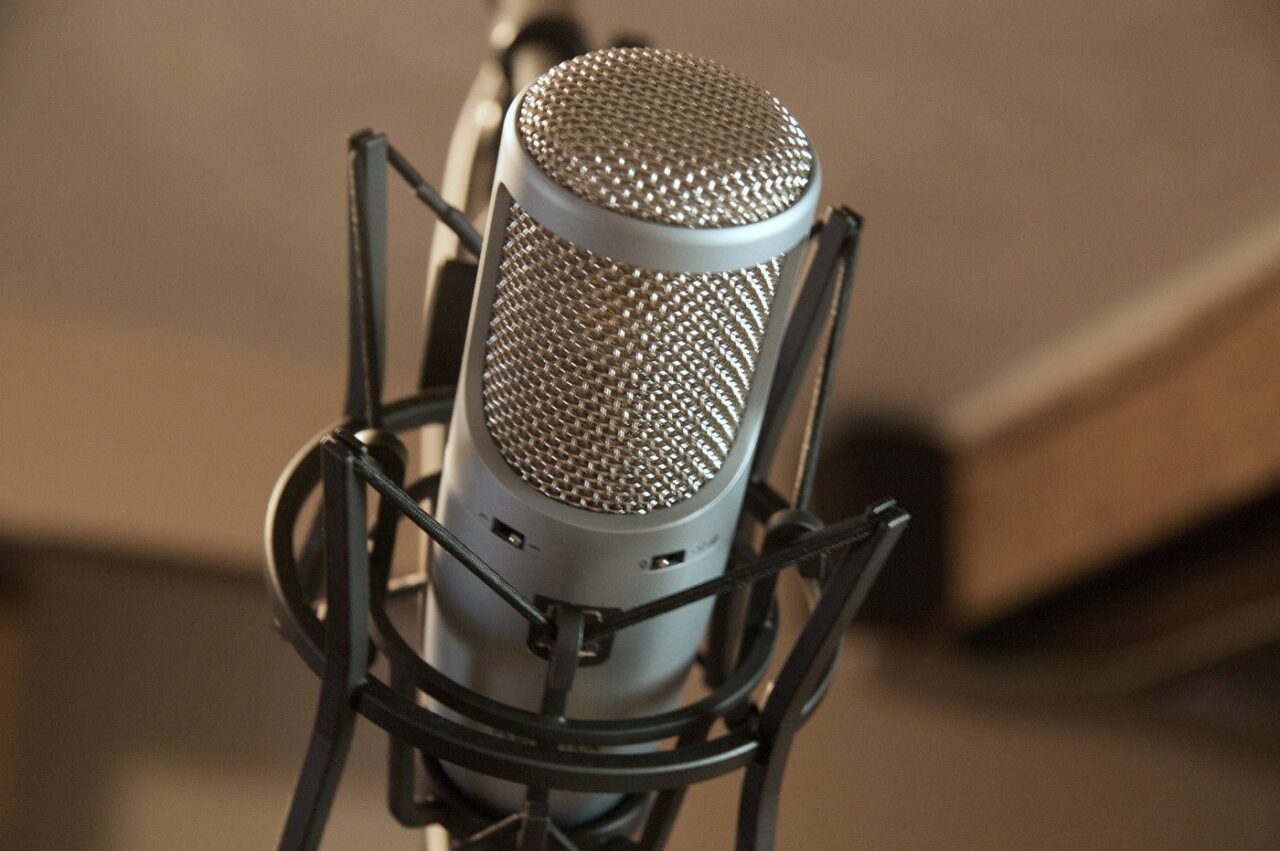
From active noise cancellation to digital assistants that are always listening for your commands, audio is perhaps one of the most important but often overlooked aspects of modern technology in our daily lives. Dr. Chris Mitchell, CEO and founder of Audio Analytic, discusses the challenges, and the fun, involved in teaching machines to listen.
Subscribe to the AI Podcast: Now available on Amazon Music
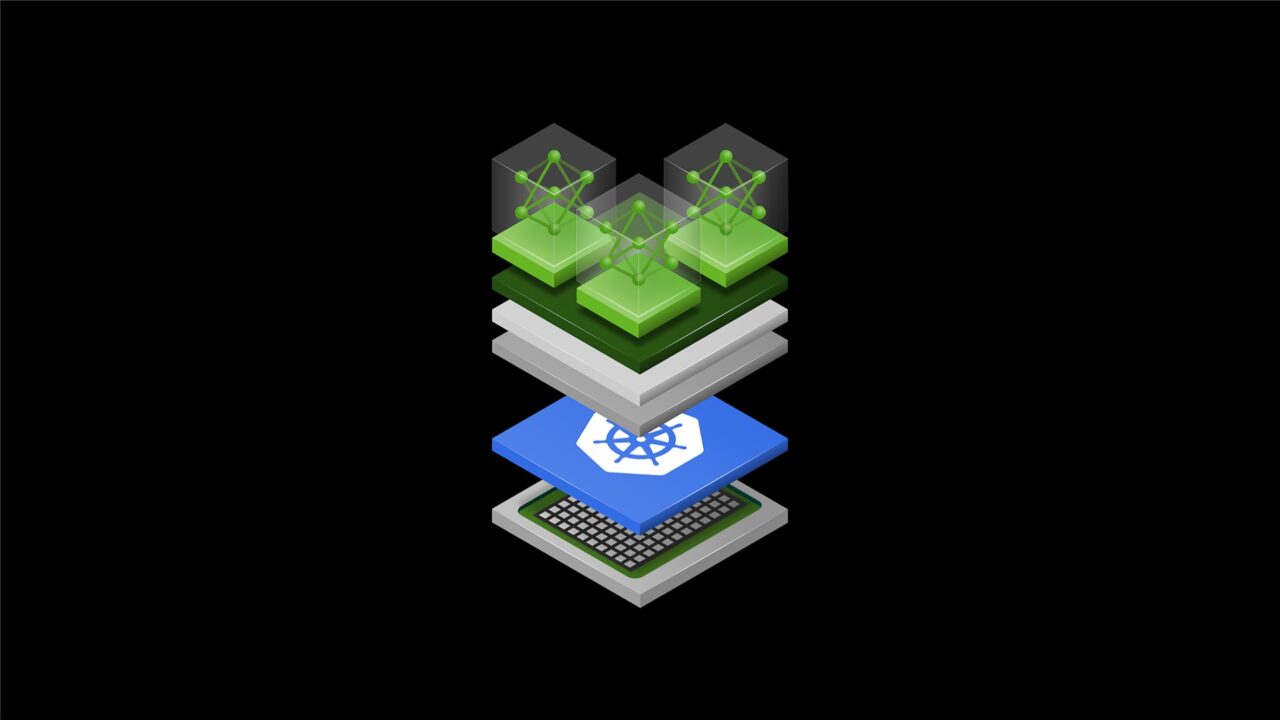
Advancing Open Source AI, NVIDIA Donates Dynamic Resource Allocation Driver for GPUs to Kubernetes Community
In addition, NVIDIA announced at KubeCon Europe a confidential containers solution for GPU-accelerated workloads, updates to the NVIDIA KAI Scheduler and new open source projects to enable large-scale AI workloads.
Artificial intelligence has rapidly emerged as one of the most critical workloads in modern computing.
For the vast majority of enterprises, this workload runs on Kubernetes, an open source platform that automates the deployment, scaling and management of containerized applications.
To help the global developer community manage high-performance AI infrastructure with greater transparency and efficiency, NVIDIA is donating a critical piece of software — the NVIDIA Dynamic Resource Allocation (DRA) Driver for GPUs — to the Cloud Native Computing Foundation (CNCF), a vendor-neutral organization dedicated to fostering and sustaining the cloud-native ecosystem.
Announced today at KubeCon Europe, CNCF’s flagship conference running this week in Amsterdam, the donation moves the driver from being vendor-governed to offering full community ownership under the Kubernetes project. This open environment encourages a wider circle of experts to contribute ideas, accelerate innovation and help ensure the technology stays aligned with the modern cloud landscape.
“NVIDIA’s deep collaboration with the Kubernetes and CNCF community to upstream the NVIDIA DRA Driver for GPUs marks a major milestone for open source Kubernetes and AI infrastructure,” said Chris Aniszczyk, chief technology officer of CNCF. “By aligning its hardware innovations with upstream Kubernetes and AI conformance efforts, NVIDIA is making high-performance GPU orchestration seamless and accessible to all.”
In addition, in collaboration with the CNCF’s Confidential Containers community, NVIDIA has introduced GPU support for Kata Containers, lightweight virtual machines that act like containers. This extends hardware acceleration into a stronger isolation, separating workloads for increased security and enabling AI workloads to run with enhanced protection so organizations can easily implement confidential computing to safeguard data.
Simplifying AI Infrastructure
Historically, managing the powerful GPUs that fuel AI within data centers required significant effort.
This contribution is designed to make high-performance computing more accessible. Key benefits for developers include:
Massive Scale: It provides native support for connecting systems together, including with NVIDIA Multi-Node NVlink interconnect technology. This is essential for training massive AI models on NVIDIA Grace Blackwell systems and next-generation AI infrastructure.
Flexibility: Developers can dynamically reconfigure their hardware to suit their needs, changing how resources are allocated on the fly.
Precision: The software supports fine-tuned requests, allowing users to ask for the specific computing power, memory settings or interconnect arrangement needed for their applications.
A Collaborative, Industry-Wide Effort
NVIDIA is collaborating with industry leaders — including Amazon Web Services,Broadcom, Canonical,Google Cloud, Microsoft, Nutanix, Red Hat and SUSE — to drive these features forward for the benefit of the entire cloud-native ecosystem.
“Open source will be at the core of every successful enterprise AI strategy, bringing standardization to the high-performance infrastructure components that fuel production AI workloads,” said Chris Wright, chief technology officer and senior vice president of global engineering at Red Hat. “NVIDIA’s donation of the NVIDIA DRA Driver for GPUs helps to cement the role of open source in AI’s evolution, and we look forward to collaborating with NVIDIA and the broader community within the Kubernetes ecosystem.”
“Open source software and the communities that sustain it are a cornerstone of the infrastructure used for scientific computing and research,” said Ricardo Rocha, lead of platforms infrastructure at CERN. “For organizations like CERN, where efficiently analyzing petabytes of data is essential to discovery, community-driven innovation helps accelerate the pace of science. NVIDIA’s donation of the DRA Driver strengthens the ecosystem researchers rely on to process data across both traditional scientific computing and emerging machine learning workloads.”
Expanding the Open Source Horizon
This donation is just part of NVIDIA’s broader initiatives to support the open source community. For example, NVSentinel — a system for GPU fault remediation — and AI Cluster Runtime, an agentic AI framework, were announced at GTC last week.
In addition, NVIDIA announced at GTC new open source projects including the NVIDIA NemoClaw reference stack and NVIDIA OpenShell runtime for securely running autonomous agents. OpenShell provides fine-grained programmable policy security and privacy controls, and natively integrates with Linux, eBPF and Kubernetes.
NVIDIA also today announced that its high-performance AI workload scheduler, the KAI Scheduler, has been onboarded as a CNCF Sandbox project — a key step toward fostering broader collaboration and ensuring the technology evolves alongside the needs of the wider cloud-native ecosystem. Developers and organizations can use and contribute to the KAI Scheduler today.
NVIDIA remains committed to actively maintaining and contributing to Kubernetes and CNCF projects to help meet the rigorous demands of enterprise AI customers.
In addition, following the release of NVIDIA Dynamo 1.0, NVIDIA is expanding the Dynamo ecosystem with Grove, an open source Kubernetes application programming interface for orchestrating AI workloads on GPU clusters. Grove, which enables developers to express complex inference systems in a single declarative resource, is being integrated with the llm-d inference stack for wider adoption in the Kubernetes community.
Developers and organizations can begin using and contributing to the NVIDIA DRA Driver today.
GTC Spotlights NVIDIA RTX PCs and DGX Sparks Running Latest Open Models and AI Agents Locally
NVIDIA Nemotron 3 open models unlock fast, private AI agents like OpenClaw; creativity accelerated with RTX-optimized NVFP4 and FP8 visual generative AI models.
The paradigm of consumer computing has revolved around the concept of a personal device — from PCs to smartphones and tablets. Now, generative AI — particularly OpenClaw — has introduced a new category: agent computers. These devices, like the NVIDIA DGX Spark desktop AI supercomputer or dedicated NVIDIA RTX PCs, are ideal for running personal agents — privately and for free.
NVIDIA GTC, running this week, is showcasing a host of agentic AI announcements including:
New open models for local agents, including NVIDIA Nemotron 3 Nano 4B and Nemotron 3 Super 120B, and optimizations for Qwen 3.5 and Mistral Small 4.
NVIDIA NemoClaw, an open source stack for OpenClaw that optimizes OpenClaw experiences on NVIDIA devices by increasing security and supporting local models.
Easier fine‑tuning with Unsloth Studioto further improve open model accuracy for agentic workflows.
In-person GTC attendees can swing by the NVIDIA build-a-claw event in the GTC Park, running daily through March 19, from 8 a.m.-5 p.m. NVIDIA experts will help guests customize and deploy a proactive, always-on AI assistant using their device of choice. Whether technical or just curious, participants will name their agent, define its personality and grant it access to the tools it needs — creating a personal assistant reachable from their preferred messaging app.
New Open Models Bring Cloud-Level Quality to Local Agents
The next generation of local models — with increasingly large context windows — delivers the intelligence to run agents on PC. Combined with richer user context and powerful local tools, these advances are unlocking new possibilities on AI PCs, especially on DGX Spark, with its 128GB of unified memory that supports models with more than 120 billion parameters.
Nemotron 3 Super, released last week, is a 120‑billion‑parameter open model with 12 billion active parameters, designed to run complex agentic AI systems. Nemotron 3 Super is optimal for powering agents on the DGX Spark or NVIDIA RTX PRO workstations. On PinchBench — a new benchmark for determining how well large language models perform with OpenClaw — Nemotron 3 Super scored 85.6%, making it the top open model in its class.
Mistral Small 4, a 119-billion-parameter open model with 6 billion active parameters — 8 billion including all layers — unifies the capabilities of Mistral’s flagship models. Users now have an ultraefficient model optimized for general chat, coding and agentic tasks.
Both of these models run locally on DGX Spark and RTX PRO GPUs.
For GeForce RTX users looking for smaller models, Nemotron 3 Nano 4B is the latest model to join the NVIDIA Nemotron 3 family of open models, providing a compact, capable starting point for building agents and assistants locally on RTX AI PCs. The model is a strong fit for building action-taking conversational personas in games and apps that run on resource-constrained hardware. It’s available across any NVIDIA GPU-enabled system and combines state-of-the-art instruction-following and exceptional tool use with minimal VRAM footprint.
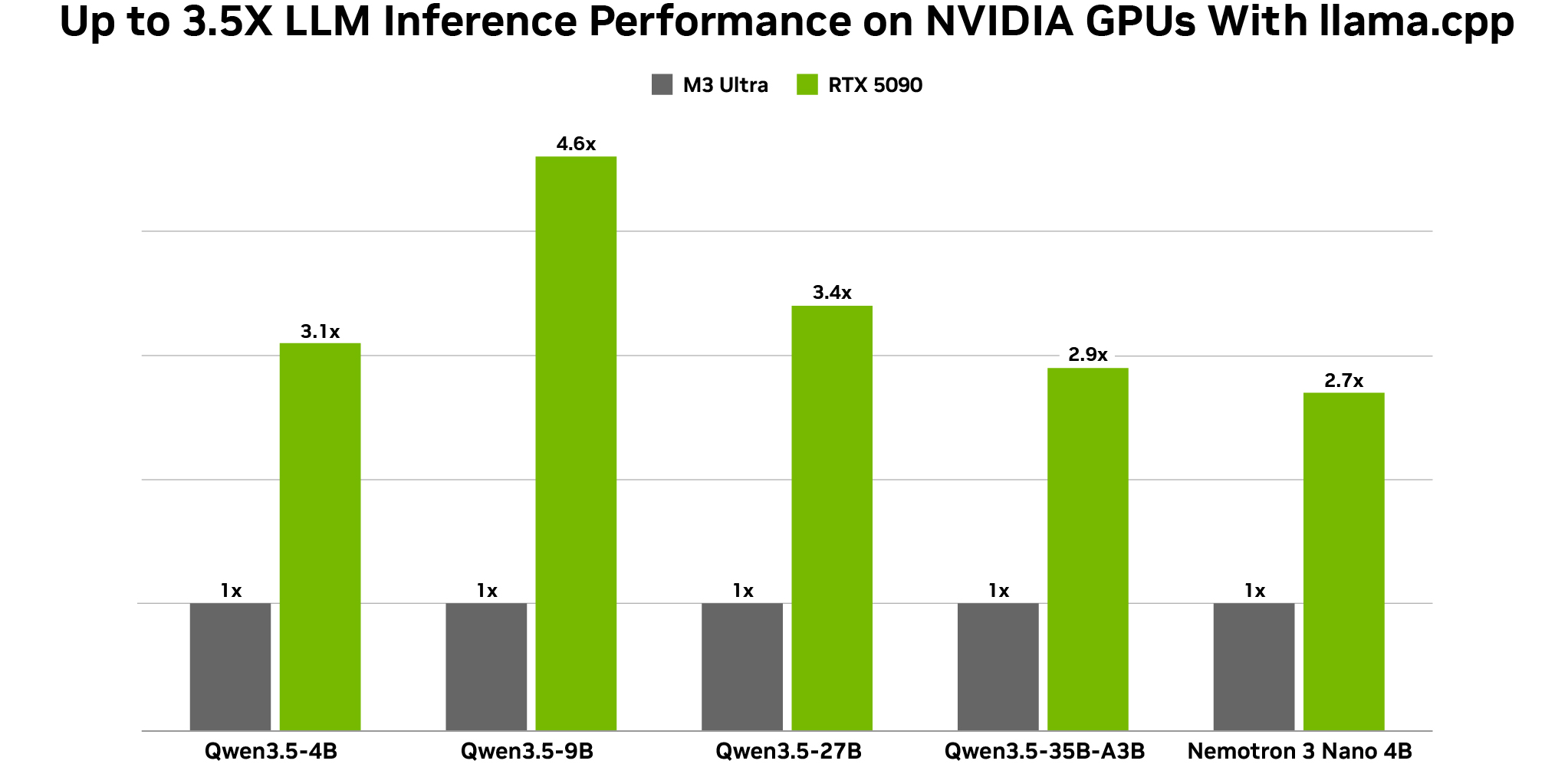
In addition, NVIDIA announced optimizations for Alibaba’s Qwen 3.5 models,which have demonstrated outstanding accuracy (27B, 9B and 4B) and are suited for running local agents on NVIDIA GPUs. The new models natively support vision, multi-token prediction and a large 262,000-token context window. The dense 27-billion-parameter model excels when paired with an RTX 5090 GPU.
All configurations measured using Q4_K_M quantizations BS = 1, ISL = 1024 and OSL = 128 on NVIDIA RTX 5090 and Mac M3 Ultra desktops. Token generation throughput measured on llama.cpp b7789, using the llama-bench tool.
Users can try these models today via Ollama, LM Studio and llama.cpp, with accelerated inference powered by RTX GPUs and DGX Spark. Learn more about the latest on NVIDIA open models.
Faster Creative AI With the Latest RTX-Optimized Models
LTX 2.3, Lightricks’ state-of-the-art audio-video model, released earlier this month, now has support for NVFP4 and FP8 distilled models, accelerating performance by 2.1x. Learn more about Lightricks’ LTX 2.3 model.
In addition, Black Forest Lab’s FLUX.2 Klein 9B received an update last week, accelerating image editing by up to 2x. NVIDIA has collaborated with Black Forest Labs to release an FP8 version, optimized for the fastest performance and optimal memory consumption on RTX GPUs.
NVIDIA NemoClaw — NVIDIA Optimizations for OpenClaw
AI developers and enthusiasts are buying DGX Spark supercomputers or building dedicated RTX PCs to run autonomous AI agents, such as OpenClaw, that draw context from personal files, apps and workflows and can automate daily tasks. However, as adoption of agentic systems like OpenClaw grows, so do concerns about token costs, as well as security and privacy.
To help address these concerns, NVIDIA this week introduced NemoClaw, an open source stack for OpenClaw that deploys optimizations for OpenClaw on NVIDIA devices. The first features available in NemoClaw are NVIDIA Nemotron open models and the NVIDIA OpenShell runtime. Nemotron local models enable users to run inference locally, which means better privacy and no token costs. OpenShell is the runtime designed for executing claws more safely.
Learn more aboutNemoClaw. Watch theGTC keynote from NVIDIA founder and CEO Jensen Huang and explore sessions.
Fine-Tuning Made Easy With Unsloth Studio
As open models make giant leaps, one way of further improving accuracy is fine-tuning, which allows users to customize a model for their own data and use cases. This technique normally requires in-depth technical expertise, coding knowledge and massive amounts of configuration. Unsloth, a leading open source library for model fine-tuning and alignment, today launched Unsloth Studio, an easy-to-use, web-based user interface that simplifies the fine-tuning process for AI enthusiasts and developers.
Unsloth Studio offers support for more than 500 AI models. The simple user interface makes the training and fine-tuning process easy: Users can just drop in their dataset, tap the graph-based canvas to generate additional high-quality synthetic data and start the fine-tuning job. It supports quantized low-rank adaptation, low-rank adaptation and full fine-tuning. As the model is being fine-tuned, users can monitor and visualize job progress. Finally, they can export the model into a framework of choice and chat away, all within the same web app.
Unsloth Studio’s new interface is built on the Unsloth library, which delivers up to 2x faster training with up to 70% VRAM savings, using custom and specialized GPU kernels. This means that new users can get the most out of their NVIDIA RTX GPUs and DGX Spark, right out of the box.
Try Unsloth Studio today, including with new models like Nemotron 3 Nano 4B and Qwen 3.5. Check out other RTX AI Garage posts for more information on fine-tuning models with NVIDIA GeForce RTX GPUs.
#ICYMI From GTC 2026
✨RTX AIvideo generation guide featuring RTX Video in ComfyUI: Launched at CES earlier this year, the new RTX AI video generation guide shows creators and enthusiasts how to go from concept to creation using guided text-to-image workflows to produce keyframes for AI-generated videos, then upscale to 4K with RTX Video technology running on local GPUs. Get started with the guide and share creations on social media with #AIonRTX.
💿NVIDIA AI for Media is a set of high‑performance, easy‑to‑use software development kits that bring NVIDIA Broadcast-class AI effects — enhanced audio (Linux or Windows), video and augmented-reality features — to live media, video conferencing and post‑production workflows. The latest update — available today — adds more accurate lip-syncing, multi‑active-speaker detection, faster 4K upscaling on RTX PRO and GeForce RTX 40 and 50 Series GPUs via the RTX Video Super Resolution feature, better background noise reduction and lower latency for the NVIDIA Studio Voice feature.
💻 NVIDIA DLSS 5, arriving this fall, delivers an AI-powered breakthrough in visual fidelity for games by infusing pixels with photoreal lighting and materials to bridge the gap between rendering and reality.
🤖Maxon released Redshift 2026.4, introducing a new real-time visualization workflow powered by DLSS to allow architects to walk through projects at interactive speed and quality. “NVIDIA’s DLSS technology is a critical component, allowing us to deliver high-quality visuals at interactive speeds,” said Philip Losch, chief technology and AI officer at Maxon.
🪟Reincubate Camo has added Windows ML on NVIDIA TensorRT RTX EP for AI Autotune in its Camo Streamlight app, significantly improving performance on RTX GPUs.