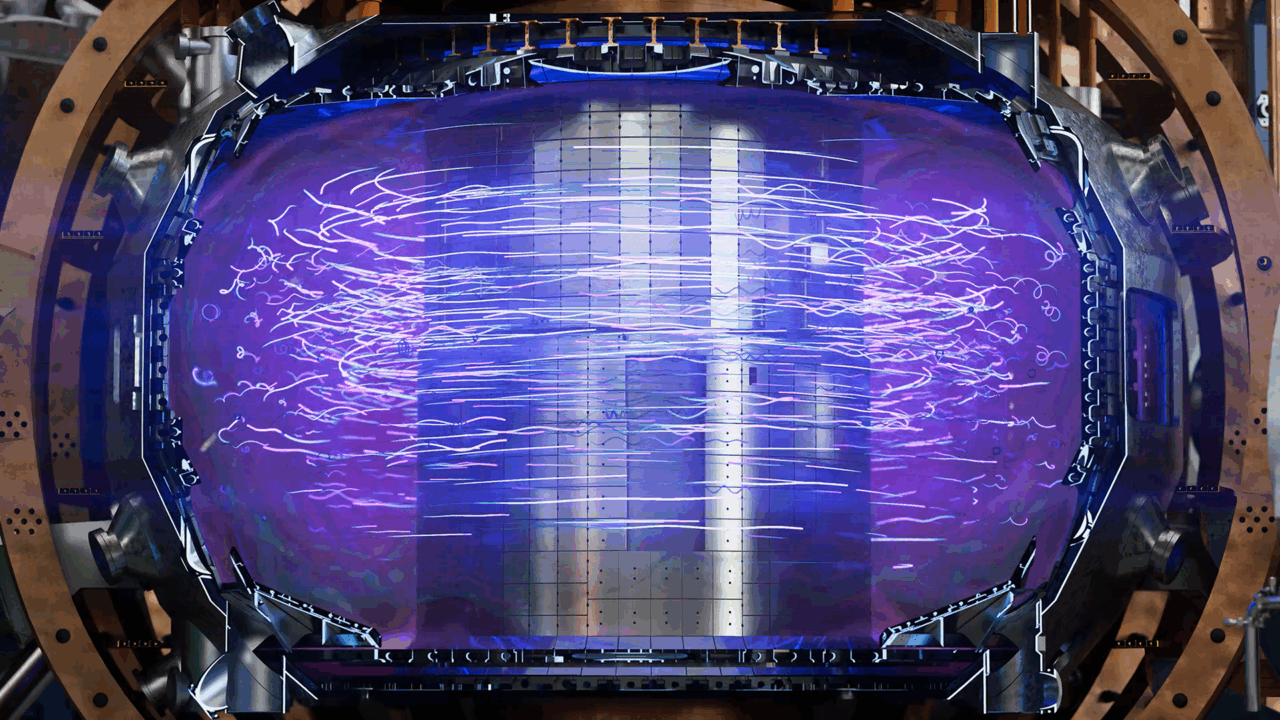
The race to bottle a star now runs on AI.
NVIDIA, General Atomics and a team of international partners have built a three dimensional, interactive AI-enabled digital twin for a fusion reactor, with technical support from San Diego Supercomputer Center at UC San Diego School of Computing, Information and Data Sciences, the Argonne Leadership Computing Facility (ACLF) at Argonne National Laboratory and National Energy Research Scientific Computing Center (NERSC) at Lawrence Berkeley National Laboratory.
In this case, a digital twin is a virtual environment that co-locates physical computer-aided design, instrument materials, sensor information and AI-surrogates that represent possible plasma interactions happening inside the reactor.
The effort, announced today at the NVIDIA GTC Washington, D.C., conference, used Polaris at the ALCF and Perlmutter at NERSC supercomputing systems to train three distinct AI surrogate models on a combination of experimental data and synthetic data from simulations.
This effort provides a foundational step toward constructing a magnetic fusion reactor. It uses the NVIDIA Omniverse platform, NVIDIA CUDA-X libraries and data center GPUs to help researchers tackle one of science’s toughest problems: making fusion energy work on Earth.
Here’s why this matters: fusion promises virtually limitless, clean energy by replicating the process that powers the sun.
“The ability to explore scenarios virtually through this interactive digital twin is a game-changer,” said Raffi Nazikian, fusion data science lead at General Atomics. “Working with NVIDIA, we can now test and refine new ideas orders of magnitude faster, accelerating the path toward practical fusion energy.”
But controlling plasma at extreme temperatures — think hundreds of millions of degrees Celsius — and predicting its behavior fast enough to keep reactors running is a massive challenge.
Plasma is the fourth state of matter, a swirling soup of charged particles under extreme conditions of temperatures exceeding 100 million degrees. It’s what stars are made of. It’s also at the frontiers of scientific modeling; fusion plasmas are nonlinear, turbulent, multiscale systems, where the governing equations are still not well defined.
In fusion reactors, plasma is the fuel — the stuff that, if tamed, could power cities with the energy of the sun. Imagine trying to bottle a star. That’s the metaphor fusion scientists love, and for good reason: it’s poetic and accurate.
That’s where AI comes in. Once trained with advanced AI methods, the resulting inference in the surrogate model is multiple orders of magnitude faster than the simulations used to generate training data. The quick response time of the AI surrogates enables two use cases that were previously not possible. Researchers can interact with the digital twin as the reactor is running, and in some cases, the surrogates are fast enough to enable an autonomic use case as part of the physical control system.
At the forefront of this effort, General Atomics is developing an AI-enabled digital twin as part of its research at the U.S. Department of Energy’s DIII-D National Fusion Facility to push fusion research forward.
AI: Turning Weeks to Seconds
Traditionally, simulating plasma behavior requires from hours to days, or even weeks, on even the fastest supercomputers.
General Atomics is now using AI surrogate models — trained on decades of real-world data — to predict aspects of plasma behavior in seconds, all of which continue to be improved.
These models, including EFIT (for plasma equilibrium), CAKE (for plasma boundary) and ION ORB (for heat density of escaping ions), can potentially help operators keep the plasma stable in real time, reducing the risk of damage and speeding up research.
Running on NVIDIA GPUs, these models deliver predictions orders of magnitude faster than physics-based simulations. They’re among the many models used to help simulate the behavior of fusion reactors and control them, which can be accelerated by AI.
The Digital Twin
NVIDIA and General Atomics are building a fully interactive digital twin of the DIII-D inside NVIDIA Omniverse, powered by NVIDIA RTX PRO Servers and NVIDIA DGX Spark, with supporting contributions from the San Diego Supercomputer Center, ALCF and NERSC.
This virtual reactor dynamically fuses sensor data, physics-based simulations, engineering models and AI surrogates — creating a unified, interactive environment that can quickly inform decisions.
The digital twin is synchronized with the physical DIII-D, allowing the international team of 700 scientists from 100 different organizations to test ideas and run “what-if” scenarios without touching the real machine.
Key controls can be explored in the digital twin to refine the science before running real experiments, which can enable rapid optimization and faster progress toward commercial fusion.
Why It Matters
By replacing weeks-long simulations with AI surrogates fast enough for scientists to explore interactively, the digital twin could become a “fusion accelerator” — a platform to rapidly test new ideas, optimize reactor designs or control settings and put commercial fusion energy on a faster track.
The fusion community building high-value plasma physics models is invited to collaborate with NVIDIA and General Atomics to jointly develop AI surrogate models that integrate into next-generation digital twins for faster, more predictive fusion design and operations.
Learn more about how NVIDIA and partners are advancing AI innovation in the U.S. by watching the NVIDIA GTC Washington, D.C., keynote by Jensen Huang.