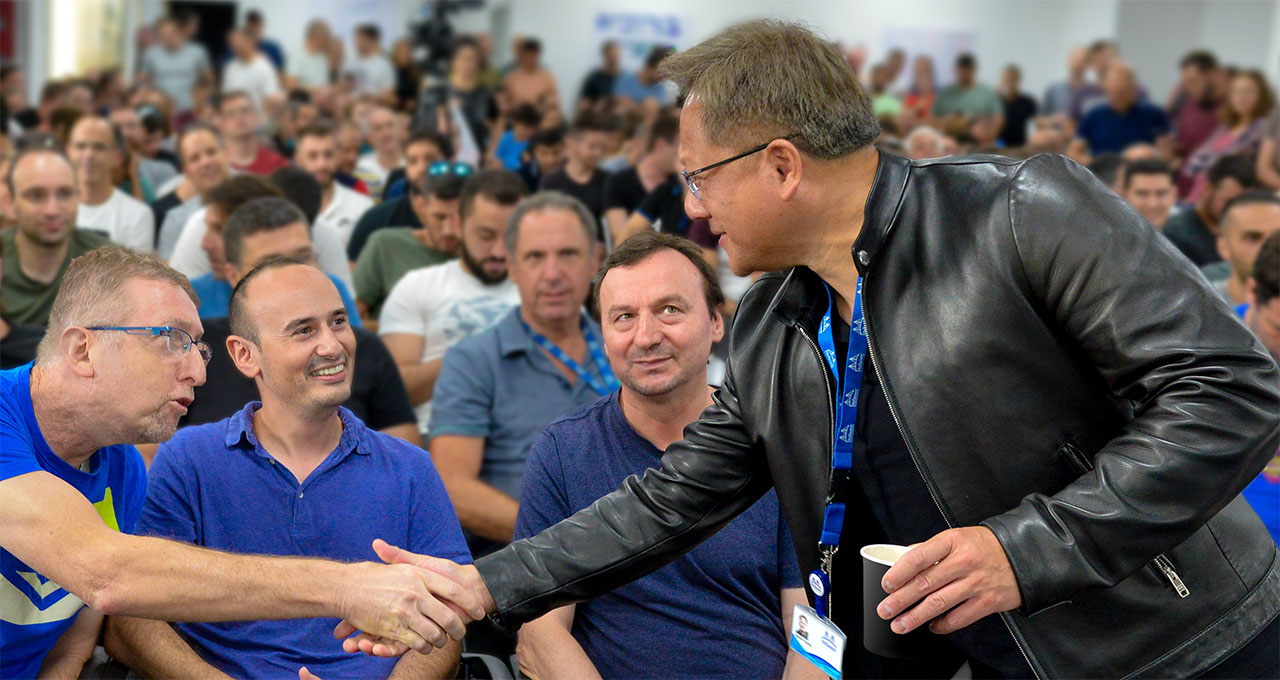
NVIDIA founder and CEO Jensen Huang sent the following letter to our enlarged employee base when the Mellanox acquisition closed earlier this week:
Hi everyone,
I hope all of you and your families are well and safe during these extraordinary times.
On March 11 last year, we announced plans to buy Mellanox, the world leader in high-performance networking. Last week, China gave us the green light. In addition to the U.S., E.U., and Mexico, all jurisdictions have approved our combination. I am thrilled to announce that today, April 27, 2020, NVIDIA and Mellanox are officially one company!
Mellanox is now NVIDIA’s networking brand, our networking business unit, and Israel is one of NVIDIA’s most important technology centers, with 2,500 employees. The new NVIDIA has a much larger footprint in data center computing, end-to-end and full-stack expertise in data center architecture, and tremendous scale to accelerate innovations. We are uniting two powerful forces and doubling down on data center.
Our journey started in my hotel room at SC18 on November 18, 2018. Eyal and I had a 7 am breakfast meeting at the Dallas Ritz-Carlton. He told me there were multiple parties interested in buying Mellanox and asked if NVIDIA would like to join the bid. I told him that I loved Mellanox – the company, the technology, the products, and strategic position. We’ve partnered to build many supercomputers and AI systems. “Mellanox is an amazing company,” I said to Eyal. He went on for the next hour, telling me that “Mellanox is an amazing company.” I agreed. He’s incredibly proud of Mellanox, and rightfully so. At the end of the conversation, I told him that NVIDIA would be the final and highest bidder. The bidding was intense. NVIDIA was the highest bidder.
NVIDIA and Mellanox are a perfect combination. The first reason is that we both care deeply about high-performance computing. Our companies are both wired for performance and technology leadership. NVIDIA accelerates 50% of the new supercomputers on the latest Top500 list. Mellanox is the networking in 6 of the top 10 supercomputers. When NVIDIA accelerates compute by 10-50x, moving data becomes the bottleneck. Amdahl’s law. Mellanox and NVIDIA amplify each other’s technologies.
The big picture reason is that the future of the data center is being reshaped and playing into our strengths. Yesterday’s cloud data center architecture is called Hyper-Converged Infrastructure, where CPU-servers with integrated storage “scale out” into large data centers. Cloud computing was born and revolutionized the industry. AI is now driving an architecture change from Hyper-Converged Infrastructures to Accelerated-Disaggregated Infrastructure. NVIDIA and Mellanox are at the epicenter of this shift.
AI, the most powerful technology force of our time, is a fundamentally new computing model that is reshaping data center architectures. AI is insanely computation- and data-intensive. Because CPUs designed for general-purpose computing cannot efficiently handle the workload, NVIDIA is used to accelerate AI algorithm processing, and Mellanox is used to accelerate data processing and networking. The data center is now accelerated.
Simultaneously, the rapid adoption of data center-scale workload orchestration platforms like Kubernetes is changing software development and data center operations in a significant way. Applications and services are decomposed into smaller executable containers and deployed onto available servers across the data center. Services can dynamically compose the infrastructure with the optimal type and amount of computing elements to process each workload. Large monolithic applications no longer bog down some computers while leaving others sitting idle. Data center utilization, throughput, ease and cost of operations are all improved.
The data center is now a composable computer. The data center computing elements are disaggregated — i.e., CPU servers, GPU servers, and storage servers are separated and scaled independently. Mellanox’s networking fabric that connects the computing elements becomes all-important to the data center.
Our growing businesses reflect the need for fast computing and networking. When we announced the acquisition a year ago, Mellanox did $305M in revenue that quarter. Mellanox had 4 consecutive record quarters since and just announced $429M in quarterly revenue – increasing 41%. During that same period, NVIDIA’s data center business grew from $680M to approaching $1B last quarter, also increased over 40%. This is just the beginning.
Breakthroughs in natural language understanding, conversational AI, and deep recommendation systems are pushing AI complexity to new levels. The models are complex. Data intensity is growing exponentially. And the relentless push to smarter predictions and faster response is driving computation demands.
AI computing, networking, and data processing are more important than ever in this new world. Together we possess deep expertise and exceptional capabilities to invent this future. NVIDIA and Mellanox are a dream team combination.
The fastest computing and the fastest networking go hand in hand. That’s why NVIDIA selected Mellanox for our DGX AI systems. Mellanox switches and networking fabric connect NVIDIA’s own research AI supercomputers. Mellanox data processing chips do networking, storage, and security for our EGX edge AI and 5G platform and our AGX self-driving car computer.
It is a tremendous joy to work with Mellanox’s world-class people. Getting to know you more deeply this past year, we love the company, the technology, the products, and strategic position even more. Eyal, the management team, and all the people of Mellanox have built a truly extraordinary company.
We are thrilled to become one family and invent the future together.
Bruchim abahim le mishpachat NVIDIA!
Jensen