country_code

AI Will Drive Scientific Breakthroughs, NVIDIA CEO Says at SC24

by
Jensen Huang

NVIDIA kicked off SC24 in Atlanta with a wave of AI and supercomputing tools set to revolutionize industries like biopharma and climate science.

The announcements, delivered by NVIDIA founder and CEO Jensen Huang and Vice President of Accelerated Computing Ian Buck, are rooted in the company’s deep history in transforming computing.

“Supercomputers are among humanity’s most vital instruments, driving scientific breakthroughs and expanding the frontiers of knowledge,” Huang said. “Twenty-five years after creating the first GPU, we have reinvented computing and sparked a new industrial revolution.”

NVIDIA’s journey in accelerated computing began with CUDA in 2006 and the first GPU for scientific computing, Huang said.

Milestones like Tokyo Tech’s Tsubame supercomputer in 2008, the Oak Ridge National Laboratory’s Titan supercomputer in 2012 and the AI-focused NVIDIA DGX-1 delivered to OpenAI in 2016 highlight NVIDIA’s transformative role in the field.

“Since CUDA’s inception, we’ve driven down the cost of computing by a millionfold,” Huang said. “For some, NVIDIA is a computational microscope, allowing them to see the impossibly small. For others, it’s a telescope exploring the unimaginably distant. And for many, it’s a time machine, letting them do their life’s work within their lifetime.”

At SC24, NVIDIA’s announcements spanned tools for next-generation drug discovery, real-time climate forecasting and quantum simulations.

Central to the company’s advancements are CUDA-X libraries, described by Huang as “the engines of accelerated computing,” which power everything from AI-driven healthcare breakthroughs to quantum circuit simulations.

Huang and Buck highlighted examples of real-world impact, including Nobel Prize-winning breakthroughs in neural networks and protein prediction, powered by NVIDIA technology.

“AI will accelerate scientific discovery, transforming industries and revolutionizing every one of the world’s $100 trillion markets,” Huang said.

CUDA-X Libraries Power New Frontiers

At SC24, NVIDIA announced the new cuPyNumeric library, a GPU-accelerated implementation of NumPy, designed to supercharge applications in data science, machine learning and numerical computing.

With over 400 CUDA-X libraries, including cuDNN for deep learning and cuQuantum for quantum circuit simulations, NVIDIA continues to lead in enhancing computing capabilities across various industries.

Real-Time Digital Twins With Omniverse Blueprint

NVIDIA unveiled the NVIDIA Omniverse Blueprint for real-time computer-aided engineering digital twins, a reference workflow designed to help developers create interactive digital twins for industries like aerospace, automotive, energy and manufacturing.

Built on NVIDIA acceleration libraries, physics-AI frameworks and interactive, physically based rendering, the blueprint accelerates simulations by up to 1,200x, setting a new standard for real-time interactivity.

Early adopters, including Siemens, Altair, Ansys and Cadence, are already using the blueprint to optimize workflows, cut costs and bring products to market faster.

Quantum Leap With CUDA-Q

NVIDIA’s focus on real-time, interactive technologies extends across fields, from engineering to quantum simulations.

In partnership with Google, NVIDIA’s CUDA-Q now powers detailed dynamical simulations of quantum processors, reducing weeks-long calculations to minutes.

Buck explained that with CUDA-Q, developers of all quantum processors can perform larger simulations and explore more scalable qubit designs.

AI Breakthroughs in Drug Discovery and Chemistry

With the open-source release of BioNeMo Framework, NVIDIA is advancing AI-driven drug discovery as researchers gain powerful tools tailored specifically for pharmaceutical applications.

BioNeMo accelerates training by 2x compared to other AI software, enabling faster development of lifesaving therapies.

NVIDIA also unveiled DiffDock 2.0, a breakthrough tool for predicting how drugs bind to target proteins — critical for drug discovery.

Powered by the new cuEquivariance library, DiffDock 2.0 is 6x faster than before, enabling researchers to screen millions of molecules with unprecedented speed and accuracy.

And the NVIDIA ALCHEMI NIM microservice, NVIDIA introduces generative AI to chemistry, allowing researchers to design and evaluate novel materials with incredible speed.

Scientists start by defining the properties they want — like strength, conductivity, low toxicity or even color, Buck explained.

A generative model suggests thousands of potential candidates with the desired properties. Then the ALCHEMI NIM sorts candidate compounds for stability by solving for their lowest energy states using NVIDIA Warp.

This microservice is a game-changer for materials discovery, helping developers tackle challenges in renewable energy and beyond.

These innovations demonstrate how NVIDIA is harnessing AI to drive breakthroughs in science, transforming industries and enabling faster solutions to global challenges.

Earth-2 NIM Microservices: Redefining Climate Forecasts in Real Time

Buck also announced two new microservices — CorrDiff NIM and FourCastNet NIM — to accelerate climate change modeling and simulation results by up to 500x in the NVIDIA Earth-2 platform.

Earth-2, a digital twin for simulating and visualizing weather and climate conditions, is designed to empower weather technology companies with advanced generative AI-driven capabilities.

These tools deliver higher-resolution and more accurate predictions, enabling the forecasting of extreme weather events with unprecedented speed and energy efficiency.

With natural disasters causing $62 billion in insured losses in the first half of this year — 70% higher than the 10-year average — NVIDIA’s innovations address a growing need for precise, real-time climate forecasting. These tools highlight NVIDIA’s commitment to leveraging AI for societal resilience and climate preparedness.

Expanding Production With Foxconn Collaboration

As demand for AI systems like the Blackwell supercomputer grows, NVIDIA is scaling production through new Foxconn facilities in the U.S., Mexico and Taiwan.

Foxconn is building the production and testing facilities using NVIDIA Omniverse to bring up the factories as fast as possible.

Scaling New Heights With Hopper

NVIDIA also announced the general availability of the NVIDIA H200 NVL, a PCIe GPU based on the NVIDIA Hopper architecture optimized for low-power, air-cooled data centers.

The H200 NVL offers up to 1.7x faster large language model inference and 1.3x more performance on HPC applications, making it ideal for flexible data center configurations.

It supports a variety of AI and HPC workloads, enhancing performance while optimizing existing infrastructure.

And the GB200 Grace Blackwell NVL4 Superchip integrates four NVIDIA NVLink-connected Blackwell GPUs unified with two Grace CPUs over NVLink-C2C, Buck said. It provides up to 2x performance for scientific computing, training and inference applications over the prior generation. |

The GB200 NVL4 superchip will be available in the second half of 2025.

The talk wrapped up with an invitation to attendees to visit NVIDIA’s booth at SC24 to interact with various demos, including James, NVIDIA’s digital human, the world’s first real-time interactive wind tunnel and the Earth-2 NIM microservices for climate modeling.

Learn more about how NVIDIA’s innovations are shaping the future of science at SC24.
 

Coherent Breaks Ground on Expanded Texas Facility, Scaling AI’s Optical Backbone

Coherent’s expansion at its Sherman, Texas, campus scales what it calls the world’s first volume production 6-inch indium phosphide fab, a key supplier across NVIDIA’s AI stack.
by

AI runs at the speed of light. More and more, that light is made in Texas.

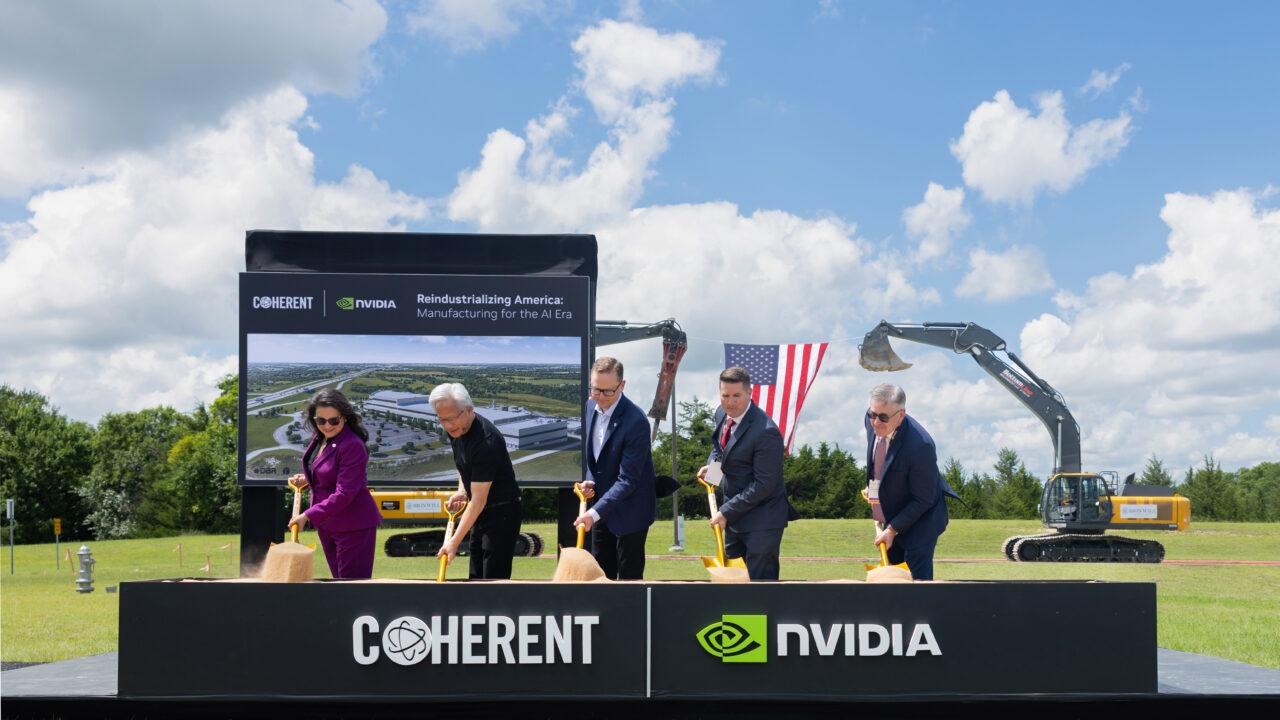
Coherent broke ground today on an expanded manufacturing building in Sherman, Texas. 

The company makes the lasers, optical components and compound semiconductors that wire AI systems together — and runs what it calls the world’s first 6-inch indium phosphide fab. 

NVIDIA founder and CEO Jensen Huang and Coherent CEO Jim Anderson were on hand for the ceremony, joined by Sherman Mayor Shawn Temann and Adriana Cruz, executive director of Texas Economic Development and Tourism, who delivered remarks.  

The expanded building will scale production of the same InP wafers that carry data between chips, servers and data centers at the speed of light — the optical backbone of modern AI infrastructure.

It’s the kind of milestone that turns a commitment into construction: a concrete step in expanding advanced semiconductor manufacturing in the United States.

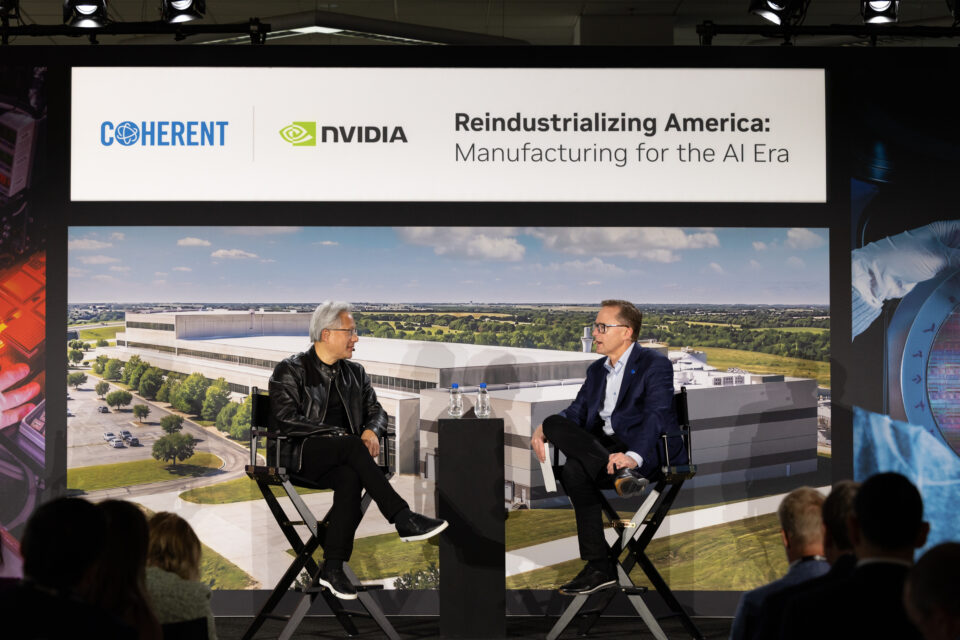
“AI is the ultimate general-purpose technology,” Huang said during a conversation with Anderson at the groundbreaking. “Because intelligence is fundamental — the ability to process information, to reason and solve problems — it affects every single industry.”

Public programs like the CHIPS Act, funded at roughly $50 billion, were designed to bring chip manufacturing back to the U.S. 

As part of today’s event, Coherent is announcing a $50 million CHIPS Act grant to help finance the expanded Sherman facility — building on roughly $17 million in earlier support from the Texas CHIPS program and the Sherman Economic Development Corporation.

NVIDIA’s own commitment to produce up to $500 billion of AI infrastructure in the U.S. through industry partnerships with new sites in Arizona and Texas adds private-sector momentum.

“Coherent is a world-class company, and the work you do is vital to our future, vital to the future of artificial intelligence and vital to reindustrializing the United States,” Huang said.

NVIDIA founder and CEO Jensen Huang and Coherent CEO Jim Anderson.

Compound semiconductors like indium phosphide and gallium arsenide — the materials behind the high-speed networking and optical interconnects that modern AI runs on — don’t get the headlines that logic chips do. But their domestic supply chains have been thin for years. Today’s event was an argument that the gap is closing.

When 576 GPUs span eight racks and operate as a single system — as they will in NVIDIA Vera Rubin Ultra NVL576, which links eight NVLink racks of 72 NVIDIA Rubin Ultra GPUs into one 576-GPU domain — copper can’t carry the signal across that distance. 

To connect hundreds of thousands of processors separated by hundreds or thousands of feet across a data center, the only way to solve that problem is silicon photonics, Huang explained. 

As signaling rates climb, the reach of a metal trace shrinks, and spanning eight racks in copper would burn power on retimers and signal conditioning that a data center would rather spend on compute. 

Optics pays a one-time penalty to move from electrical to light, but once paid, distance is nearly free. At NVL576 scale, light is the most power-efficient option. 

NVIDIA and Coherent aren’t new to each other — they’ve worked together for roughly two decades. 

In March, they deepened the relationship into a multiyear strategic partnership: NVIDIA is investing $2 billion in Coherent to support R&D, future capacity and U.S.-based manufacturing, alongside a multibillion-dollar purchase commitment for advanced laser and optical networking products.

Sherman, a city of roughly 45,000 people an hour north of Dallas, has become the latest dateline for the AI era — emblematic of a boom built as much on picks, shovels and manufacturing muscle as on software.

“When we get to full capacity, this site will support more than 550 direct jobs — and thousands of jobs, direct and indirect,” Anderson said.

What the factory ships isn’t a single product dropped into a single slot. It’s the lasers, transceivers and pluggable optical modules that move data across NVIDIA networking — each enabling a different part of the system.

“As AI systems grow larger and more powerful, connectivity is just as important as compute,” Anderson said. “AI runs on compute, but it scales on connectivity — and Sherman is where that connective tissue gets built.”

Today’s event made that visible.

Before the groundbreaking, guests toured the existing fab and previewed the equipment that will populate the expanded building once it’s running. An NVIDIA rack stood on the factory floor, one of the six stops on the tour. 

The tour was followed by a fireside chat with Huang and Anderson, where the two CEOs discussed the partnership and what scaling domestic optical manufacturing means for the AI buildout ahead.

“Today marks an important milestone — not just for Coherent, but for American manufacturing and for the future of AI infrastructure,” Anderson said. 

The semiconductor laser was born in U.S. labs — Bell Labs demonstrated a room-temperature version in 1970 — before the technology and its manufacturing largely migrated overseas.

“We were founded as a manufacturing company in 1971. We’ve always been a U.S. manufacturing company — and after 50 years, the most advanced 6-inch indium phosphide line in the world is right here in Sherman,” Anderson said. 

That manufacturing gap shows up in the wafers themselves: while silicon fabs run on 12-inch wafers, most of the world’s InP production is still stuck on 3- and 4-inch wafers — lower yields and far fewer components per run. 

Moving to 6-inch wafers roughly quadruples the usable area of a 3-inch wafer (area scales with the square of the diameter), driving down cost and unlocking the volume the AI buildout demands.


It took 50 years to build the first line, Huang said — and in one year, they’ve quadrupled it, a measure of the demand for accelerated computing.

Inside, the core processes are familiar: lithography, photoresist, depositing and etching materials, layer by layer. The difference is the material. On an InP substrate, engineers grow exotic compound-semiconductor layers and tune them for precise optical properties — the physics that lets a chip emit and modulate light.

Today, that InP travels inside Coherent’s pluggable optics — transceivers about the size of a USB stick that plug into the front of NVIDIA networking switches and move data between racks across the data center floor, where copper can’t reach. Each module carries an indium phosphide laser. 

Those same modules now help enable NVIDIA Spectrum-X Photonics and Quantum-X Photonics switches with co-packaged optics: Coherent supplies the external laser module that plugs into the switch’s front plate. 

And as NVIDIA works to keep optics from becoming the next bottleneck, demand for those lasers only climbs.

“Ten years from now, I think we’ll look back and realize AI is what made it possible to invest in sustainable energy, upgrade our energy grid and reconstitute a workforce,” Huang said. “You can’t have only information workers in an economy — you also have to have builders. We have an opportunity over the next 10 years to reshape our communities and be much more balanced.”

How the UK Is Turning Sovereign AI Ambition Into Action With NVIDIA Technologies

A year after declaring itself an “AI maker, not an AI taker,” the UK is delivering sovereign compute, showcasing breakthrough startup and enterprise AI deployments across biology, agentic AI, coding and more.
by

A year ago at London Tech Week, NVIDIA founder and CEO Jensen Huang and U.K. Prime Minister Keir Starmer made a declaration: the U.K. would be an AI maker, not an AI taker. 

At this year’s event, NVIDIA and its partners are showcasing how that commitment is producing real momentum across the nation’s infrastructure, startups and enterprises. 

U.K. technology leaders are innovating across healthcare and life sciences, coding, agentic AI, inference and more — all running on sovereign AI deployments.

“A year ago, we said the U.K. would be an AI maker, not an AI taker,” said U.K. AI Minister Kanishka Narayan. “Today we’re delivering on that — with sovereign compute powering British startups to push the boundaries of what AI can do, from drug discovery to healthcare to robotics. This is what it looks like when a country backs its own talent with the infrastructure to match. 

“NVIDIA’s decision to invest billions here is a reflection of the strength of what’s being built in Britain,” he added. “We are determined to make sure the next generation of AI breakthroughs happens in this country, and we have everything we need to make it happen.”

Commitment to Compute

Over the past year, the number of AI cloud providers planning to deploy AI infrastructure on U.K. soil has doubled. 

Nebius has announced plans to expand customers and cloud capabilities with three new deployments of advanced NVIDIA AI infrastructure, as the NVIDIA AI Cloud ecosystem partner continues to build out its commercial and AI R&D hub in London. Combined, the deployments are expected to reach 65 megawatts when fully ramped up in 2027.

CoreWeave is building in the U.K. Government’s AI Growth Zones, and seven more NVIDIA AI Cloud ecosystem partners have plans in the pipeline. BT and Nscale announced plans to build sovereign AI data centers across three existing BT sites in the U.K., combining NVIDIA AI infrastructure, Nscale’s full stack and BT’s trusted nationwide connectivity backbone. 

From Fund to Frontier

Central to that sovereign compute story is Isambard-AI — the U.K.’s most powerful computer. Built on 5,400 NVIDIA GH200 Grace Hopper Superchips and running entirely on zero-carbon electricity, it’s the engine behind some of the U.K.’s most ambitious AI research. 

The U.K. government’s Sovereign AI Fund is putting that capability to work by backing homegrown companies and providing the domestic infrastructure needed to scale their ambitions. 

Among its first recipients is Ineffable Intelligence, which recently announced a collaboration with NVIDIA to build the future of reinforcement learning infrastructure. 

Other recipients include four U.K.-based NVIDIA Inception startups, each pushing the AI frontier using Isambard-AI. These startups are:

Cosine Builds Sovereign Coding Platform

Cosine is building an end-to-end sovereign AI coding platform for highly regulated industries such as financial services, critical infrastructure and national security. Using Isambard, Cosine is training a new, large-parameter, mixture-of-experts, multimodal agentic LLM for natively handling data types beyond text and image. 

“Access to Isambard enables the project, full stop,” said Alistair Pullen, cofounder and CEO of Cosine. “We already have the people who know how to do this. We have the data. We have the infrastructure and the training. The thing we’ve never had is this level of compute.”

Cursive Trains Self-Improving AI Systems

Cursive is building self-improving AI systems that learn continuously from real-world data, enabling them to operate autonomously over long periods of time. This is unlocked through new memory-augmented architectures with dramatically larger context windows, currently in development using the Sovereign AI Fund resources. In addition, the team recently adopted the NVIDIA Megatron-LM framework for distributed training at scale.

“The Sovereign AI Fund is more than just processing power — it’s a statement about investing in AI in the U.K.,” said Talfan Evans, cofounder and CEO of Cursive. “Sovereignty is actually now a buying criterion — and it’s a challenge to tap into the resources we uniquely have as U.K. and European companies.”

Doubleword Optimizes Inference to Deliver Abundant Intelligence Tokens

Doubleword, the U.K.’s first dedicated inference lab, optimizes every layer of the AI stack to maximize what it calls “IQ per dollar.” The company deploys open models including NVIDIA Nemotron 3 Super 120B and builds on the NVIDIA Dynamo inference framework. 

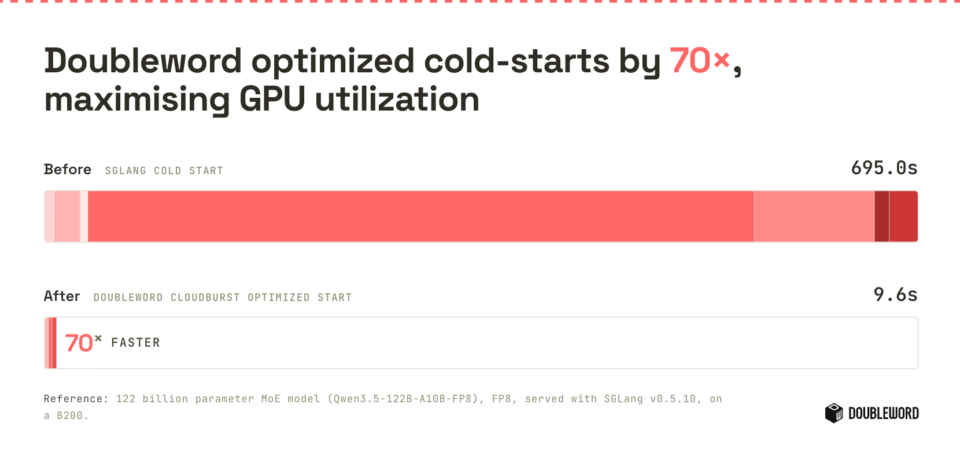
On Isambard, Doubleword’s early results achieved 70x faster model cold starts — aka model loading times — and 4x lossless KV cache compression, critical advancements for long-running agentic workloads. The result: inference at 90-95% lower costs than other leading inference providers.

Image courtesy of Doubleword.

“Sovereign AI is most impactful at the inference layer,” said Meryem Arik, cofounder and CEO of Doubleword. “Inference is when you’re actually getting the value from the model — we want that value created in the U.K., with U.K. compute and U.K. data centers.”

Prima Mente Uses Foundation Models to Study Alzheimer’s and More

Prima Mente builds biological foundation models to identify new biomarkers, subtypes and drug targets of Alzheimer’s, Parkinson’s and ALS. With its Isambard allocation, the company is developing Pleiades 2, a foundation model combining five biological data modalities. 

Achieving nearly 3x speedups in model training with NVIDIA Blackwell GPUs, Prima Mente also uses NVIDIA Parabricks for genomic data processing and NVIDIA Transformer Engine for model optimization.

“Research shows Alzheimer’s might be 25 different subgroups of disease, and we want to help by using AI to identify these subtypes and the biology within the cells as they change,” said Hannah Madan, cofounder of Prima Mente.

Video courtesy of Nebius and Prima Mente.

AI Talent, Policy and Production

NVIDIA’s £2 billion investment in the U.K. startup ecosystem — in collaboration with leading venture capital firms — is bringing new capital and advanced AI infrastructure to major U.K. hubs including London, Oxford, Cambridge and Manchester. 

U.K. membership in the NVIDIA Inception program has increased by 50% over the past year. AI-native companies like Doubleword, Synthesia and PolyAI are scaling globally from U.K. roots. 

At last year’s London Tech Week, NVIDIA announced a collaboration with the U.K Department for Science, Innovation and Technology on 6G and AI skills. The 6G collaboration has seeded testbeds at four U.K. universities. In May, the NVIDIA Deep Learning Institute (DLI) delivered two new courses — added to support the nation’s wireless research community — to participants from over 30 U.K. universities.

Plus, as part of this AI skills collaboration, NVIDIA DLI courses are offered as part of QA’s AI Apprenticeships in England. 

And the NVIDIA Developer Program now includes more than 200,000 U.K. developers. 

The Sovereign AI Forum, which launched last year with seven charter members, convened the country’s AI leadership to turn policy into deployment roadmaps. Over the past year, the Forum has welcomed dozens of participants across government, industry and the startup community — turning policy into deployment roadmaps.

And enterprise AI is moving from pilot to production:

  • Apian is building digital twins of two National Health Service hospitals, combining autonomous devices, ground robots, computer vision and robotic simulation.
  • Deliverance AI is helping regulated enterprises to run, govern and scale AI agents inside their own environment — through a single control plane. The Agentic Operating System is built for organizations where data sovereignty is non-negotiable.
  • Glass Futures has installed an AI-driven digital twin of its glass furnace capable of testing and predicting new, optimal ways to make glass. The digital twin taps into NVIDIA accelerated computing and the NVIDIA PhysicsNeMo framework.
  • OneAdvanced is fine-tuning NVIDIA Nemotron 2 Nano 9B with the NeMo AutoModel for its AI-consultation and triage app with sovereign, real world NHS Primary Care patient triage data.
  • Orbital Industries has announced codesigned, NVIDIA Vera Rubin DSX AI Factory-compliant AI infrastructure that accelerates time to first token.
  • Reading Football Club is partnering with Stelia to establish an AI Centre of Excellence, combining Stelia’s full-stack AI platform with accelerated compute infrastructure from NVIDIA and Lenovo.

It all reflects momentous progress in U.K. AI leadership — and offers a glimpse of where it’s heading.

Join NVIDIA at London Tech Week.

  • Categories:
  • AI

Industrial Software Leaders Build Secure, Autonomous AI Engineers With NVIDIA NemoClaw

Showcased at GTC Taipei at COMPUTEX, autonomous AI engineers compress weeks of simulation work into just hours.
by

Accelerated computing has revolutionized industrial engineering, compressing simulation times from weeks to hours. 

Today’s remaining challenges sit in the end-to-end workflow surrounding the simulations: computer-aided design, meshing, simulation setup and debugging, as well as post-processing and generating summary reports of these processes. 

At GTC Taipei at COMPUTEX, NVIDIA and more than a dozen engineering software providers are showcasing how autonomous AI agents automate this entire workflow.

These AI engineers are based on NVIDIA NemoClaw, an open blueprint for building specialized, long-running agents with a secure runtime and frontier models. 

NemoClaw includes a choice of harness — meaning it can be integrated with various orchestration frameworks enterprises use to deploy and coordinate agents, such as OpenClaw and Hermes — as well as a model router and NVIDIA NeMo libraries for customization. 

Users can easily deploy NemoClaw from NVIDIA DGX Spark personal AI supercomputers, as well as through enterprise data centers and cloud service providers. NVIDIA OpenShell — the open source runtime at its core — governs how each agent accesses files, networks and tools, enforcing policy-based security at every layer.

Industrial Engineering Leaders Build AI Agents Across Design, Engineering, Simulation

Industrial software leaders are building AI engineers for computer-aided engineering (CAE) and electronic design automation (EDA) use cases across automotive, aerospace, semiconductors and manufacturing.

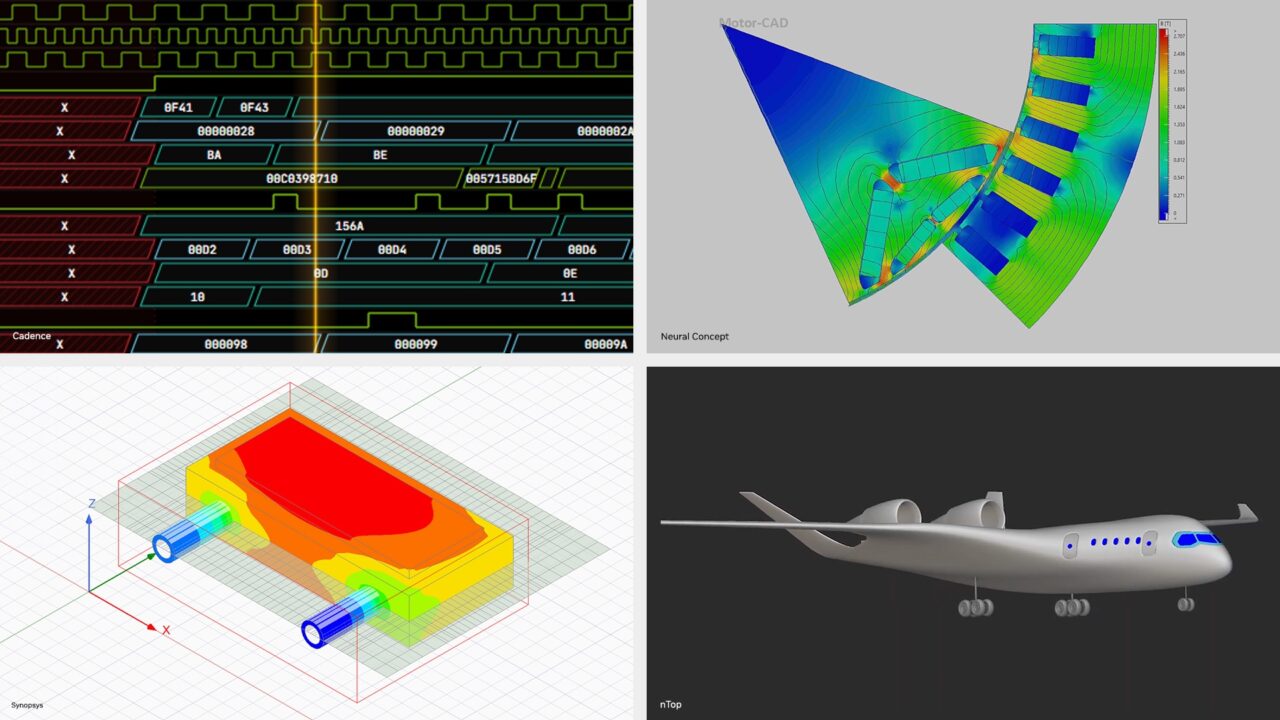
Cadence is building an autonomous register-transfer level (RTL) engineer with NemoClaw that orchestrates Cadence Design Systems ChipStack for design and verification. The workflow was featured yesterday in a GTC Taipei keynote demo and is cutting time for RTL verification — a key step in digital circuit design — from weeks to hours.

Dassault Systèmes is actively productizing the 3DEXPERIENCE Agentic Platform to operate long-running and autonomous agents for design, simulation and manufacturing operations, in a secured environment powered by NVIDIA NemoClaw and OpenShell.  

Siemens is integrating NVIDIA NemoClaw and OpenShell into Fuse EDA AI Agent, a purpose-built autonomous agent that plans and orchestrates domain-scoped multi-tool workflows across semiconductor, 3D integrated circuit and printed circuit board system design.

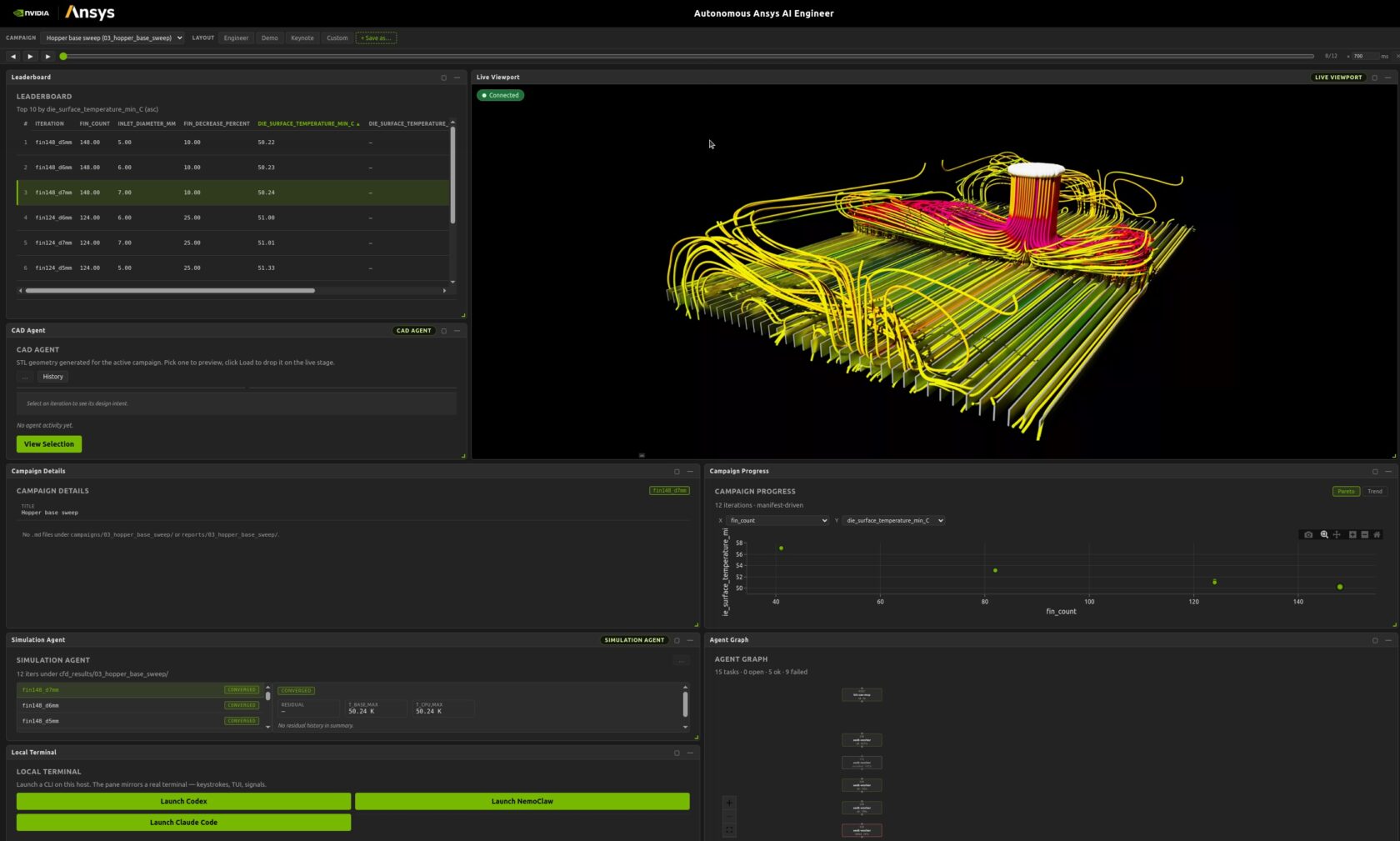
Synopsys is collaborating with NVIDIA to apply agents to end-to-end engineering workflows with NVIDIA NemoClaw. Ansys Icepak, part of the Synopsys portfolio, is being demoed on the COMPUTEX show floor this week, used within a NemoClaw-based autonomous AI engineer to mesh, simulate and optimize GPU electronics cooling designs.

Image courtesy of Synopsys.

Startups Extend the Reach of Agentic AI

In addition, cutting-edge startups are building AI engineers for their workflows — all using NVIDIA NemoClaw.

Flexcompute is applying OpenShell to its Tidy3D and PhotonForge agents for multiphysics co-packaged optics design. Flexcompute’s autonomous AI workflow combines optical, electrical and thermal simulation to explore thousands of design variants overnight, producing higher-performing components with lower energy consumption. NVIDIA is using Flexcompute technology for the design and optimization of advanced optical and photonic devices.


Video courtesy of Flexcompute.

Luminary is building a long-running AI engineer using NemoClaw to dramatically reduce the time and complexity of training AI physics models by autonomously orchestrating data generation, machine learning model selection, and training and re-training loops.


Video courtesy of Luminary.

Neural Concept is deploying an agent for electric motor design. The workflow chains electromagnetic, structural and noise, vibration and harness simulations in a multistep engineering pipeline. Watch the full demo.


Video courtesy of Neural Concept.

nTop, the geometry engine behind JetZero’s blended-wing-body aircraft program, is using NVIDIA NemoClaw to run autonomous design workflows that compress days of geometry iteration into hours.


Video courtesy of nTop.

PhysicsX is partnering with the Microsoft Surface team to build an electronics thermal simulation agent that compresses weeks of manual CAE workflows into automated, AI-driven design cycles. Bringing together the PhysicsX platform, Microsoft Discovery and NVIDIA NemoClaw, the agent automates the full thermal simulation lifecycle for consumer devices such as Microsoft Surface laptops — from mesh sensitivity analysis and simulation data generation, through physics AI model training and optimization-loop execution, to continuous accuracy monitoring across the design exploration process.


Video courtesy of PhysicsX.

P-1 AI is building Archie, an AI mechanical and electrical engineer that already works with data center cooling and critical power systems, and will soon work for automotive, aerospace and national security use cases. In a workflow representative of its work with Daikin Applied Americas, Archie synthesizes requirements, selects components, runs design trade studies and produces engineering artifacts to help industrial manufacturers scale engineering capacity.


Video courtesy of P-1 AI.

SimScale is adopting NVIDIA NemoClaw to build autonomous simulation agents for hundreds of cross-industry engineering use cases, including noise, vibration and harshness analysis, automating workflows that previously required multiple engineers working over several weeks. 


Video courtesy of SimScale.

Synera is building an engineering agent for injection molding — a manufacturing process used to efficiently mass-produce identical parts by injecting molten material, usually plastic, into a custom mold — with Autodesk Moldflow, NVIDIA OpenShell with OpenClaw, as well as Nemotron models.


Video courtesy of Synera.

Learn more about NVIDIA technologies for CAE and watch NVIDIA founder and CEO Jensen Huang’s GTC Taipei keynote in replay.

  • Categories:
  • AI