country_code

AI Breakthroughs From Europe, the Middle East and Africa at GTC 2022

Discover top sessions and workshops exploring advancements in conversational AI, healthcare, financial services and more from Europe, the Middle East and Africa.
by
Top Sessions and AI Breakthroughs in EMEA GTC22

Starting in just two weeks, NVIDIA GTC presents the opportunity to learn about the latest technological advancements and groundbreaking research taking place around the globe.

GTC runs March 21-24, featuring experts from industries transformed by AI such as healthcare, manufacturing and automotive. Designed for all technical levels and interests, pick from 190+ sessions led by speakers in Europe, the Middle East and Africa.

Free to attend, the virtual conference features a brilliant display of the latest in AI development with the keynote on March 22, delivered by NVIDIA CEO and founder Jensen Huang.

Inspirational Topics for Everyone

Delivered by some of the greatest minds in Europe, the Middle East and Africa, explore these sessions, and many more, to broaden your skill set and discover new ways organizations are using AI.

  • Ariel Ekgren, research scientist at AI Sweden, expands the capabilities of natural language processing to Swedish, Norwegian and Danish.
  • Haris Shuaib, consultant physicist at Guy’s & St. Thomas’ NHS Foundation Trust, presents an overview of the AI Deployment Engine — a world-leading program to enable AI at the point of care.
  • Ola Engkvist, senior director of discovery sciences at AstraZeneca, explores how AI has impacted drug design in the last few years, and what we can expect to see in the future.
  • Marc Päpper, CIO at Mindpeak GmbH, shares how GPU computing and deep learning technology can bring precision medicine into breast cancer diagnostics.
  • Jean-Marc Alkazzi, senior AI engineer, and CTO Jimmy Nasif at idealworks share how they’re designing and building AI and robotics solutions for BMW Group.
  • Florian Couret, Immersive LAB & W.I.R.E.D director at BNP Paribas Real Estate, combines data visualization and 3D ability to provide interactive maps of Europe for the real estate industry.
  • Prof. Dr. Bjorn Stevens, managing director and director of the Atmosphere in the Earth System department at the Max Planck Institute for Meteorology, explores the next generation of climate models, and how an Earth digital twin will make it possible to experience virtual Earths simulating the past, present and future.
  • Stefan Sicklinger, head of division for BigLoop and Advanced Systems at CARIAD SE, a VW Group Company, talks about how the company is using in-vehicle intelligent data collection to feed the data-driven development loop.

Tools for Success

Build a Career in AI

AI is a rapidly advancing technology. A combination of computer programming, mathematics and creativity, solving problems with AI often means thinking differently. From self-driving cars to building factories of the future, AI is being used across every industry.

If you’re interested in building a career in the most-talked-about technology of our generation, join the 5 Steps to Starting a Career in AI GTC panel discussion to hear from AI experts. Professionals will give insights into their journey, and discuss the top five most practical steps for beginning a career in AI.

Deep Learning, Demystified

GTC is the perfect place to grow your skills with hands-on, instructor-led training sessions and workshops.

With NVIDIA Deep Learning Institute, get access to two-hour workshops for free as part of your GTC registration, or sign up for a handful of full-day workshops to get NVIDIA Deep Learning Institute certification.

Find DLI workshops covering conversational AI and natural language processing, and a series of fundamentals workshops for accelerated computing with CUDA Python, accelerated data science and deep learning.

Connect With the Experts

Connect with NVIDIA product and research experts at GTC to ask your toughest questions. Take the opportunity to discuss projects and challenges, in a group or one-on-one. The 50-minute sessions are designed to provide a deeper understanding of the hottest topics in deep learning, accelerated computing, data science, virtualization, robotics and more.

Emerging Chapters Developer Meetup

NVIDIA Emerging Chapters is an education and technical enablement program built for developer communities in emerging markets. It provides opportunities for communities to educate, build and scale their AI, data science and gaming skills, nurturing emerging technologies and driving innovation.

Join the exclusive Emerging Chapters virtual meetup for developer communities in Africa and the Middle East. Learn fundamentals in computer vision, data science, edge computing and conversational AI. Plus, hear from local developer community leads and interact with NVIDIA experts. Try your luck in the raffle to earn $100-$500 in AI course coupons for the NVIDIA Deep Learning Institute.

Register free for GTC and discover how to accelerate your life’s work at these sessions and more.
NVIDIA Alpamayo 2 Super, the Frontier Open Model for Robotaxis and Autonomous Vehicles, Now Available for Commercial Use

Open commercial licensing, benchmark‑leading reasoning and inspectable decisions bring autonomous vehicles, including robotaxis, closer to production and widescale deployment.
by

For robotaxis and other autonomous vehicles (AVs), the hardest problems aren’t the everyday scenarios. They’re the rare, complex situations that are difficult to anticipate and train for.

Handling these long‑tail events takes more than just object detection and motion prediction. AVs must understand the situation, reason about cause and effect, choose the right action and turn that decision into a safe, comfortable path — all in real time and in a way developers can inspect, validate and trust.

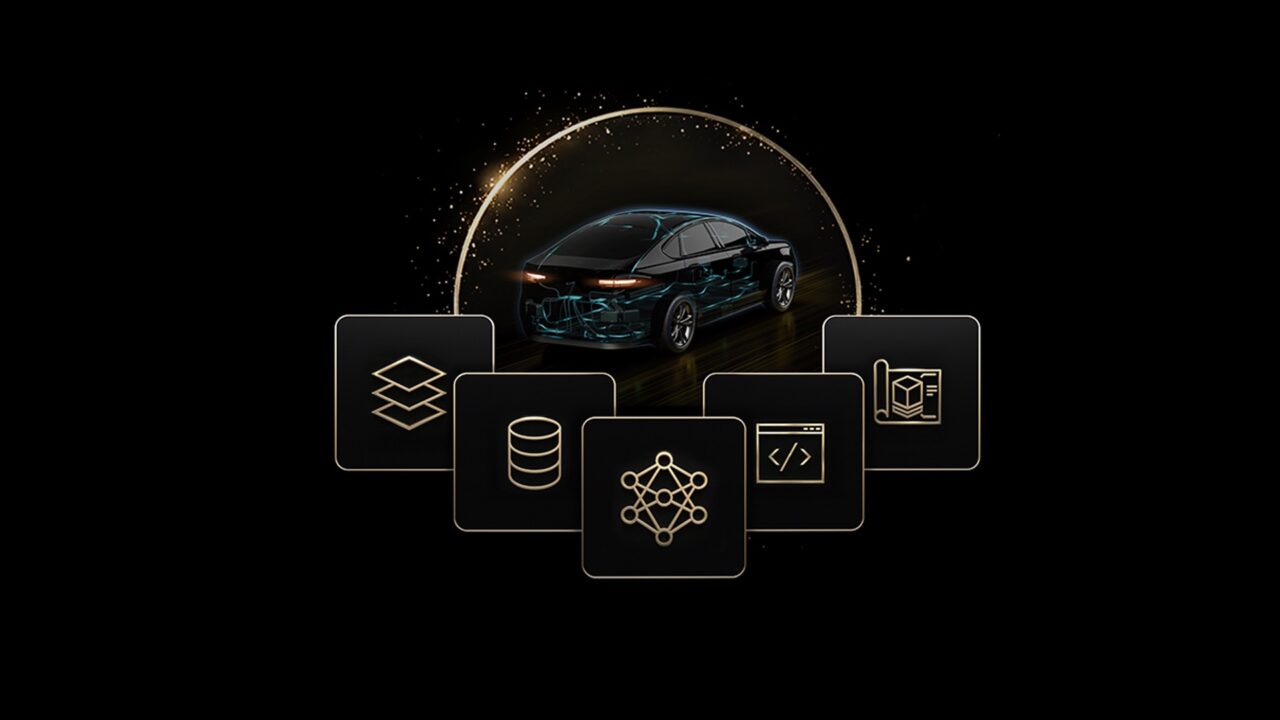
NVIDIA Alpamayo 2 Super, available now for commercial use, is part of the Alpamayo family, the most-adopted open reasoning models for autonomous driving on Hugging Face, supporting a wide range of AV-relevant capabilities within a single foundation model. 

Built on NVIDIA Cosmos 3 Super Reasoner and post‑trained with reinforcement learning, the model advances the AV ecosystem on two fronts: open commercial licensing and leading multitask capabilities for autonomous driving. 

Alpamayo 2 Super is part of NVIDIA’s growing collection of open models, datasets and tools for autonomous driving, expanding access, strengthening competition, giving developers greater control and supporting safer, more transparent AV deployment. 

Open Licensing for Production AVs

Alpamayo 2 Super is available on Hugging Face under OpenMDW‑1.1, the Linux Foundation’s permissive license for open AI model distributions. The license covers fine‑tuning, derivative models and commercial redistribution, allowing AV developers, automakers, truckmakers and suppliers to adapt Alpamayo to their own data, driving policies and deployment strategies. 

This openness lets AV researchers and companies keep control of their own data and infrastructure, as well as own the value they create through specialized models and accumulated know‑how. Such control is essential for workflows involving proprietary fleets and safety. 

Earlier Alpamayo releases were initially introduced for R&D. The OpenMDW license is now being  applied across the entire Alpamayo model family so developers can deploy any of the models commercially without requiring additional permissions. This creates a direct path from adaptation to deployment.

Open weights make that path economically viable. Teams can build on advanced reasoning without re‑training every foundation capability from scratch or paying frontier‑model costs for every task, matching the right model to the right job at the right cost. 

Alpamayo 2 Super enables frontier-scale reasoning in cloud-based development workflows, where developers can generate high-quality reasoning traces, synthetic training data and teacher outputs for model distillation. Within the Alpamayo model family, Alpamayo 2 Super delivers the highest reasoning and driving performance for multimodal autonomous driving development, while Alpamayo 1.5 and Alpamayo 1 provide more cost-efficient options for cloud-based development and model distillation.

The resulting distilled models can then be optimized for efficient, real-time inference in production vehicles. Together, the Alpamayo model family provides a cloud-to-car workflow that combines frontier-scale reasoning with scalable deployment across commercial AV fleets.

For AV programs, that means frontier‑scale reasoning in the cloud and efficient, specialized models in the vehicle — a more sustainable way to scale safe autonomy into commercial fleets.

Benchmark-Leading Reasoning at Frontier Scale

Alpamayo 2 Super ranks first on LingoQA, an autonomous driving reasoning benchmark, among nearly 40 models evaluated. In NVIDIA testing using the Lingo‑Judge metric, it outperformed Qwen2.5‑VL 72B by 17.0 points, Gemini 2.5 Pro by 15.1 points and GPT‑4o by 23.2 points, demonstrating state‑of‑the‑art reasoning for driving‑centric scenarios. Alpamayo 2 Super also ranks first across all autonomous driving benchmarks evaluated by NVIDIA, underscoring its leading performance across a broad range of AV capabilities. 

Alpamayo 2 Super offers 3x the scale of the 10‑billion‑parameter NVIDIA Alpamayo 1.5 and Alpamayo 1 models. The added capacity helps the model better generalize reasoning from sparse examples — a critical capability for the rare, multi‑agent interactions where conventional systems often struggle. 

The model reasons over full‑surround camera coverage, fusing views from the vehicle’s front, sides and rear. This 360‑degree context enables richer understanding of lane changes, merges, unprotected turns and complex intersections, where risks commonly arise.

A Multitask Foundation Model for Robotaxis and Autonomous Driving

For each driving situation, Alpamayo 2 Super can produce five tightly coupled outputs:

  • A trajectory describing the vehicle’s planned path.

  • A chain‑of‑causation (CoC) trace that explains the reasoning behind the decision.

  • A meta‑action (e.g., yield, lane changes, stops) that captures the model’s intent.

  • Reasoning auto-labels that generate CoC annotations for training and validation data.

  • Visual question answering responses with 2D visual grounding that link the model’s answers to specific regions in camera images.

Together, these outputs offer insight into the model’s decision-making process. Developers can tie what the model observed to the action it selected, making decisions easier to understand, critique and validate. 

CoC traces integrate with NVIDIA Halos safety‑validation workflows and support AI safety aligned with ISO/PAS 8800 requirements, providing a stronger foundation for AV safety engineering. 

Alpamayo 2 Super can also be deployed as an autolabeler to generate CoC labels and perform visual question answering with 2D grounding on proprietary fleet data. By linking its reasoning to specific regions in camera images, the model can transform raw driving clips into richer training data, compressing annotation cycles from months to days.

Beyond planning and auto-labeling, Alpamayo 2 Super supports scene understanding, model critiquing and knowledge distillation. These multitask capabilities enable developers to use a single foundation model across more of the development stack, simplifying tooling and accelerating iteration.

An Open Ecosystem for Reasoning‑Based AVs

Alpamayo 2 Super is part of a broader family of open models, frameworks and datasets for AV development. 

Other tools in the family include: 

  • NVIDIA AlpaSim, which provides closed‑loop simulation.

  • NVIDIA AlpaGym, which enables high‑throughput reinforcement learning.

  • NVIDIA Physical AI Open Datasets, which supply data for training and testing.

  • Open training recipes and an autolabeling pipeline to accelerate model development, training and validation.

Alpamayo has already surpassed 500,000 downloads on Hugging Face, reinforcing its position as the most-adopted open reasoning model family for autonomous driving on the platform.

Download NVIDIA Alpamayo 2 Super on Hugging Face to explore the model, evaluate its reasoning capabilities and start building the next generation of robotaxis and autonomous vehicles.

For Robotaxis, Safety Must Be Built In, Not Bolted On

by

Editor’s note: The name of NVIDIA DRIVE Hyperion was changed to NVIDIA Hyperion in September 2026. All references to the name have been updated in this blog.

A car pulls up to the curb. The app says, “Your ride is here.” No one’s in the driver’s seat. For people who live in one of the dozens of cities now hosting robotaxi services, this is already a reality.

The robotaxi industry has moved from prototype milestones to commercial operations, with an expanding ecosystem accelerating the pace of deployment. New collaborations announced at NVIDIA GTC Taipei reflect robotaxi programs spinning up around the world:

  • Uber and Autobrains are launching a robotaxi program in Munich on the NVIDIA Hyperion platform, using Autobrains’ agentic AI to support scalable operations. 
  • Foxconn is expanding its collaboration with NVIDIA to deploy robotaxi fleets, combining its services with NVIDIA Hyperion for rapid integration and scaling in Taiwan.
  • VinFast is working with Autobrains to bring level 4 vehicles built on Hyperion to the Southeast Asia market.
  • HUMAIN is working to bring Hyperion-powered robotaxis to Saudi Arabia, expanding the platform’s global footprint into the Middle East.

Building a Safe Software Foundation

As the robotaxi industry scales, safety is paramount.

Regulators, certification bodies and developers are scrutinizing what safe deployment at scale requires. 

Industry discussion on level 4 autonomy often centers on what the vehicle can perceive and decide. 

That discussion is well-founded. Accurate perception, sound decision-making and handling the unexpected are difficult problems, and real progress toward solving them is being made.

But perception and decisions alone are not the whole story. Regulators require something more: proof that the overall system behaves reliably, isolates faults before they escalate and never operates outside the boundaries it was designed for. 

Robotaxi safety requires solving four distinct challenges simultaneously:

  • A safety-certifiable operating system
  • Safe, standardized hardware and software interfaces
  • AI that operates within verifiable guardrails
  • Validation at scale before vehicles touch public roads

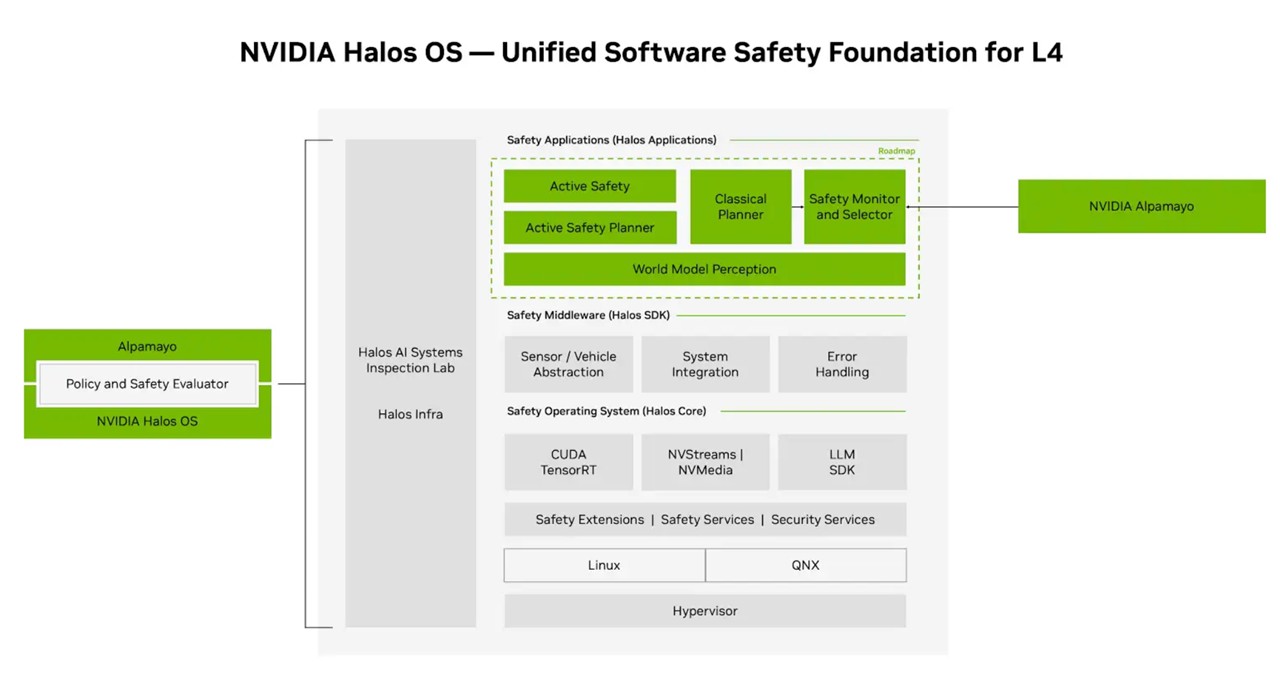
To help solve these challenges, the recently introduced Halos Operating System (OS) — a component of the NVIDIA Halos full-stack, comprehensive safety system — offers a unified, production-ready safety foundation for AI-driven vehicles, built on NVIDIA Hyperion. It comprises: 

Halos Core: A Certified OS Foundation

At the foundation of NVIDIA Halos OS is Halos Core, which is the next generation of NVIDIA DriveOS and certified to automotive safety standards. It’s audited, documented and proven to behave predictably under fault conditions, with a hypervisor — a specialized software layer — that isolates safety-critical functions so failures can’t reach vehicle controls. 

Halos Core is compliant with ISO 26262 ASIL D, includes safety-certified support for NVIDIA CUDA and TensorRT, and provides the TensorRT Edge-LLM open source framework for high-performance large language model inference.

Halos SDK: Standardized and Safe Interfaces

A robotaxi integrates cameras, radar, lidar and other sensors, each streaming data in a different format at a different rate. Without a standardized middleware layer, every hardware change forces teams to manually rebuild those integrations. 

Halos SDK removes that burden. Its sensor abstraction layer decouples the autonomous driving stack from individual sensor drivers, so adding or swapping a sensor no longer causes ripples through application code, while a vehicle abstraction layer connects the autonomous driving stack to the rest of the vehicle through a single, consistent interface. 

On top, Halos SDK provides the runtime building blocks that safety-critical software demands: a deterministic application-level scheduler for predictable timing, zero-copy inter-process communication that moves data without added latency, a comprehensive system error-handling framework and a robust scenario data recorder — delivering the foundation for highly reliable and low-latency automotive applications.      

Halos Applications: Safety Guardrails for AI

AI models can match human driving behavior, but regulators require more than performance. 

The Halos Applications layer provides safety guardrails for AI through deterministic, rule-based functions, analyzed and designed to behave within defined bounds. It includes world model perception and the top-rated NVIDIA DRIVE active safety stack featuring automatic emergency braking, lane departure warning, blind spot monitoring, collision warning and more. 

In addition, in Halos Applications, Halos OS can be combined with end-to-end AI models for which explainability and transparency are essential. This includes the NVIDIA Alpamayo family of open models for autonomous vehicle development, which enables chain-of-thought reasoning, continuously evaluating the road, planning next steps and adapting to changing conditions.

The Halos Safety Evaluation Framework

Halos Infra is the cloud-side development infrastructure that enables autonomous vehicle training, simulation and validation at scale. It’s the foundation for the recently released NVIDIA Halos Safety Evaluation Framework (SEF).

SEF provides the tools and guidelines needed to build a credible safety case, from L2 driver assistance to L4 robotaxis. It draws on more than 330 research papers and 1,000 patents developed within NVIDIA Halos OS.

Halos Infra runs on NVIDIA’s three-computer autonomous driving solution: 

Halos OS spans the full development lifecycle — from training and simulation in Halos Infra to inference in the vehicle itself.

Learn more about NVIDIA Halos.

NVIDIA Research Unlocks Advanced Grasping, Smarter Autonomous Driving and Agent Training at Scale

New NVIDIA Research breakthroughs show how training at scale — across gripper types, driving scenarios and virtual worlds — creates AI that generalizes to diverse applications.
by

What makes a robot gripper useful isn’t that it can pick up one object — it’s that it can pick up the next one, and the one after that, with a tool it’s never held before. 

What makes an autonomous vehicle system safe isn’t just that it can reason through a situation — it’s that it can do so quickly enough on the hardware actually installed in the car. 

What makes a virtual agent capable is exposure to as many different environments as possible before it faces the real world. 

At this year’s Computer Vision and Pattern Recognition (CVPR) conference, NVIDIA Research is presenting three papers that address each of these challenges — and share a common theme: training at scale creates systems that generalize across diverse applications.

The three papers cover different challenges in physical AI research: 

  • GraspGen-X, the first foundation model for zero-shot grasping, was trained on billions of simulated grasps to work with any gripper it’s shown.
  • LCDrive introduces a model that replaces expensive text-based reasoning with compact latent representations, letting autonomous vehicles think faster on embedded hardware.
  • NitroGen is a generalized gameplay AI foundation model that harnesses the NVIDIA Isaac GR00T robot foundation model architecture to help train embodied agents in virtual environments across tens of thousands of hours of interaction.

NVIDIA also unveiled at CVPR new physical AI agent skills that help researchers and developers speed the development of autonomous vehicles, robots and vision AI systems.

NitroGen and another NVIDIA-authored paper, PixelDIT, were named best paper finalists at the conference — an accolade given to just 15 of over 4,000 accepted papers at CVPR.

The First Foundation Model for Grasping

Most AI systems for robotic grasping are specialists.

A vision-language-action policy trained for a two-finger gripper only learns to grasp with those two fingers. Similarly, a policy for dextrous grasping will only work for the bespoke multi-fingered gripper it’s trained on. For every new embodiment, the process typically needs to be repeated — requiring new training data, fine-tuning and validation. This constraint means most robotics companies pick a gripper, train for it and stick with it.

GraspGen-X is the first foundation model for grasping built to eliminate this bottleneck. 

Like a large language model that can apply its understanding of language to a new task without retraining, GraspGen-X applies its understanding of geometry and contact to any robotic gripper it encounters. Given the geometry of a new gripper and an unknown object it’s never seen before, the model generates reliable grasp pose proposals to enable the robot to grasp the object.

To get there, the researchers needed a dataset that’s impossible to collect in the real world at scale. They generated 2 billion simulated grasps across thousands of object shapes and synthetic gripper configurations, spanning the diversity of form factors a deployed robot might encounter. 

For robot developers, this foundation model eliminates the need for per-gripper training cycles and can be applied out of the box for several commonly used grippers. GraspGenX can be used in conjunction with curoboV2, a new CUDA-accelerated motion planning library, to achieve these grasp poses in unknown environments. 

Building on the GraspGen research foundation, another paper, Grasp-MPC — presented at ICRA 2026 — advances the next step in the pipeline: moving from grasp generation to closed-loop grasp execution.

Teaching Autonomous Vehicles to Think Faster

In recent years, researchers have found that letting an AI reason — generating intermediate thinking steps before committing to an answer — reliably improves its decision-making. 

For autonomous vehicles, the challenge is doing that reasoning on the hardware inside an actual vehicle. Text-based chain-of-thought reasoning generates words, and every word is a token that takes time to produce. On the processor running inside a car, token count is a real constraint on how fast the system can respond.

LCDrive tackles this problem by replacing words with compressed latent representations. 

Instead of generating human-readable reasoning steps, the system thinks in a compact latent space — states that capture spatial information rather than producing text. The architecture alternates between two kinds of thinking: proposing candidate actions, then predicting what the world will look like if those actions are taken. 

It uses that predicted world state to refine its next step. It’s the same reasoning loop — just in a more computationally efficient form than natural language.

The result: comparable output trajectory quality to text-based reasoning, using roughly half the tokens. 

The model was built on NVIDIA Alpamayo and trained using supervision derived from existing vehicle data.

Embodied Agents Trained in Virtual Worlds

Isaac GR00T — NVIDIA’s open foundation model for humanoid robots — is built on a simple principle: expose a model to enough diverse situations, and it will generalize to ones it hasn’t seen. 

NitroGen extends that principle to virtual environments, using the GR00T architecture to train a foundation model for embodied agents across a breadth of virtual worlds.

Video games offer something that’s hard to build from scratch: structured, varied worlds with defined goals and well-specified success conditions. They’re high-quality training environments, available at scale. 

NitroGen treats them that way — as a training ground for agents that will eventually be trained to handle novel real- or simulated-world situations, like powering a robot that helps with housework based on broad instructions such as, “Put these items away in the pantry.”  

Trained across more than 1,000 games and 40,000 hours of interaction using a model based on GR00T, the resulting agents learn to generalize across environments. The model was evaluated across a range of action role-playing games, platformers, roguelikes and open-world games, demonstrating gameplay behaviors spanning combat, navigation and exploration. 

The same techniques could eventually help enable more adaptive nonplayable characters, AI companions and gameplay systems inside games, as well as broader testing of complex game environments.

In low-data conditions — where an agent has seen only a handful of examples of a new environment — starting with NitroGen gives agents a huge head start, improving performance by up to 52% over previous state-of-the-art methods. 

The model is open source, available on GitHub and Hugging Face. 

Learn more about NVIDIA at CVPR and explore NVIDIA Research’s work in physical AI, computer vision and autonomous systems. Get started with Isaac GR00T and NVIDIA robotics tools.